
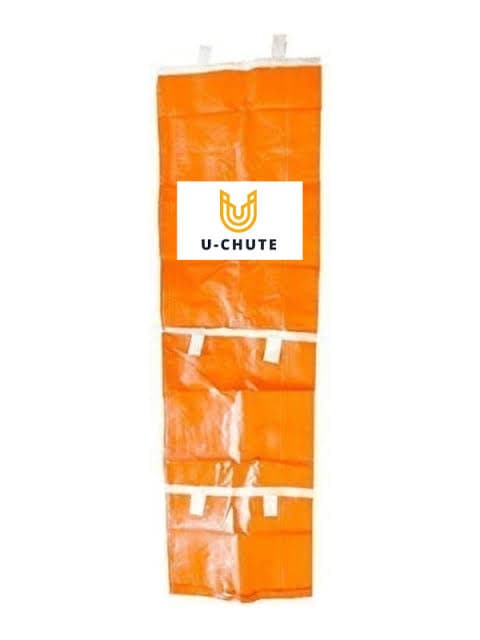
When a demolition crew is gutting the top floors of a mid-rise building, or a roofing team is stripping a six-story commercial structure, the distance between the work floor and the dumpster below is not a small detail — it is the central engineering problem of the whole operation. A chute that is too short leaves a gap. A chute that cannot handle the load tears under the first heavy drop. And a chute with vague or missing specifications puts workers, bystanders, and site managers in an impossible position when they are trying to plan the job.
This guide covers every meaningful specification for the 50 ft heavy-duty construction chute manufactured by U-Chute. By the end, you will know exactly what the product is made of, what it can handle, how to configure it for different drop heights, what safety rules apply, and how it compares to shorter options in the U-Chute lineup. Nothing has been left vague.
What Makes a 50ft Heavy Duty Chute Different from Shorter Models
U-Chute offers four sizes: the 10 ft lite-duty, the 10 ft heavy-duty, the 25 ft heavy-duty, and the 50 ft heavy-duty. The progression is not just about length — it reflects a fundamentally different set of job-site conditions.
The Problem the 50ft Model Solves
On a two-story residential teardown, a 25 ft chute is usually enough. But multi-story commercial buildings, high-rise condos, and tall industrial structures demand a longer run. The 50 ft heavy-duty model is purpose-built for those scenarios. When you need to move debris from five or six floors down to a ground-level container, a shorter chute simply cannot bridge the gap safely.
- Five to six story coverage in most standard commercial construction where floor-to-floor height runs 9 to 11 feet.
- Continuous gravity-fed flow so debris does not pile up at a transition point or mid-chute connection.
- Reduced manual handling because workers at upper floors load the chute once — gravity does the rest, all 50 feet of it.
Heavy-Duty vs. Lite-Duty Construction
The heavy-duty designation indicates a reinforced polymer-fabric construction that handles abrasive, angular, and heavy debris loads that would wear through a lite-duty chute prematurely. Broken concrete, jagged metal studs, ceramic tile shards, and roofing material all have edges that punish weaker chute material. The 50 ft model uses the same heavy-duty polymer fabric as the 10 ft and 25 ft heavy-duty versions — just configured for the longer run.
Material and Build Specifications
Understanding what the chute is made of is not an academic exercise. It tells you how long the product will last, what debris types it can handle, and what care and storage protocols are appropriate between jobs.
Polymer-Fabric Shell
U-Chute chutes are manufactured from a reusable polymer-fabric composite. This material is chosen for a specific combination of properties:
- Tear resistance — the woven polymer structure resists puncture and tearing under impact from angular debris.
- Flexibility — the chute can be folded, rolled, and packed without cracking or deforming, which matters when you are transporting it between job sites.
- Lightweight construction — despite the 50 ft total run, the chute sections remain light enough for a single worker to carry and position at height.
- Weather tolerance — the polymer material handles UV exposure, rain, and temperature swings without degrading rapidly, which is critical for outdoor demolition and roofing work.
Sectional Design and Stacking
The 50 ft heavy-duty chute is not a single 50-foot tube. It is built as a series of sections that stack together, allowing the installer to match the actual drop height of the job. If your building measures 47 feet from loading point to dumpster, you do not need to use all 50 feet — you configure the stack to fit. This modular approach also means damaged sections can be replaced individually rather than scrapping the entire chute.
- Sections connect securely at each joint to prevent separation during use.
- The stacking design keeps the chute running straight and contained, reducing the risk of debris escape at connection points.
- Each section is independently manageable, so crews working at height can assemble the chute from the top down without needing large rigging equipment.
Load Capacity and Debris Type Ratings
The most critical functional specification for any construction chute is what it can actually carry. Contractors make costly mistakes by assuming a chute rated for light renovation waste will hold up under roofing tear-off or concrete block demolition.
Appropriate Debris Types
The 50 ft heavy-duty model is designed to handle the demanding debris categories typical of large commercial and multi-story demolition work:
- Drywall and plaster fragments
- Roofing shingles, felt, and underlayment
- Wood framing scraps and dimensional lumber cutoffs
- Ceramic and porcelain tile pieces
- Broken concrete in manageable fragment sizes
- Metal lath, wire mesh, and light structural scrap
- Insulation batts and rigid foam board
- Cardboard, packaging, and general construction waste
What to Avoid Loading
Even a heavy-duty chute has limits. Loading oversized or excessively heavy single pieces creates impact loads that the chute was not designed to absorb:
- Large intact concrete blocks or full-size masonry units
- Intact structural steel members or heavy pipe runs
- Full sheets of plywood or OSB (break these down first)
- Hazardous materials including asbestos-containing materials, lead paint debris, or chemical waste — these require specialized handling protocols separate from any chute system
For guidance on handling construction waste that may contain regulated materials, the EPA recycling and waste management program provides contractor-relevant information on proper disposal streams.
Dimensions and Configuration Options
A 50 ft total length is the headline number, but job sites rarely have perfectly round-number drop heights. Here is how to think about configuration in practice.
Usable Drop Height Range
The 50 ft heavy-duty chute covers the following typical building types:
- 4-story buildings — approximately 36 to 44 ft drop to grade, well within the 50 ft capacity.
- 5-story buildings — approximately 45 to 55 ft drop, fitting the 50 ft model when loading begins at the fifth floor level rather than the roof.
- Rooftop loading on 4-story structures — 40 to 48 ft depending on parapet height, a common roofing application.
Combining with Other U-Chute Sizes
For job sites that exceed 50 feet, or where the geometry requires a secondary run (for example, an interior atrium where a straight vertical drop is not possible), additional sections from shorter U-Chute models can be integrated into the system. Reviewing the trash chute sizing guide for demolition projects gives a practical framework for calculating how many feet of chute a specific job requires based on floor count and floor-to-floor height.
Attachment and Rigging Specifications
The chute itself is only as safe as the connection points that hold it to the structure. This section covers the rigging considerations that every site supervisor should review before the first debris load goes in.
Securing the Top Section
The uppermost section must be anchored to a structural element capable of bearing both the static weight of the loaded chute and the dynamic impact of debris being dropped in. Typical anchor points include:
- Window openings with a properly rated header
- Floor deck edges with appropriate railing or anchor hardware
- Scaffold framework when the chute runs alongside a scaffold system
The connection hardware is the installer's responsibility at the job site. U-Chute provides the chute system; site-specific rigging must be engineered to match the structural conditions of the building. Always confirm that the anchor point load rating exceeds the anticipated peak load from a debris drop event, not just the static weight of the empty chute.
Mid-Span Stabilization for 50ft Runs
At 50 feet, wind loading and debris momentum can cause the chute to sway or bow away from the building face. Mid-span tie-off points — typically every 10 to 15 feet along the run — keep the chute close to the structure, prevent lateral movement, and ensure the bottom exit remains aimed at the dumpster. This is not optional on tall structures; it is a baseline safety measure.
- Use soft ties or strapping rated for the chute weight plus anticipated debris weight.
- Do not use sharp-edge hardware against the polymer fabric — this accelerates wear at contact points.
- Check all tie-off points at the start of each workday, especially after high winds or rain overnight.
OSHA ergonomics guidance is also worth reviewing for the manual handling tasks involved in chute setup at height — proper lifting technique and team lift coordination prevent the crew injuries that are most common during equipment installation.
Safety Requirements for 50ft Heavy-Duty Chute Deployment
A chute running five or six stories presents different hazard profiles than a 10 ft unit on a one-story job. The fall hazard is higher, the potential energy of debris is greater, and the dumpster exclusion zone at the bottom is larger.

Ground-Level Exclusion Zone
Every chute exit requires an exclusion zone — a defined area below and around the chute bottom where non-essential personnel are not permitted while the chute is in use. At 50 ft, debris exits the chute with significant velocity. The exclusion zone should extend a minimum of 6 feet in all directions from the dumpster perimeter, with clear signage and physical barriers. Cones alone are not sufficient on active multi-trade job sites.
Loading Protocol at the Top
Proper loading discipline prevents blockages, reduces impact stress on the chute, and keeps debris from bouncing out of the entry opening:
- Break debris into manageable pieces before loading — no single piece larger than what fits easily through the chute opening without force.
- Load at a controlled rate. Do not attempt to empty an entire floor load in one continuous pour.
- Keep the entry opening free of debris buildup — a blocked entry causes workers to push material in, which can dislodge the top anchor.
- Never lean over the entry opening. Use a chute funnel or entry collar if the geometry of the loading point requires extended reach.
Inspection Before Each Shift
A daily pre-shift inspection is non-negotiable on any multi-day deployment. For the 50 ft heavy-duty model, the inspection checklist should include:
- Visual check of each section for tears, punctures, or abrasion wear at the fabric surface.
- Confirmation that all section connections remain secure — no separation at joints.
- Verification that all mid-span tie-offs are intact and positioned correctly.
- Check that the top anchor is still properly seated and has not shifted.
- Confirm the dumpster is correctly positioned under the exit and has adequate remaining capacity.
For more on job-site safety practices related to chute use, the common construction chute mistakes on high-rise job sites article walks through the failure patterns that cause injuries and project delays.
Environmental and Sustainability Specifications
The reusability of the 50 ft heavy-duty model is not just a cost argument — it is an environmental one. Single-use containment systems generate their own waste stream. A polymer-fabric chute that survives dozens of job deployments has a fundamentally different lifecycle footprint.
Reusability and Lifecycle
U-Chute chutes are designed to be reused across multiple projects, not discarded after a single job. The polymer-fabric construction resists the wear patterns that would prematurely fail a lower-grade material, extending the useful life of the product. When a section does eventually reach end of life, it is a single discrete piece — not an entire 50 ft assembly.
Contribution to Construction Waste Diversion
Using a chute system correctly actually improves construction waste sorting. Debris that travels through a controlled chute system lands in a single designated container, where it can be sorted for recycling or proper disposal. Debris that is tossed or kicked off floors — or dumped in open containers without containment — tends to be contaminated, mixed, and harder to sort. According to the EPA's materials waste and recycling data, construction and demolition debris represents one of the largest categories of solid waste generated in the United States — meaning that better containment and sorting at the source has meaningful aggregate impact.
For a deeper look at how chute systems compare to open dumpster approaches from an environmental standpoint, the construction chute vs. open dumpster environmental comparison covers this topic in detail.
Shipping, Delivery, and Storage Specifications
The 50 ft heavy-duty chute ships free anywhere in the United States. This matters practically because the weight and size of a 50 ft chute system would make freight costs a significant line item with many suppliers — U-Chute absorbs that cost so buyers know exactly what they are paying when they order.
Packaged Dimensions and Weight
Because the chute is manufactured from lightweight polymer fabric rather than rigid pipe or metal, the packaged form factor is manageable even for a 50 ft system. Sections fold or roll into compact bundles that can be transported in a work truck, van, or job-site storage unit without specialized freight equipment. This is a meaningful logistical advantage when crews are moving between multiple sites or need to bring a chute into a building elevator.
Storage Between Projects
Proper storage extends the chute's service life significantly:
- Clean debris from each section before folding and storing — residual material adds weight and can harbor moisture that degrades the fabric over time.
- Store in a dry location away from direct UV exposure during long-term storage (extended outdoor exposure between jobs accelerates UV degradation).
- Avoid storing under heavy objects that would permanently crease or deform the sections.
- Inspect sections for damage at the end of each project so any needed replacements are identified before the next job begins — not during setup on a new site.
Cost and Value Specifications: 50ft vs. Alternatives
Specifications on paper need to be evaluated against cost. The 50 ft heavy-duty chute sits at the top of the U-Chute product line in terms of total system length, and its price reflects that. But the correct comparison is not just purchase price — it is total cost across the number of jobs the product will serve.
Purchase vs. Rental Cost Calculus
For contractors who run multiple multi-story projects per year, purchasing a 50 ft heavy-duty chute outright typically produces a better total cost position than renting a comparable system repeatedly. Rental costs accumulate; a purchased chute amortizes its cost over every successive deployment. The trash chute rental vs. purchase total cost of ownership breakdown walks through the math in detail with practical examples.
Contractor Pricing and Online Ordering
U-Chute prices all four models directly on the site — no quote request, no sales call, no waiting. Contractors can see the price, compare it to rental rates they have paid previously, and make the purchase decision the same day. Combined with free US shipping, the total delivered cost is the price shown, full stop.
For a broader look at what debris chute systems cost across the Texas market and beyond, the construction debris chute cost guide for Texas provides market context.
Industries and Applications Best Matched to the 50ft Heavy-Duty Model
The 50 ft heavy-duty chute is not the right choice for every project, and selling the wrong tool for a job is bad for everyone. Here is where this model genuinely fits best.
Demolition Contractors on Mid-Rise Projects
Interior demolition of floors 4 through 6 in commercial buildings is the most common application for this model. The chute handles the abrasive, mixed debris generated by gut-and-rebuild projects efficiently, and the sectional design allows setup on floors where elevator access may be limited or unusable during demolition.
Roofing Contractors on Tall Structures
A roofing crew stripping shingles from a 4 to 5 story building generates a high-volume, high-weight debris load in a compressed time window. Running that material through a 50 ft chute to a dumpster directly below the work area is dramatically faster and safer than manual haul-down or dump-over methods. The heavy-duty fabric handles the abrasive texture of old shingles and granules without tearing.
Junk Removal Companies Handling Multi-Floor Cleanouts
Commercial property cleanouts, estate liquidations in multi-story buildings, and office clearing projects all generate bulk waste that needs to move from upper floors quickly. Junk removal companies that invest in a 50 ft chute system can take on these higher-value contracts that competitors without chute capability often turn down. The complete guide to construction debris chutes for junk removal companies covers the business case in depth.
Renovation General Contractors
Large-scale interior renovation projects — hotel room renovations, hospital wing upgrades, school building refreshes — generate sustained debris loads over weeks or months. A purchased 50 ft chute that moves with the project from floor to floor is a productivity tool that pays for itself quickly on projects of this duration.
Comparing the 50ft Model to the 25ft Heavy-Duty Option
Contractors who work across a range of building heights often wonder whether the 50 ft model is worth the investment over the 25 ft, or whether two 25 ft chutes offer more operational flexibility. Here is an honest comparison.
- Drop height coverage: The 50 ft model reaches floors that the 25 ft simply cannot — on a 5-story building, a 25 ft chute requires loading at floor 3 or below, which means manual debris movement for two additional floors. The 50 ft eliminates that labor cost entirely.
- Setup complexity: A single 50 ft assembly from one entry point is generally simpler than managing two separate 25 ft systems at different levels, especially on buildings where upper-floor access is restricted.
- Portability: Two separate 25 ft chutes give you operational flexibility to run two simultaneous operations on different buildings or different zones of the same job. That flexibility has value for companies with large crews and multiple concurrent projects.
- Cost efficiency: For projects that regularly exceed 25 ft drops, the 50 ft model prevents the workaround costs of running multiple shorter chutes in improvised series.
If your typical work is concentrated in the 3 to 4 story range, the 25 ft heavy-duty is likely the right primary tool. If you are regularly working at 5 stories or above, the 50 ft heavy-duty is the model designed for your conditions.
U-Chute's Coverage Across the United States
Because U-Chute ships free to anywhere in the United States, contractors in every market can access the same product at the same total delivered price. Whether you are based in the Southeast, the Mountain West, the Mid-Atlantic, or the Pacific Northwest, the 50 ft heavy-duty chute arrives ready to deploy without freight surprises.
U-Chute serves active markets across the country, including contractors in Boulder, Colorado, crews in Asheville, North Carolina, demolition teams in Sarasota, Florida, roofers in Bend, Oregon, and renovation contractors in Charleston, West Virginia — all with the same product, the same heavy-duty specifications, and the same free shipping offer.
For an overview of the full product lineup and how each size serves different project types, visit the debris chute systems page.
Frequently Asked Questions
How many stories does a 50ft heavy-duty construction chute typically cover?
In most standard commercial construction, floor-to-floor height runs between 9 and 11 feet. At those measurements, 50 feet of chute covers a loading point at the fifth-floor level down to grade, or roof-level loading on a four-story structure. The sectional design allows configuration to fit the actual drop height, so you are not locked into using all 50 feet if your building measures slightly less. Always measure the actual vertical distance from your loading point to the dumpster before finalizing your chute configuration.
What type of debris can the 50ft heavy-duty U-Chute handle?
The 50 ft heavy-duty model is rated for the debris types typical of large demolition, roofing, and renovation work: drywall and plaster fragments, roofing shingles, wood framing scraps, ceramic tile pieces, broken concrete in manageable sizes, insulation, and general construction waste. Avoid loading oversized intact masonry, heavy structural steel, full plywood sheets, or any hazardous materials that require specialized disposal protocols. Breaking debris into appropriately sized pieces before loading extends the chute's service life and prevents blockages.
Does the 50ft chute require mid-span tie-offs to the building?
Yes. At 50 feet of hang length, the chute is subject to wind loading and the lateral momentum of debris traveling through it. Mid-span tie-offs — positioned roughly every 10 to 15 feet along the run — keep the chute against the building face, prevent lateral sway, and ensure the exit remains aimed at the dumpster. Using soft strapping rather than sharp-edge hardware at contact points protects the polymer fabric from accelerated abrasion wear. Check all tie-offs at the start of every workday.
Can the 50ft heavy-duty chute be used by junk removal companies, or is it only for demolition contractors?
The 50 ft heavy-duty chute is well-suited for junk removal companies handling multi-floor commercial cleanouts, estate liquidations in tall residential buildings, and office clearing projects. Any application where bulk waste needs to move from upper floors to a ground-level container quickly and safely is a good match. Junk removal companies that add this capability can take on high-value multi-story contracts that competitors without chute equipment typically decline. The lightweight polymer construction makes transport between jobs straightforward with a standard work vehicle.
What is included in the free shipping offer, and are there any exceptions?
U-Chute offers free shipping on all models, including the 50 ft heavy-duty, to anywhere in the contiguous United States. The price shown on the product page is the total delivered price — there are no freight surcharges added at checkout. This makes total cost straightforward to compare against rental alternatives. For specific delivery timing and any location-related questions, the contact page and the U-Chute FAQ provide direct answers.
How does the reusable design affect total cost compared to renting a chute repeatedly?
A purchased 50 ft heavy-duty chute amortizes its cost across every project it serves. Rental fees accumulate with each deployment and add no residual value to the renting company. For contractors running three or more multi-story projects per year, purchase typically produces a lower total cost within the first season of use. The polymer-fabric construction is designed for repeated deployment rather than single-use, so the product's useful life spans many projects. Proper cleaning and storage between jobs extends service life further.
How should the 50ft chute be stored between projects to maximize its lifespan?
After each deployment, remove all debris from the sections before folding. Store sections in a dry location away from prolonged direct UV exposure during extended storage periods. Avoid placing heavy equipment or materials on top of stored sections, which can cause permanent creases or deformation in the fabric. Inspect each section for tears, abrasion wear, or joint damage at the end of every project so you can identify any replacement needs before the next job begins rather than during setup on-site.
Ready to Order the 50ft Heavy-Duty Chute for Your Next Project?
If your work regularly takes you above three stories, the 50 ft heavy-duty construction chute is the model that fits your job conditions without compromise. The specifications covered in this guide — polymer-fabric construction, sectional stacking design, heavy-duty debris handling, free US shipping — are all reflected in the product as it ships.
Browse the full U-Chute lineup, confirm the size that matches your project's drop height, and order directly on the site. There is no quote request, no wait for a callback, and no freight charge added at checkout. Visit the debris chute systems page to see all four models side by side, or go to the frequently asked questions page if you have additional specification questions before ordering. If you need to talk through the right configuration for an unusual job-site geometry, the contact page is the fastest way to get a direct answer from U-Chute.