
Junk removal is a physical business. Your crew hauls sofas down staircases, muscles old appliances through narrow hallways, and drags demolition rubble across uneven floors — all before the real work of loading a truck even begins. If you run a junk removal company, you already know that the carrying is where time bleeds out and injuries happen.
A construction debris chute for junk removal companies changes that math entirely. Instead of walking every load down every flight of stairs, your crew drops materials from the window or roof edge directly into the bin or pile below. One section at a time, the debris falls where you need it — fast, safe, and without the back-breaking relay that eats up your labor hours.
This guide walks through everything a junk removal operator needs to know: why debris chutes belong in your equipment lineup, how to size the right chute for your jobs, best practices for setup and safety, and how to calculate the real return on your investment. Let's get into it.
Why Junk Removal Companies Are Turning to Debris Chutes
The junk removal industry has grown fast over the past several years, and so has competition. Customers compare prices online in seconds. Margins are thinner than they used to be. The companies winning market share are the ones who can move more volume per crew-hour — and that is exactly what a debris chute delivers.
Think about a typical two-story cleanout job. Without a chute, two people carry every item from the second floor, down a staircase, out the front door, across the yard, and into the truck. With a chute, one person pushes material out a window and one person guides it into the container below. You halve the travel distance for every pound of debris on that job.
Multiply that across ten jobs a week and the time savings become significant enough to fit an extra job or two into each week's schedule — without hiring additional crew.
The Link Between Chutes and Crew Retention
Junk removal companies often struggle with high turnover because the work is genuinely hard on the body. Repetitive stair carrying is one of the leading contributors to musculoskeletal strain in manual labor. OSHA's ergonomics guidance is clear that reducing repetitive heavy lifting directly reduces injury risk — and injury risk is directly tied to turnover, workers' comp claims, and crew morale.
When you give your crew a chute, you are not just saving time. You are telling them you take their physical wellbeing seriously. That matters to the people who show up every morning ready to do hard work.
How a Debris Chute Actually Works on a Junk Removal Job
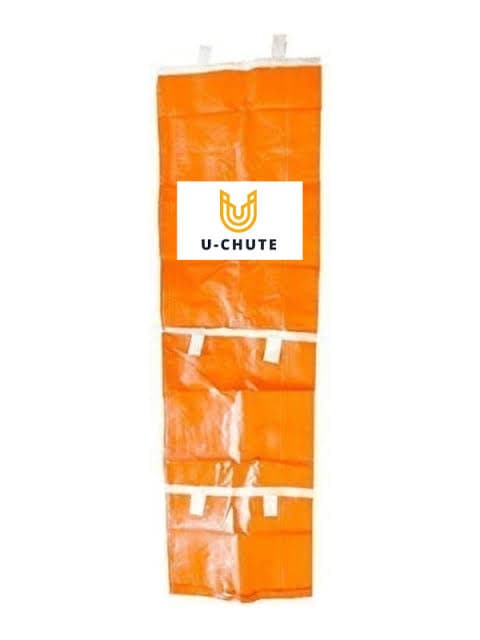
A debris chute is a sectional tube — typically made from heavy-duty polymer-reinforced fabric — that attaches to a window, balcony edge, or roofline and angles downward toward a dumpster, truck bed, or debris pile on the ground. Sections connect to each other to match the height of the building. Debris enters from the top and slides out the bottom, contained the entire way down.
U-Chute's reusable polymer-fabric chutes are built specifically for this kind of demanding field use. The material is tough enough to handle demolition rubble, heavy enough to resist tearing, but light enough that one person can carry and connect sections without a second pair of hands. That last detail matters a lot when you are already short on crew.
Key Components of a Sectional Debris Chute
- Top inlet section: attaches to the window frame or anchor point, with a wider opening to accept material being tossed in.
- Mid-body sections: stack together to extend the chute down the face of the building. More sections equal more height coverage.
- Bottom outlet section: directs debris into a dumpster, roll-off, or designated pile — keeping the drop zone clean and contained.
- Connecting hardware: hooks or rings that join sections securely so the chute doesn't shift or separate during use.
Setup takes minutes once your crew knows what they are doing. The first job feels slow; by the third job, it is routine.
Choosing the Right Chute Size for Junk Removal Work
Not every job requires a 50-foot chute. Matching the chute length to the typical drop height on your jobs is the most practical decision you will make. U-Chute offers four sizes designed to cover the range of work junk removal operators actually encounter:
- 10 ft lite-duty: Best for single-story structures, low-slope roofs, or situations where the drop height is modest and materials are lighter — bagged debris, smaller household items, loose rubble.
- 10 ft heavy-duty: Same drop coverage as the lite model but with a stronger fabric construction — better suited when you are feeding heavier or sharper materials through a short drop.
- 25 ft heavy-duty: The workhorse for most residential junk removal jobs. Covers two to three stories comfortably, handles dense demolition debris, and remains manageable to set up with a small crew.
- 50 ft heavy-duty: Commercial and multi-story residential work — apartment cleanouts, office strip-outs, high-rise roof debris. When the elevator isn't an option and the stairwell is a bottleneck, a 50-footer is the answer.
See the full breakdown of available sizes and specifications on the Debris Chute Systems for Construction Sites Across Texas page, or check the Frequently Asked Questions About U-Chute Trash Chute for quick answers on sizing.
How to Estimate Drop Height Before You Order
A common mistake is underestimating the actual drop height on a job. The rough rule: measure from the floor level of the highest work area to the top of the container or ground contact point below. Add a few feet of buffer — you want the bottom outlet to reach inside the container, not float above it.
- Single-story residential: typically 10-14 feet — a 10 ft chute works in most cases.
- Two-story residential: typically 18-24 feet — a 25 ft chute gives you the coverage you need.
- Three-story residential or light commercial: typically 28-38 feet — a 25 ft chute may work from upper windows; a 50 ft gives more flexibility.
- Four stories and above: plan on the 50 ft heavy-duty and confirm your anchor point before committing to setup.
The Labor Cost Math Junk Removal Operators Need to See
Let's run a real scenario. Say your crew does a two-story full-house cleanout — roughly 2,000 pounds of mixed junk, appliances, furniture, and debris. Without a chute, the total carry time (including stair trips) might run four to five crew-hours for the move-out phase alone. With a chute in place, that same phase often drops to two to three crew-hours.
If your labor costs $20 per crew-hour fully burdened, you save $40-$60 in labor on a single job. Run five of those jobs a week and you are looking at $200-$300 in weekly labor savings — purely from the chute cutting stair-trip time.
A U-Chute 25 ft heavy-duty unit costs a fraction of that over its lifetime of reuse. Compare that to what you would spend on a chute rental for a few jobs — then check out the full breakdown in our Trash Chute Rental vs Purchase: Total Cost of Ownership Breakdown and Debris Chute Rental vs Buy for Construction: The Complete 2026 Decision Guide.
Hidden Costs the Labor Numbers Don't Capture
Beyond the direct labor saving, there are costs that are harder to put a number on but equally real:
- Workers' comp premiums: Fewer stair-carry injuries mean fewer claims, which can affect your experience modifier and what you pay for insurance.
- Job-site downtime: When a crew member tweaks a back hauling something heavy down stairs, the whole job slows. A chute reduces that risk.
- Customer satisfaction: A chute keeps the interior of the building cleaner — debris is channeled out rather than dragged through hallways and doorways. Customers notice.
- Scope creep control: When stair-carry work goes faster, you stay closer to your quoted time and avoid margin erosion on fixed-price jobs.

Safety Best Practices When Using a Debris Chute for Junk Removal
A debris chute is a safety tool — but only when it is used correctly. Running a chute without following basic protocols can create hazards of its own. Make sure your crew is trained on these non-negotiables before the first job.
Anchor the Chute Before Loading It
Every section must be connected and the top inlet must be anchored to the building before any material goes in. A chute that swings free under load can strike the building face, pinch against a window frame, or dump debris unpredictably. Use anchor straps or carabiner connections rated for the load — never improvise with tape or rope.
Establish a Drop Zone Below
Before setup begins, mark a clear exclusion zone around the chute's outlet at ground level. No crew members, passersby, or pets should be in that zone while the chute is in use. Use cones, tape, or flagging to make the boundary visible. Check out our dedicated post on How to Prevent Debris Spillage from Trash Chutes on Multi-Story Buildings for additional ground-level safety protocol.
Control What Goes Into the Chute
Not everything should go through a debris chute at full speed. Loose fluids (paint cans, oil containers), pressurized canisters, or extremely dense single pieces — like a cast-iron radiator — need special handling. Run fluid containers capped and bagged. Break down large rigid items before feeding them into the chute. The goal is a controlled, steady flow, not a chaotic dump.
Inspect Sections After Every Job
Reusable chutes last a long time, but only if they are maintained. After each use, quickly inspect every section for tears, worn connection points, or deformation. A small tear caught early is a five-minute repair. Ignored, it becomes a section that fails mid-job and creates a debris scatter hazard.
Junk Removal Job Types Where a Debris Chute Pays Off Most
Not every junk removal job benefits equally from a chute. Here are the job types where deploying a chute consistently delivers the clearest return:
- Full-house cleanouts on multi-story homes: Multiple floors, heavy mixed debris, repeated stair trips — the chute cuts carry time dramatically.
- Apartment building unit cleanouts: Hallways are narrow, elevators are often small or unavailable on load-in, and multi-unit buildings can have strict move-out protocols that require contained debris handling.
- Roof debris removal: Roofers already know this, but junk removal companies that pick up roofing contracts — torn-off shingles, underlayment, flashing — find the chute indispensable. Read how this overlaps with contractor use in our guide to Debris Chute Systems for Construction Sites.
- Gut-out and demolition-assist jobs: When you are helping a general contractor strip a space down to the studs, the debris volume is enormous. A chute keeps the pace up and the site cleaner.
- Commercial strip-outs: Office furniture, cubicle systems, ceiling tiles, light fixtures — commercial cleanouts generate bulk fast and often happen in multi-story buildings where elevator access is restricted during business hours.
- Estate cleanouts in older multi-story homes: Older homes accumulate heavy items — cast iron, solid wood furniture, dense textiles — and often have narrow staircases not designed for modern furniture removal. A chute through a window is sometimes the only practical path.
Debris Chute vs. Dumpster-Only Approach: What Junk Removal Crews Actually Experience
Some operators wonder whether a chute adds complexity that slows things down. The honest answer: the first time you deploy one, setup takes a little longer than expected. By the fifth or sixth time, it is faster to rig and use the chute than to organize repeated stair-carry runs.
For a deeper look at how chutes compare to pure dumpster-based approaches for debris management, see our full analysis: Construction Debris Chute vs Dumpster: Which Is Right for Your Project?
Where a Chute Outperforms Stair Carrying
- Any job over one story where debris volume exceeds a single truckload.
- Jobs with a tight turnaround window — speed matters when you have back-to-back appointments.
- Jobs in hot climates where repeated stair trips increase heat stress risk for crew members.
- Jobs with particularly heavy or bulky items that are awkward to navigate on staircases.
Where a Chute Adds Less Value
- Single-story residential jobs with a short carry distance from room to truck — the setup time may not justify the time savings on very small jobs.
- Interior-only jobs where no exterior drop point is accessible — a courtyard, narrow alley, or zero-lot-line property can limit where the chute outlet can land.
- Jobs where the building management prohibits window or balcony rigging — always confirm with property management before setup.
Environmental Considerations for Junk Removal Operations
Junk removal companies are increasingly being asked by customers — especially commercial clients — about their environmental practices. A reusable debris chute is a stronger environmental story than single-use alternatives. Rather than consuming cardboard chute liners or disposable system components job after job, a polymer-fabric chute serves hundreds of uses before it needs to be retired.
The EPA's recycling guidance and the agency's broader data on materials waste and recycling both underscore the importance of reducing consumable waste in construction and demolition operations. A reusable chute fits that framework well — it reduces waste per job and gives your company a genuine sustainability talking point when marketing to clients who care about those metrics.
If your company separates recyclable materials on-site, a chute can also help organize the flow — running recyclables down the chute into one container and general debris into another, rather than mixing everything in a single pile that needs sorting later.
Using Debris Chutes to Expand Your Service Offerings
A debris chute doesn't just make your existing jobs faster — it opens up job categories you might otherwise pass on or subcontract out. Multi-story commercial cleanouts, high-rise unit turnovers, and demolition-assist work often go to whoever can demonstrate the right equipment and workflow. Showing up with a 50-foot heavy-duty chute positions your company as equipped for serious work, not just residential haul-away.
Some junk removal companies have used their chute investment to pitch explicitly for roofing debris cleanup contracts, partnering with roofing companies that want the debris removal handled but prefer to focus on the roofing work itself. It's a natural adjacency — and one that becomes available when you already own the right equipment.
Marketing Your Chute Capability to Clients
Don't assume customers know what a debris chute is or why it benefits them. Spell it out in your marketing:
- Faster job completion — their home or building is less disrupted.
- Cleaner interior — debris is channeled outside rather than dragged through hallways.
- Safer crew — reducing injury risk means fewer delays mid-job.
- Capable of multi-story work — not every company can do it well.
The SBA's small-business marketing guidance is clear that differentiating on real capability — rather than on price alone — is the more durable competitive strategy. Your chute is a genuine differentiator; make sure your website, proposals, and crew introductions communicate that.
Buying vs. Renting a Debris Chute for Your Junk Removal Fleet
Rental chutes exist, but they come with complications that regular operators find frustrating: scheduling around rental availability, returning the equipment on deadline, paying rental fees that stack up quickly across multiple jobs per week, and dealing with equipment that isn't always in great condition when it arrives.
For a junk removal company doing more than a handful of jobs per month that require a chute, ownership makes financial sense quickly. The math runs clearly in favor of buying after just a few months of regular use — especially when you factor in that a reusable U-Chute is built to last across hundreds of deployments.
We have explored this comparison in detail in two dedicated posts: Trash Chute Rental vs Purchase: Total Cost of Ownership Breakdown and Debris Chute Rental vs Buy for Construction: The Complete 2026 Decision Guide. Both are worth reading before you make a purchasing decision.
What to Look for When Buying a Debris Chute
- Material quality: Polymer-reinforced fabric holds up to sharp debris edges, repeated folding for storage, and outdoor UV exposure far better than cheap alternatives.
- Section weight: Each section your crew handles in the field should be light enough for one person to manage without straining. Heavier is not always better — it just means slower setup.
- Connector reliability: Connections between sections should be positive-lock — not just friction-fit — so sections can't work apart under load.
- Size range: Buying a chute that only works for one job type limits your ROI. Choose a size that covers your most common drop height, and consider adding a second unit if you regularly encounter both short and tall drops.
- Shipping: U-Chute ships free anywhere in the United States — factor that into any total cost comparison.
Special Situations: Chutes in Sensitive Job Environments
Junk removal companies don't always work in empty buildings. Sometimes there are pets, fragile items being kept, or renovation work happening simultaneously. A debris chute actually helps in these situations by containing and directing the flow of debris, rather than having crew members moving through shared spaces repeatedly.
For renovation and cleanout jobs where household pets are present, we've covered the overlap between chute use and pet-safe work environments in our post: Construction Debris Chute for Pet-Friendly Home Renovation: The Complete Guide. The short version: a well-rigged chute that channels debris out a specific window or opening gives you better control over where debris flows — which means fewer open doors, fewer escape routes for anxious pets, and a cleaner work environment overall.
Frequently Asked Questions
What size debris chute should a junk removal company buy first?
For most junk removal companies, the 25 ft heavy-duty chute is the best starting point. It covers the majority of two- and three-story residential work comfortably, handles mixed heavy debris well, and gives you flexibility without the added bulk of a 50-footer. If your business does significant commercial or high-rise work, start with or add the 50 ft heavy-duty. If you primarily handle single-story jobs, the 10 ft heavy-duty is a cost-effective entry point.
Can one person set up and take down a debris chute on a junk removal job?
In most cases, yes — though it goes faster with two people. U-Chute's polymer-fabric sections are lightweight by design, so a single crew member can carry and connect sections. The trickier part is anchoring the top inlet at the window or edge, which benefits from a second set of hands for safety and alignment. With a small two-person junk removal crew, one person can manage the anchor while the other connects the lower sections, and you are rigged and ready in under ten minutes once you've done it a few times.
Are debris chutes allowed in all residential and commercial buildings?
Most residential buildings allow debris chutes as long as the equipment is properly anchored and a safe drop zone is established below. Commercial buildings, condominiums, and apartments may have building management rules about exterior equipment — always check with the property owner or manager before setup. Some municipalities also have noise or debris ordinances that affect outdoor debris operations. When in doubt, ask before you rig, and document any authorization in your job paperwork.
How do I prevent debris from scattering or spilling when using a chute?
The most common cause of spill is debris that is too large or oddly shaped being forced into the chute. Break down large items before feeding them in — flatten boxes, disassemble furniture where possible, and bag loose materials. Ensure the bottom outlet is positioned directly over the container opening and as close to it as practical, which reduces the drop gap where scatter can occur. Use a proper exclusion zone below and never leave the outlet unsupervised while debris is actively flowing through. For a detailed protocol, see our post on preventing debris spillage on multi-story buildings.
How many jobs can a reusable debris chute last through before it needs replacement?
A well-maintained polymer-fabric debris chute can last hundreds of jobs. The key factors are how it is stored between uses (folded clean and dry, not crammed wet into a truck box), how carefully the crew inspects connections and fabric after each job, and whether it is used within its rated weight and debris type capacity. Small tears or worn connectors caught early can often be repaired, extending the chute's service life significantly. A chute that gets regular care will typically outlast its cost payback point many times over.
Is a debris chute worth the investment for a small junk removal operation?
Even a solo operator or two-person crew can see a return on a debris chute investment if multi-story jobs are a regular part of the workload. The chute effectively replaces one person's worth of stair-carry labor on applicable jobs — meaning a two-person crew operates with the throughput of a larger team on those jobs. For very small operations that rarely encounter multi-story work, the ROI is less immediate, but the chute still opens up job categories that may otherwise go to better-equipped competitors. The free shipping from U-Chute removes one common barrier to the first purchase.
Can debris chutes handle roofing materials and demolition rubble, or just household junk?
The heavy-duty U-Chute models are built for exactly this kind of harsh material. Roofing shingles, broken drywall, concrete chunks, metal scraps, and demolition rubble all pass through heavy-duty polymer-fabric chutes regularly. The fabric is reinforced to resist tearing from sharp edges and abrasive surfaces. The important practice is avoiding extremely large, rigid single pieces that could jam a section — break up large panels or chunks before feeding them in. For standard construction and junk removal debris, the heavy-duty models handle the full range of material types your crew is likely to encounter.
Ready to Put a Debris Chute to Work for Your Junk Removal Company?
If your junk removal business tackles multi-story jobs, cleanouts, gut-outs, or any work where stair-carry time is eating into your margins, a debris chute is one of the most practical equipment investments you can make. U-Chute manufactures reusable polymer-fabric chutes in four sizes — from the 10 ft lite-duty for smaller drops up to the 50 ft heavy-duty for commercial and high-rise work — with free shipping anywhere in the United States.
You buy online, it ships to you, and your crew can be rigged on the next applicable job. No rental scheduling, no return deadlines, no recurring fees — just a tool that pays for itself and keeps paying every time you deploy it.
Browse the full product lineup and pricing on the Debris Chute Systems page, get quick answers about sizing and use on the U-Chute FAQ, or contact us directly if you want to talk through which size fits your typical work before you order. U-Chute is built for the crews who take their work seriously — and serious crews deserve equipment that keeps up with them.