
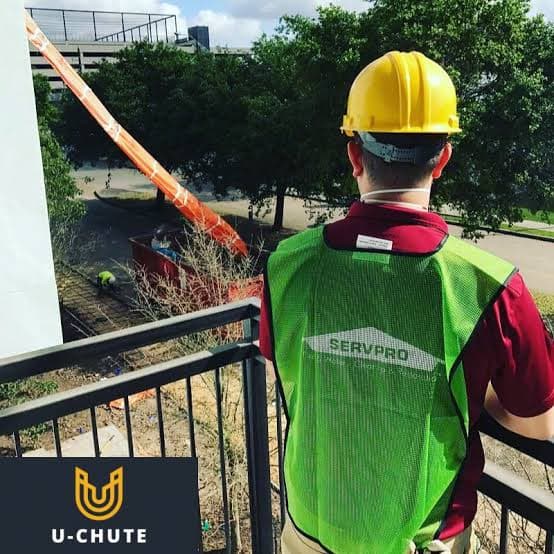
Picking the wrong size construction debris chute wastes money, creates safety hazards, and slows your crew down. Too short and debris free-falls the last few feet — kicking up dust and risking injury. Too light a duty rating and the chute tears mid-pour. Too heavy for the job and you're lugging unnecessary equipment up four flights of stairs.
This guide works like a construction debris chute size calculator: walk through each factor systematically, match your numbers to the right product, and order with confidence. Whether you're a demolition contractor stripping a multi-story commercial building or a roofer clearing shingles off a two-story home, the formula is the same — measure the drop, assess the material, pick the duty rating, buy the right length.
Why Getting Chute Size Right Matters More Than You Think
Most debris chute mistakes happen at the planning stage, not on the job site. A crew grabs whatever is available without calculating the actual drop height or thinking about what they're throwing in it. That's when accidents happen and equipment fails prematurely.
The consequences of an undersized or undersupported chute are serious:
- Debris scatter: Chute sections that don't fully reach the dumpster or ground level let material spray out at the base, creating fall hazards for anyone working nearby.
- Material blowout: A lite-duty chute handling heavy concrete chunks or roofing material will fail — seams tear, sections separate, and you're left with a dangerous open drop.
- OSHA exposure: OSHA ergonomics and site-safety standards require that overhead debris work be contained. An improperly sized or improperly rated chute puts your site out of compliance.
- Crew slowdowns: When sections are too short or mismatched, workers improvise — which always takes longer and costs more than doing it right the first time.
Treating chute selection like a calculation — not a guess — is the difference between a smooth job and a costly problem. Let's walk through that calculation step by step.
Step 1 — Measure the True Drop Height
The single most important number in your debris chute size calculation is the vertical drop: from the point where material enters the chute to the point where it exits into the dumpster or collection area at grade level.
How to Measure Your Drop Height Accurately
Don't eyeball this. Walk the building and take a tape measure or laser distance tool to the window, scaffold edge, or roof peak where you'll hang the chute. Measure from that point down to the lip of your dumpster or the ground surface directly below.
- Single-story residential roof: Typically 12–18 ft of drop depending on pitch and eave height.
- Two-story residential: 18–28 ft is common.
- Three-story commercial or residential: 28–42 ft.
- Four stories and above: 42 ft and beyond — this is where the 50 ft heavy-duty chute earns its place.
Always add a buffer of 2–3 ft to your measured drop. Dumpsters sit at various heights, the hang point may shift as the job progresses, and you want the chute exit to actually reach inside the container rather than hovering above it.
Accounting for Setback and Angle
If the dumpster can't sit directly below your hang point — a common scenario on tight urban lots or narrow alleyways — the chute needs to angle slightly. A significant horizontal offset increases the effective length you need. As a rule of thumb, for every foot of horizontal offset, add 0.5 ft to your required chute length to maintain a safe and functional angle.
Step 2 — Identify the Material Type and Weight
Drop height tells you how long the chute needs to be. Material type tells you how strong it needs to be. These two variables together narrow your size and duty-rating choice significantly.
Light Materials: Shingles, Drywall, Insulation, Light Debris
Asphalt shingles, fiberglass batts, torn drywall, lightweight wood trim — these are the bread and butter of roofing and light remodel jobs. They flow through a chute without excessive impact force. A lite-duty 10 ft chute handles these materials on single-story drops. For two-story drops with light material, consider a 25 ft heavy-duty for peace of mind, even if the material itself is light — because the velocity it builds over a longer drop increases the impact stress on the chute fabric.
Heavy Materials: Concrete, Brick, Tile, Dense Lumber
Concrete chunks, ceramic tile, brick, and heavy hardwood all hit the chute walls hard during the drop. Even at relatively modest heights, these materials demand a heavy-duty rating. The polymer fabric used in U-Chute's heavy-duty lineup is engineered for the repeated impact stress of dense construction debris — it's not a material you want to economize on when you're dropping masonry.
Mixed Loads: The Real-World Scenario
Most demolition jobs involve mixed loads. You're stripping a bathroom: tile comes out, then cement board, then drywall, then framing. The safest practice is to rate your chute for the heaviest material that will go through it, not the average. If there's any chance concrete or masonry enters the chute, choose heavy-duty regardless of what else is going in.
Step 3 — Match Your Numbers to the Right U-Chute Size
U-Chute manufactures four sizes designed to cover the full range of construction and demolition scenarios. Once you have your drop height and material type, matching to the right product is straightforward.

10 ft Lite-Duty: Small Jobs, Light Materials, Single-Story Drops
The 10 ft lite-duty chute is designed for single-story residential work with light demolition materials. Think roof tear-offs on ranch-style homes, light remodel debris, or any situation where the drop is under 15 ft and the material is non-dense. It's lightweight, easy for one person to hang, and ships free across the US. It's not the tool for masonry or multi-story work — that's why the other sizes exist.
10 ft Heavy-Duty: Short Drop, Dense Material
The 10 ft heavy-duty chute covers the same height range but is built to handle significantly heavier impact. If you're doing a single-story demo that involves tile, concrete block, or dense materials, this is the right call. The heavy-duty fabric takes the abuse without the risk of a midpour failure.
25 ft Heavy-Duty: Two- to Three-Story Work
The 25 ft heavy-duty chute is the workhorse for most mid-rise residential and light commercial demolition. Covering the 18–28 ft drop range that represents the majority of two- to three-story construction work, this size handles heavy material across longer drops where velocity is a real factor. It's the size roofers and interior demo contractors reach for most often on larger residential projects and small commercial buildings.
For a deeper look at interior applications, see our guide on the best trash chute for interior demolition in multi-story buildings.
50 ft Heavy-Duty: Four Stories and Above
The 50 ft heavy-duty chute is built for serious commercial and multi-story demolition — the jobs where you need continuous coverage from a high floor down to grade without sectioning up and managing multiple shorter units mid-job. At four stories and above, drop velocity is significant, and the heavy-duty construction of this chute is not optional — it's what keeps the job safe and compliant.
If you're working on a large commercial project and weighing chute ownership versus rental, the analysis in our debris chute rental vs buy guide breaks down the cost math in detail.
The Construction Debris Chute Size Calculator: A Quick-Reference Formula
Here's the streamlined decision matrix you can print and keep on the job trailer. Run through it before every project:
- Measure the drop: Tape from hang point to dumpster lip. Add 3 ft buffer.
- Identify the heaviest material: Light (drywall, shingles, insulation) or Heavy (concrete, tile, brick, dense lumber).
- Apply the matrix:
- Drop under 15 ft + light material → 10 ft Lite-Duty
- Drop under 15 ft + heavy material → 10 ft Heavy-Duty
- Drop 15–30 ft + any material → 25 ft Heavy-Duty
- Drop 30–55 ft + any material → 50 ft Heavy-Duty
- Drop over 55 ft → 50 ft Heavy-Duty + consult project engineer for extension rigging
When in doubt, go one size up and one duty rating heavier. The cost difference between chute sizes is far smaller than the cost of a chute failure on the job.
Common Sizing Mistakes Contractors Make (and How to Avoid Them)
Years of field experience across roofing, demolition, junk removal, and commercial construction reveal the same sizing errors over and over. Recognizing them in advance saves you from learning the hard way.
Mistake 1: Measuring to the Floor, Not the Dumpster
Crews measure the drop from the hang point to the ground — but the dumpster sits 3–4 ft above grade on its own base. A 22 ft measured drop to the ground becomes an 18–19 ft effective drop to the dumpster lip. That 3–4 ft matters: don't over-buy length you don't need, and don't assume you can make a too-short chute work by angling it.
Mistake 2: Choosing Lite-Duty to Save Money on a Mixed-Load Job
The price difference between lite-duty and heavy-duty is modest. The cost of a midpour failure — torn sections, scattered debris on a public sidewalk, potential injury, OSHA citation — is not modest. If there's any dense material in the load, use the heavy-duty rating. Every time.
Mistake 3: Not Accounting for Future Projects When Buying
If you're buying a chute (rather than renting), think about the range of jobs you'll use it on over the next two to three years. A roofer who mostly does single-story work but occasionally tackles two-story jobs should buy the 25 ft heavy-duty — it handles both scenarios. Buying the 10 ft and then renting the difference for every two-story job is a false economy.
Mistake 4: Ignoring the Safety Checklist
A correctly sized chute still fails if it's improperly hung or loaded. Work through a proper pre-use safety review on every job. Our 10 ft construction trash chute safety checklist covers the key inspection points that apply to all sizes.
How Material Volume Affects Your Chute Choice
Size and duty rating address the structural requirements. Volume — how much material you're moving per shift — affects how you use the chute and how quickly you need to work. It doesn't change which chute you buy, but it changes how you manage the job around it.
A high-volume demolition job means the dumpster fills faster, requiring more frequent swaps. It also means more sustained impact on the chute fabric throughout the day. For very high-volume jobs, inspect the chute at midday — look for any fabric stress points, worn seams, or loose connections that need addressing before the afternoon push. This is especially important when running heavy material through a 50 ft chute, where the drop velocity generates the most impact force.
The EPA's data on construction and demolition materials consistently shows that C&D debris is one of the largest waste streams by volume in the US. Efficient chute setup isn't just a productivity issue — it directly affects how cleanly a site separates recyclable materials from general waste, which matters increasingly for construction recycling compliance in many jurisdictions.
Debris Chutes vs. Dumpsters: When Size Calculation Changes the Math
Running a chute size calculation often leads contractors to a broader question: is a chute even the right tool for this job, or should we just use multiple dumpsters? The answer depends heavily on building height and site access.
For any job above one story, a debris chute is almost always faster and safer than manually carrying debris down stairways or dropping it unsecured. The tipping point is around the 15 ft mark — below that, a well-placed dumpster with a short throw may be equally efficient. Above 15 ft, a chute wins on speed, safety, and labor cost almost every time.
For a head-to-head cost and logistics analysis, see our post on construction debris chute vs dumpster, which runs the numbers across several common project types.
Junk removal companies, in particular, have found debris chutes to be a significant operational upgrade over repeated stair carries. The same applies to roofing crews, where fatigue from carrying heavy shingle bundles down ladders is both a productivity and a safety concern. OSHA's ergonomics guidance is clear that repetitive heavy carrying on stairs is a significant musculoskeletal risk — a chute eliminates that exposure entirely.
Sizing for Specialized Applications
Not every job fits the standard residential or commercial demolition mold. Here's how to apply the size calculator logic to some less obvious use cases.
Roofing Tear-Offs
Roofing is one of the most common debris chute applications, and one where sizing errors are most costly because the work happens fast. Measure from the roof peak (where shingles get pushed off) to the dumpster lip. On steeper-pitched roofs, the peak is higher than you think — always measure, never estimate. Shingles are a medium-weight material: they're not concrete, but they're not light either. Use heavy-duty rating for any roofing job where more than one square of shingles is going through the chute.
Interior Demolition — Multi-Story Commercial
Interior demo through a window opening requires knowing both the floor height and the window sill height — the effective hang point is the window sill, not the floor. Measure floor-to-sill, then add that to the story height below. On a four-story building with 10 ft ceilings and 3 ft sills, a fourth-floor window hang point is at 33 ft above grade — that's a 50 ft chute job, not a 25 ft job.
Junk Removal from High-Rise Apartments
Junk removal companies increasingly use debris chutes to clear multi-story apartment cleanouts. The hang point is typically a hallway window or balcony railing, and the load is mixed — furniture, bagged junk, small appliances. Use the heavy-duty rating for anything that could include dense or sharp items, and never attempt to push oversized items through a chute that isn't rated for them.
Scaffold-Mounted Applications
When the chute hangs from a scaffold rather than a window or roof edge, the hang height is the scaffold deck height, not the building height. This is often lower than the building itself, which can reduce the chute length needed. Remeasure for every scaffold configuration — don't assume the same setup works across different scaffold heights on the same job.
Permit Considerations That Affect Your Chute Setup
In many jurisdictions, running a debris chute over a public sidewalk or ROW requires a permit. The permit may specify the minimum clearance height, the required netting or enclosure around the base, and the maximum duration of installation. All of these can affect your chute configuration and length.
Our comprehensive breakdown of trash chute permit requirements by state in 2026 covers the key requirements in detail. The bottom line: check local requirements before you set up, and if the permit requires a specific chute exit height above the sidewalk, factor that into your effective drop measurement.
Permits also sometimes require that the chute exit into an enclosed dumpster enclosure rather than an open-top container — which changes the geometry of your setup. Account for enclosure height in your measurements.
Buying vs. Renting: How Size Choice Affects the Decision
One practical output of running the debris chute size calculation is that it often clarifies whether buying or renting makes more sense for your business. If you land on the 25 ft heavy-duty as the right size for 80 percent of your jobs, ownership economics are compelling: the chute pays for itself after a handful of uses compared to repeated rental fees.
U-Chute sells directly online with free US shipping, which removes the logistics friction that makes equipment ownership less attractive in other categories. You order the size you need, it ships to you, and you own a reusable asset that can work on dozens or hundreds of future jobs. For businesses that consistently need the same size, this is straightforwardly better economics than renting.
Our detailed trash chute vs dumpster rental cost comparison runs through the break-even analysis across different job frequencies — worth reading if you're still deciding which approach fits your business model.
You can browse all current sizes and pricing on our services page, or explore the full debris chute product lineup to compare specs side by side.
Regional Considerations: Does Location Affect Chute Size Needs?
The fundamental size calculation doesn't change based on geography — a 30 ft drop is a 30 ft drop whether you're in Texas, Colorado, or Maine. But regional building patterns do influence which size is most commonly the right answer in a given market.
In the Mountain West and Pacific Northwest, where multi-story residential construction is common, the 25 ft and 50 ft heavy-duty chutes see heavy use. In the Sun Belt, where single-story commercial and residential projects dominate, the 10 ft and 25 ft sizes are more frequently the right call. In dense urban markets on the East Coast and Northeast, multi-story work is the norm and the 50 ft chute is a jobsite staple.
U-Chute ships free to all 50 states, so contractors in markets from Boulder, Colorado to Sarasota, Florida and Asheville, North Carolina can order exactly the size they need without freight cost eating into the savings.
Frequently Asked Questions
How do I calculate what size debris chute I need?
Measure the vertical drop from your hang point (window, roof edge, or scaffold deck) down to the lip of your dumpster or collection area. Add a 2–3 ft buffer. Then identify the heaviest material going through the chute. If the drop is under 15 ft and the material is light, the 10 ft lite-duty works. Heavy material at any height, or any material over 15 ft, requires a heavy-duty rating. Match the drop distance to the closest chute length that exceeds your measurement — always size up, never down.
Can I use a shorter chute on a taller building by angling it?
Not safely. Angling a debris chute reduces its effective vertical coverage, but it also concentrates stress on specific sections and creates unpredictable debris trajectory at the exit. The correct approach is to use a chute that fully covers your measured drop height. Attempting to extend coverage by angling a too-short chute is a common cause of chute failure and debris scatter incidents. If your drop exceeds any single chute's length, contact U-Chute for guidance on appropriate setups for your specific height.
What is the difference between lite-duty and heavy-duty chutes?
The duty rating refers to the strength of the polymer-fabric construction — how much impact force the chute sections can absorb as material travels through. Lite-duty is designed for low-density materials like drywall, insulation, and light debris on short drops. Heavy-duty is engineered to handle repeated impact from dense materials including concrete, brick, tile, and heavy lumber, and is also the correct choice for any drop over 15 ft regardless of material type, because drop velocity increases impact stress significantly.
Do I need different sizes for different sections of a job?
Generally, no — you select one chute size that covers your maximum drop height for that job, and it handles all phases. If your job involves working from multiple floor levels over time, size for your highest hang point. The chute sections stack and can be configured to match whatever portion of the drop you're actively working. If you're doing back-to-back jobs at different heights, having both a 25 ft and 50 ft heavy-duty in your fleet gives you flexibility without the logistical cost of renting.
How does material weight affect which size I should choose?
Material weight affects the duty rating (lite vs. heavy-duty) rather than the length. The length is determined by drop height. However, very dense materials traveling long drops build significant velocity and impact force — which is why for drops over 15 ft, heavy-duty is always the right rating regardless of material type. When in doubt about whether your material qualifies as heavy-duty, err toward the heavier rating: the cost difference is minor compared to the cost of a chute failure mid-job.
Is free shipping really available nationwide on all chute sizes?
Yes. U-Chute offers free US shipping on all four sizes — the 10 ft lite-duty, 10 ft heavy-duty, 25 ft heavy-duty, and 50 ft heavy-duty. This is a direct-purchase model: you choose the size you need based on your job requirements, order online, and it ships to you at no additional freight cost. There are no rental fees, no return logistics, and no recurring costs — you own a reusable asset that serves your business across future jobs.
What if my drop height exceeds 50 ft?
For drops exceeding 50 ft — which typically means five or more stories — consult with a structural or project engineer before setting up any debris chute system. You may need additional rigging support, intermediate tie-off points, or a staged chute configuration. U-Chute's 50 ft heavy-duty chute is built for serious commercial work, but any application above its rated range requires professional engineering input to ensure the setup is safe and compliant with site safety requirements.
Ready to Order the Right Size? Here's Your Next Step
Run through the calculation one more time: measure your drop, identify your heaviest material, match to the size matrix above. Then head to the U-Chute debris chute product page and order the size your job actually needs — with free shipping to your location anywhere in the US.
If you still have questions about which size is right for a specific project, visit our frequently asked questions page or contact us directly. The right chute size is a one-time calculation that pays dividends across every job you run it on. Get it right before the first load goes in.