
High-rise construction and demolition work demands precision at every level — literally. When debris needs to come down from the 8th floor, the 15th floor, or higher, the margin for error shrinks fast. A poorly managed debris chute system doesn't just slow down a job; it creates safety hazards, regulatory exposure, and cost overruns that eat directly into your bottom line.
The frustrating part? Most of the worst construction chute mistakes on high-rise job sites are entirely preventable. They stem from skipping basic planning steps, buying the wrong equipment, or cutting corners that seem harmless until something goes wrong. This guide walks through every major mistake contractors make — and exactly how to avoid each one.
Underestimating Drop Height and Buying the Wrong Chute Size
This is the single most common mistake on high-rise sites, and it cascades into every problem that follows. Contractors eyeball the drop height, round down to save money, and end up with a chute system that doesn't reach the dumpster — or worse, one that's been awkwardly extended with improvised connections that compromise the whole run.
How to Measure Drop Height Correctly
Drop height is measured from the discharge point (where debris enters the chute) down to the mouth of the dumpster or debris pile on the ground. Do not measure from the floor you're working on to the ground. Account for:
- The height of the dumpster or roll-off container (typically 4 to 5 feet off the ground)
- Any scaffolding or platform offset at the discharge end
- The angle of the final section if the chute kicks out horizontally at the base
Always round up, not down. It's far easier to fold a short section than to discover you're 3 feet short when 15 workers are waiting to start a shift.
Matching Chute Size to the Job
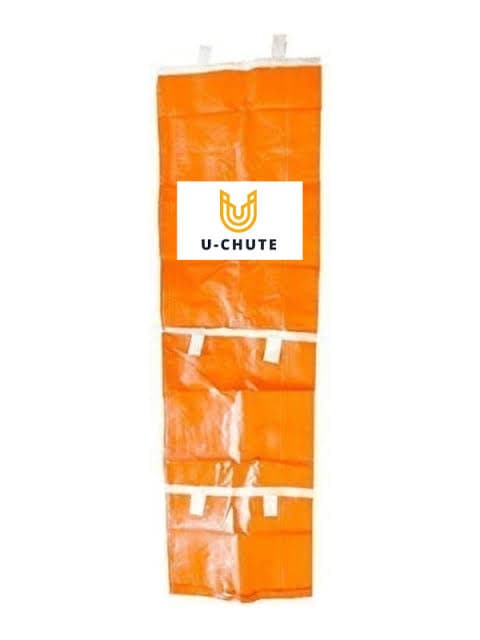
U-Chute's reusable polymer-fabric chutes are available in four configurations: the 10 ft lite-duty, the 10 ft heavy-duty, the 25 ft heavy-duty, and the 50 ft heavy-duty. For a typical high-rise demolition job — say a 12-story gut renovation — you'll want to stack sections to cover the full run. The debris chute systems page breaks down how each size is intended to be used so you can spec the right combination before you order.
Failing to Secure the Chute at Multiple Anchor Points
A freehanging debris chute swaying 10 stories above a sidewalk is one of the most dangerous conditions on a job site. Yet contractors regularly hang chutes from a single upper attachment and call it done. Wind load, debris load, and vibration from adjacent work all act on that chute simultaneously.
Anchor Point Spacing Guidelines
Industry best practice calls for a secure anchor point at every floor level the chute passes through — or at minimum every 10 feet of vertical run on open faces. Each anchor should be:
- Tied or clamped to a structural member, not just exterior sheathing or temporary fencing
- Inspected at the start of each shift
- Able to withstand lateral wind loads independently of the chute's own weight
On a 50-foot run, that means a minimum of five anchor points. On jobs where that's not practical, a rigid guide frame or scaffold-integrated mounting system should be used instead. OSHA's guidelines on safe material handling are a useful baseline for understanding load and force considerations on elevated worksites.
Ignoring Load Limits and Feeding Oversized Debris
Polymer-fabric chutes are remarkably durable — but they're not indestructible, and they're not designed to handle rebar bundles, entire sections of drywall, or concrete chunks the size of a microwave oven. Feeding oversized material through a chute creates blockages, tears the fabric, and in severe cases, can cause a section to detach mid-fall.
Establishing a Debris Sorting Protocol Before You Start
The most effective job sites treat the chute's intake point like a quality-control station. Designate one worker per shift to manage what goes in. The protocol should specify:
- Maximum piece size (a practical rule of thumb: nothing larger than one-third the chute's diameter)
- Material types that require manual lowering or separate drop zones (long lumber, pipe, bundled wire)
- Weight-per-load limits so workers don't dump a full wheelbarrow load at once
- A clear signal system so workers below know when a load is in transit
A few minutes of sorting at the top prevents hours of downtime clearing a blockage or replacing a torn section at the bottom.
Positioning the Ground-Level Discharge Incorrectly
Even a perfectly installed upper chute fails when the ground-level discharge is poorly positioned. The two most common errors are placing the dumpster too far from the chute mouth (creating a mess and dust cloud) and aiming the discharge into a high-traffic area where workers or equipment operators are at risk from falling debris.
Setting Up a Safe Landing Zone
Before rigging begins, mark out a dedicated debris landing zone. That zone should:
- Be immediately adjacent to the chute mouth — ideally with the dumpster positioned directly beneath or within 2 feet of the discharge
- Be barricaded with hard barriers (not just caution tape) on all sides visible to foot traffic
- Have overhead protection for anyone who must pass through the zone (a robust debris net or hard canopy)
- Be positioned so dust and small debris blow away from occupied areas, not toward them
On urban high-rise sites with tight footprints, this planning step often requires coordination with the site safety officer and sometimes the municipality. Don't skip it.

Skipping Daily Inspection of Chute Sections
Reusable chutes earn their keep precisely because they can handle repeated, heavy-duty use — but that durability comes with a responsibility to inspect. Contractors who set up a chute on day one and don't look at it again until teardown are setting themselves up for a mid-job failure.
What to Check Each Morning
A daily pre-shift inspection takes under 10 minutes and should cover:
- All anchor points and tie-offs — check for loosening, fraying, or slippage
- Section connections — verify each coupling is fully seated and hasn't shifted overnight
- Fabric condition — look for tears, abrasion wear, or deformation from impact
- The discharge zone — confirm the landing area is clear and the dumpster hasn't been repositioned
- Any weather-related changes — ice in winter, UV swelling in summer heat, or storm damage
Document these checks in your daily safety log. If you're operating in a state with specific seasonal requirements, the 2026 state-by-state winter safety regulations guide is worth reviewing before cold weather hits.
Using a Single-Use Plastic Chute on a Multi-Phase Project
Single-use chutes get purchased for convenience — grab one, use it, toss it. On a short single-day tearout, that might make sense. On a multi-phase high-rise project with weeks or months of demolition work across multiple floors, it's a significant waste of money and material.
Reusable polymer-fabric chutes like U-Chute's heavy-duty line are built for exactly this kind of sustained, repeated use. You buy the sections you need, configure them for your drop height on phase one, break them down, and redeploy on phase two. The economics are straightforward, and for contractors who want to run the numbers, the trash chute pricing guide for demolition contractors lays out the comparison in detail.
The Environmental Case for Reusable Chutes
Beyond the cost savings, there's a growing regulatory and client-driven pressure to reduce construction waste. EPA data on construction materials waste consistently shows the sector as one of the largest contributors to landfill volume. Choosing reusable equipment is a concrete, documentable step toward reducing that footprint — which matters more and more in 2026 as green building certifications become standard on commercial projects.
Neglecting Dust and Debris Containment at the Chute Intake
Every time a load drops through a high-rise chute, it displaces air — and that air carries dust, fine particles, and small debris fragments out of the intake opening. Without containment, that material ends up coating every surface on the floor, aggravating workers' respiratory systems, and potentially drifting to adjacent occupied spaces.
Practical Intake Containment Methods
Controlling dust at the intake point is simpler than most contractors expect:
- Install a drop-flap or hinged cover on the intake opening that closes automatically between loads
- Use plastic sheeting to create a partial enclosure around the intake area on the working floor
- Wet down heavy debris (drywall, plaster, concrete) before feeding it into the chute
- Position a HEPA air scrubber near the intake on floors where asbestos abatement or lead paint removal is adjacent to the demolition work
These measures protect workers, satisfy air quality requirements, and keep the surrounding floors from becoming a secondary cleanup project.
Failing to Brief Every Crew Member on Chute Protocol
A debris chute is only as safe as the least-informed person using it. On large high-rise jobs, that's a real risk — subcontractors from different trades come and go, new laborers start mid-project, and the original safety briefing from day one becomes a distant memory by week three.
Building Chute Safety Into Your Onboarding SOP
Make chute use a mandatory agenda item on your site-specific safety orientation. Cover:
- What materials are permitted and what must be handled separately
- Maximum load size and weight per drop
- The communication protocol between workers at the top and bottom of the chute
- Who to notify if they observe damage, blockage, or anchor failure
- Emergency stop procedure if something goes wrong mid-drop
Post a laminated one-page summary at the intake point on every active floor. It costs almost nothing and eliminates the "I didn't know" defense when something goes sideways.
Buying Undersized Chutes to Save Upfront Cost
The temptation to spec the lite-duty chute for a job that actually needs heavy-duty capacity is understandable — the price difference feels significant on the purchase order. But when the lite-duty chute tears under the weight of commercial demolition debris, you're not just replacing the chute. You're paying for downtime, emergency shipping, and potentially a safety incident investigation.
Match the chute's duty rating to the actual debris stream. For roofing tear-offs, light renovation cleanouts, and residential work, the 10 ft lite-duty or 10 ft heavy-duty may be exactly right. For commercial high-rise demolition with heavy concrete, tile, or mixed construction debris, the 25 ft heavy-duty or 50 ft heavy-duty configurations are the appropriate tools. The U-Chute FAQ page covers common questions about which configuration is right for different project types.
Improperly Storing Chute Sections Between Uses
Reusable chutes are an asset. Treat them like one. Leaving polymer-fabric sections rolled up in a puddle on the job site, storing them outdoors through a Texas summer without UV protection, or stacking heavy equipment on folded sections all degrade the material faster than normal use would.
Storage Best Practices That Extend Chute Life
- Rinse sections before storage to remove abrasive debris particles trapped in the fabric
- Allow sections to dry completely before rolling or folding to prevent mildew
- Store in a dry, shaded location — a storage bay, truck bed cover, or simple tarp shelter works fine
- Avoid folding the same crease repeatedly; alternate the fold orientation to prevent fabric fatigue along stress lines
- Inspect before storage, not just before deployment — catching a small abrasion now means you're not surprised by a failure on the next job
Good storage habits are the difference between a reusable chute that lasts dozens of jobs and one that gives out after three.
Overlooking Local Permit and Safety Requirements for Elevated Chutes
Many municipalities require a permit for debris chutes that extend over public sidewalks or right-of-ways. On high-rise jobs in dense urban areas, this is almost always the case. Contractors who start rigging without checking local requirements risk stop-work orders, fines, and the public-relations headache of a city inspector shutting down the job.
Pull the permit before you rig the chute. Coordinate with the property owner and general contractor on who carries the permit. Make sure the chute's footprint — including the ground-level debris zone — is fully within the permitted area. The SBA's small business operations guidance is a useful reminder that compliance isn't overhead — it's risk management that protects the business you've built.
Underestimating the Ergonomic Cost of Not Using a Chute at All
Some contractors skip the debris chute entirely on shorter drops — 10 or 15 feet — thinking manual carry-out or window toss is faster. The hidden cost is worker fatigue and injury. Repetitive manual debris carrying is one of the leading causes of back injuries, shoulder strains, and cumulative trauma disorders in construction.
A properly rigged chute on even a two-story renovation dramatically reduces the number of trips workers make carrying heavy debris down stairs or ladders. That reduction in physical load translates directly to fewer injury claims, less fatigue-related error in the afternoon, and faster overall project completion. OSHA's ergonomics resources quantify the musculoskeletal risk of repeated heavy lifting — the data makes a compelling case for mechanized debris removal even on smaller jobs.
Contractors in markets like Boulder, Colorado, Asheville, NC, and Boca Raton, Florida are increasingly factoring ergonomic equipment into their job bids — not just as a worker welfare measure, but as a competitive differentiator that reduces labor turnover and workers' comp claims.
Not Planning for Chute Access on Floors With Limited Window or Opening Size
High-rise buildings — especially occupied ones undergoing partial renovation — often have constrained access points. The window opening on the 14th floor might be 28 inches wide. The corridor to the window might have a 90-degree turn. Contractors who don't account for these constraints when selecting chute section dimensions end up with equipment they can't physically deploy in the space.
Measuring Access Points Before You Order
Before purchasing or deploying chute sections on a high-rise job, document:
- The width and height of every window or opening the chute will pass through
- The minimum corridor or stairwell dimension for carrying sections to upper floors
- Any exterior facade constraints (setbacks, overhangs, mechanical equipment) that affect where the chute can be rigged
U-Chute's polymer-fabric sections are lightweight and flexible, which helps significantly with access constraints compared to rigid metal chute systems. But the planning step still matters — don't assume the sections will fit until you've verified the measurements.
Frequently Asked Questions
How many chute sections do I need for a high-rise job?
The number of sections depends on your total drop height from the discharge point to the ground-level landing zone. Measure the full drop — including dumpster height — and round up to the nearest available configuration. U-Chute offers 10 ft, 25 ft, and 50 ft section lengths that can be combined to cover virtually any high-rise drop. When in doubt, order one section longer than your measured drop so you have flexibility during rigging.
What is the maximum debris size I should feed into a construction chute?
A practical rule of thumb is to limit individual pieces to no more than one-third the inner diameter of the chute. Larger pieces can create blockages mid-run, which may require disassembling sections to clear — a costly delay. For high-rise demolition work with heavy or irregular debris like concrete chunks, tile, or plaster, establish a debris sorting station at the intake point and designate a worker to control what goes in.
How often should I inspect the chute during an active high-rise project?
Inspect every anchor point, section connection, and fabric surface at the start of each shift — daily at minimum. On jobs lasting multiple weeks, also conduct a mid-week structural check of all upper anchor points, especially if the site has experienced high winds or heavy rain. Document inspections in your daily safety log. A 10-minute inspection each morning prevents the kind of mid-job failure that causes hours of downtime and potential injury.
Do I need a permit to run a debris chute on a high-rise job site?
In most urban jurisdictions, yes — especially when the chute extends over a public sidewalk, right-of-way, or shared property boundary. Permit requirements vary by city and state, so verify with the local building department before rigging begins. Your general contractor or property owner may already have a site work permit that covers the chute, but confirm this in writing before assuming you're covered.
Can I use the same chute sections for different floor heights on multi-phase projects?
Yes — that's one of the primary advantages of reusable polymer-fabric chutes. U-Chute sections can be reconfigured between project phases by adding or removing sections to match the new drop height. This makes them significantly more economical than single-use alternatives on multi-phase commercial projects where the active floor changes as work progresses.
What debris types should never go through a construction chute?
Avoid feeding through: bundled rebar or long steel members, full sheets of plywood or drywall, pipe longer than one chute diameter, hazardous materials requiring sealed containment (asbestos, lead paint debris), liquids or slurry, and any single item weighing more than your chute's rated per-piece load limit. These materials require manual lowering, a separate crane lift, or a dedicated hazmat removal protocol — not a debris chute.
Are reusable polymer-fabric chutes as durable as metal chutes for high-rise use?
For the debris types and drop heights typical of high-rise renovation and demolition — drywall, tile, plaster, light concrete, wood framing debris — reusable polymer-fabric heavy-duty chutes are fully adequate and have significant advantages: they're lighter to carry to upper floors, easier to rig in confined spaces, and far less expensive to purchase and store. Metal chutes have a role in extreme heavy industrial applications, but for most commercial high-rise work, a quality fabric chute is the practical choice.
Ready to Equip Your High-Rise Job Site with the Right Chute System?
Avoiding the mistakes covered in this guide comes down to one foundational decision: starting with the right equipment. A properly sized, properly rigged, properly inspected reusable debris chute eliminates most of the risk and cost that derail high-rise demolition and renovation projects.
U-Chute manufactures reusable polymer-fabric trash chutes in four sizes — 10 ft lite-duty, 10 ft heavy-duty, 25 ft heavy-duty, and 50 ft heavy-duty — and ships free anywhere in the United States. Whether you're running a gut renovation in a mid-rise condo or a full commercial demolition on a tower, there's a configuration that fits your drop height and your debris load.
Browse the full lineup on the debris chute systems page, review common sizing questions on the FAQ page, or reach out directly if you want to talk through the right setup for your specific job. Contractors across the country — from Portland, Maine to Sarasota, Florida to Bend, Oregon — are running cleaner, safer, more efficient job sites with U-Chute. Your next project can too.