

Winter changes everything on a construction site. Frozen ground, icy rungs, shifting load weights, and reduced daylight hours all stack up to create conditions that make debris management genuinely dangerous. If you're running a trash chute through a renovation, roofing teardown, or multi-story demolition during the cold months, understanding the regulatory landscape is not optional — it's the difference between a smooth job and a OSHA citation, a workers' comp claim, or worse.
This guide breaks down the most important winter trash chute safety regulations by state in 2026, the federal baseline every contractor must meet, and the practical steps you can take to stay compliant and keep your crew safe from the first freeze through spring thaw.
Why Winter Makes Trash Chute Safety More Complex
Trash chutes are workhorses. On a warm-weather job site, they channel debris from upper floors down to ground-level containers with minimal drama. In winter, several factors conspire to raise the risk profile considerably.
- Ice accumulation: Moisture from debris — wet drywall, sodden insulation, slushy shingles — freezes inside the chute barrel and around connection points overnight. That ice creates blockages and structural stress.
- Increased load weight: Wet and frozen debris weighs significantly more than dry material. A chute rated for a given load per section can be pushed toward its limits when crews are throwing waterlogged debris.
- Ladder and anchor hazards: Icy ladders, frozen anchor straps, and slippery window sills or balcony rails make chute installation and adjustment far more dangerous than in mild weather.
- Reduced visibility: Short winter days mean more work happens in low light. Debris landing zones that are clearly visible in July become hazard areas in the pre-dawn or post-dusk hours of December.
- Cold-weather material brittleness: Even high-quality polymer-fabric chutes perform differently at extreme cold. Understanding your product's rated temperature range matters.
Regulators at the federal and state levels have increasingly acknowledged these compounding hazards. The result is a patchwork of winter-specific requirements that vary considerably depending on where your project is located.
The Federal Baseline: What OSHA Requires Everywhere
Before diving into state-by-state differences, understand that OSHA sets the federal floor. No state can go below it, and many states have adopted their own OSHA-approved plans that exceed it.
OSHA's General Duty Clause and Winter Conditions
Section 5(a)(1) of the Occupational Safety and Health Act — commonly called the General Duty Clause — requires employers to provide a workplace free from recognized hazards. OSHA inspectors routinely apply this clause to winter site conditions even when no specific cold-weather standard exists for a given task. Translation: "there's no specific rule about icy chute anchors" is not a valid defense if a worker gets hurt.
Key OSHA Standards That Apply to Winter Chute Work
- 29 CFR 1926.502: Fall protection requirements. If installing or adjusting a chute requires work at height, fall protection obligations are triggered regardless of season — and winter conditions make compliance harder to achieve.
- 29 CFR 1926.250-252: Material storage and handling. Debris containers must be stable; accumulated ice and snow can shift containers and create tip hazards.
- 29 CFR 1926.20(b): General safety and health provisions for construction. Supervisors must conduct frequent and regular inspections of job sites and equipment — in winter this means daily checks of chute hardware, anchor points, and landing zones.
- 29 CFR 1926.25: Housekeeping. The area around the debris collection point must be kept clear. In winter, that explicitly includes snow and ice removal around the dumpster or collection bin.
OSHA's ergonomics guidance is also worth reviewing. Debris that freezes into large chunks inside a chute creates manual-handling hazards when crews have to clear blockages. Review the OSHA ergonomics resource hub for safe-lifting protocols applicable when breaking up frozen debris.
State OSHA Plans: Who Has Extra Winter Rules
Twenty-eight states and two territories operate their own OSHA-approved state plans. These states have the authority — and in many cases, the obligation — to adopt standards at least as effective as federal OSHA. Many have gone further with cold-weather and winter construction rules.
States With State Plans That Address Winter Construction Conditions
The following states operate their own OSHA plans and have adopted winter-specific construction safety guidance or standards worth knowing about:
- California (Cal/OSHA): Title 8 of the California Code of Regulations includes provisions for weather-related hazards. Cal/OSHA compliance officers treat icy debris zones as recognized hazards under the General Duty equivalent. Projects in the Sierras and Northern California high country are frequently flagged during winter inspections.
- Michigan (MIOSHA): Michigan has explicit cold-stress prevention standards for construction workers and requires written safety programs for winter operations on covered construction sites. Debris chute anchor inspections must be documented.
- Washington (WISHA/L&I): Washington's Department of Labor and Industries requires that all construction equipment, including material-handling equipment like debris chutes, be inspected and maintained in safe operating condition. The state has issued enforcement guidance treating ice-compromised chute connections as a citation-worthy defect.
- Minnesota (MNOSHA): Minnesota enforces strict cold-stress and winter-site-preparation standards. Employers working in temperatures below 20°F must have a written cold-weather plan that covers equipment inspection, including overhead material-handling equipment.
- Oregon (OR-OSHA): Oregon's Division 3 construction rules require daily inspections of elevated equipment during adverse weather. Contractors using chutes on jobs in Bend and other high-elevation Oregon markets should review these requirements carefully before winter shutdowns.
- North Carolina (NC DOL OSHA): North Carolina's state plan mirrors federal OSHA closely but has issued compliance guidance for mountain-region contractors doing winter renovation work. Projects in the Asheville area — where winter conditions can be significant — may face additional scrutiny.
- South Carolina (SC OSHA): South Carolina's OSHA program has limited winter-specific rules, but the state's Workers' Compensation risk frameworks mean that employers in Columbia and upstate areas should document all weather-related equipment inspections to protect themselves in claims.
- West Virginia (WV OSHA): West Virginia enforces federal OSHA standards as a state-plan state. Given the state's mountainous terrain and severe winters, chute anchor integrity inspections are especially important for Charleston-area and upstate contractors.
Federal OSHA States With Relevant Winter Guidance
In states without their own OSHA plan — including Texas, Florida, Georgia, and others — federal OSHA applies directly. These states are not exempt from scrutiny:
- New Hampshire: Federal OSHA jurisdiction. Winter conditions in Manchester, NH are severe, and OSHA inspectors in the region apply the General Duty Clause aggressively to winter construction sites with exposed material-handling equipment.
- Maine: Federal OSHA jurisdiction. Contractors operating in Portland, ME through winter should treat debris chute inspections as part of their formal morning site-safety walkthrough.
- North Dakota: Federal OSHA. Fargo's extreme winter temperatures make cold-weather equipment inspection non-negotiable. OSHA area offices in the Dakotas have historically prioritized winter construction compliance.
- Montana: Federal OSHA. Billings-area contractors working through Montana winters should budget for additional anchor inspection time and consider insulated storage for polymer-fabric chute sections when not in use.
- Nebraska: Federal OSHA. Scottsbluff and western Nebraska see significant winter conditions; debris container stability around chute landing zones needs daily verification.
Key Regulatory Themes Across All States in 2026
While the specific rules vary, several themes show up consistently in winter construction safety enforcement across all jurisdictions in 2026. Understanding these themes lets you build a winter chute safety program that will hold up in any state.
Daily Inspection Requirements
Almost universally, both state and federal OSHA enforcement guidance treats daily inspection of overhead equipment in winter conditions as a minimum standard. For trash chutes, that means:
- Checking all connection and coupling points for ice, stress cracking, or displacement before first use each day.
- Verifying that anchor straps, cables, or hooks have not been compromised by overnight freezing or expansion.
- Confirming the debris landing zone is clear of ice accumulation that could destabilize the container or create slip hazards for collection workers.
- Inspecting the chute opening at the upper floor for ice buildup that could redirect material unexpectedly.
- Documenting the inspection in a written log — paper or digital — that can be produced to an OSHA inspector on request.
Landing Zone Exclusion Areas
In winter, debris can travel unpredictably. Ice inside the chute changes the slide characteristics of material, and a chunk of frozen drywall behaves very differently from a loose piece of drywall on a warm day. Most state guidance — and federal OSHA's General Duty application — requires clearly marked exclusion zones at the base of any debris chute. In winter, these zones should be expanded and re-marked after any significant snowfall that may have obscured barriers.
Load Management in Cold Weather
Frozen or wet debris is heavier. If your chute sections are rated for a given material weight, you need to account for the increased density of wet or frozen materials. Overloading a chute in cold conditions stresses connection points that may already be weakened by ice. The conservative approach: reduce the volume of material per load in winter and increase load frequency rather than compensating with heavier single drops.
Worker Cold-Stress Protections
While not specific to trash chutes, cold-stress requirements affect every worker who interacts with a chute — the person loading at the top and the person managing the container at the bottom. Federal OSHA's cold-stress guidance and several state plans require scheduled warm-up breaks and appropriate PPE for workers exposed to temperatures that create cold-stress risk. Supervisors managing chute operations in winter must integrate these requirements into their work planning.
Colorado, Florida, and Sunbelt States: Don't Assume You're Exempt
A common misconception: if you work in a warmer state, winter trash chute regulations don't apply to you. That's wrong in two ways.
First, even Sunbelt states see winter conditions. Colorado's Boulder market sees significant snow from October through April. Florida's construction season still involves cold mornings; contractors in Sarasota and Boca Raton may not worry about ice, but OSHA's general hazard-recognition standards apply year-round, including to debris chute operations.
Second, federal OSHA's General Duty Clause applies in every state, every season. If a recognized hazard exists — and OSHA has repeatedly found that improperly maintained debris chutes constitute a recognized hazard — the absence of a specific winter rule does not protect you from citation.
How Chute Material Choice Affects Winter Compliance
Not all chute materials behave the same in cold weather. This matters for regulatory compliance because OSHA requires that equipment be maintained in safe operating condition — and equipment that becomes brittle, cracks, or fails under winter stress conditions may put you in violation even if you pass a visual inspection in mild weather.
Polymer-Fabric Chutes and Cold-Weather Performance
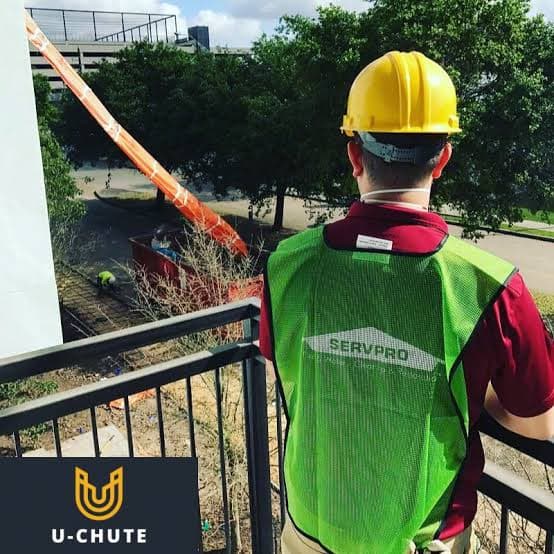
High-quality polymer-fabric construction chutes — like those manufactured by U-Chute — are designed for durability across a range of working conditions. The flexible fabric construction means they do not become brittle in the same way that rigid plastic or metal components can. That said, every contractor should confirm the operating temperature range of their specific chute product and store chute sections appropriately when not in active use. Storing sections in a heated trailer or building overnight during extreme cold events is a reasonable best practice in northern markets.
Reusability and Inspection Cycles
Reusable chutes offer a compliance advantage: because you use the same sections repeatedly, you develop familiarity with the product's normal condition, making it easier to identify signs of wear or stress. A worn or cracked section that gets used once and discarded may never be identified as a hazard. A reusable section that's been inspected twenty times is one you know intimately. Build a seasonal inspection into your program at the start of each winter — review all sections for stress points before the first cold-weather project of the season.
You can review U-Chute's full range of chute sizes and specifications on the debris chute systems page to understand what's available for different project scales.
Roofing Contractors: Winter Chute Regulations and the Roof Edge Hazard
Roofing teardowns in winter combine two of the most hazardous construction activities — working at height and working in cold, slippery conditions. If you're setting up a debris chute for a winter roofing job, the regulatory requirements are layered.
- OSHA's roofing-specific fall protection standards (29 CFR 1926 Subpart M) apply in full, regardless of temperature.
- The chute anchor point at the roof edge must be capable of withstanding both the debris load and any additional stress from ice or wind. In high-wind winter conditions, chute positioning relative to wind direction matters — a chute acting as a sail in a winter storm creates both a structural hazard and a load-displacement risk.
- Roof surfaces must be treated as slip hazards for all workers, including those managing the chute feed. Non-slip footwear and fall restraint systems are non-negotiable.
For a detailed look at best practices for roofing debris chute setup, including anchor positioning and load management, see the roofing demolition debris chute setup guide.
Multi-Story Commercial Buildings in Winter: Heightened Scrutiny
Multi-story commercial projects attract more OSHA attention in winter because the consequences of a chute failure or a debris-zone incident are more severe. When a chute system spans multiple floors, there are more connection points to fail, more potential for ice to accumulate at intermediate support brackets, and a greater debris velocity at the base.
Intermediate Support Inspections
For chute systems spanning significant height, intermediate supports tied to the building facade must be inspected daily in winter. Ice formation at bracket-to-wall connection points can shift the chute's vertical alignment and concentrate stress at unexpected locations.
Chute Length and Winter Load Calculations
When using longer chute configurations — like the 50-foot heavy-duty system — winter load dynamics require careful management. Frozen material moving through a long chute builds velocity differently than loose debris. Understanding the 50-foot heavy-duty chute specifications before winter deployment helps you plan load protocols correctly.
Common mistakes in multi-story winter setups — and how to avoid them — are covered in detail in the trash chute setup mistakes guide for commercial buildings.
Documentation: Your Best Defense in Any State
Regardless of which state your project is in, documentation is the single most effective risk management tool available to you in 2026. OSHA citations are significantly harder to sustain when the employer can demonstrate a documented safety program with records of daily inspections, worker training, and hazard correction.
What to Document for Winter Chute Operations
- Daily inspection logs: Date, time, inspector name, specific components checked, any defects found and corrective action taken.
- Worker training records: Evidence that workers who load, anchor, or manage the landing zone have received site-specific winter safety training.
- Incident and near-miss reports: Any event where a chute component was found compromised by winter conditions should be documented even if no injury occurred.
- Equipment storage records: If your protocol requires storing chute sections in heated conditions overnight during extreme cold, document that this was done.
- Weather logs: A simple daily record of temperature and precipitation conditions provides context for your inspection decisions.
The U-Chute FAQ covers many operational questions that come up during winter deployments, and the home renovation trash chute setup guide provides useful baseline planning principles that apply across project types.
Waste and Recycling Compliance in Winter: The Environmental Layer
Winter construction debris management has an environmental compliance dimension that contractors sometimes overlook. When debris — particularly materials like old roofing, insulation, or drywall — is exposed to snow and rain during winter projects, runoff and contamination risks increase.
The EPA's materials waste and recycling data makes clear that construction debris is a major contributor to the national waste stream. Proper chute management that directs debris cleanly into covered containers — rather than allowing it to scatter across a snowy job site — is both an OSHA housekeeping requirement and a sound environmental practice. The EPA's recycling guidance is worth reviewing if your project generates recyclable materials that need to be separated even during winter operations.
Practical Winter Chute Safety Checklist for Contractors
Use this checklist at the start of every winter work day when a trash chute is deployed on your site:
- Walk the full length of the chute installation from top anchor to bottom landing zone.
- Check every coupling for ice accumulation, displacement, or visible stress.
- Verify anchor straps and hardware are tight, unfrozen, and undamaged.
- Inspect the ground-level landing zone — remove ice, reposition barriers if snow has obscured them.
- Confirm the debris container is stable and has not shifted on frozen or uneven ground.
- Brief your crew on the day's weather conditions and any adjustments to load protocol.
- Confirm all workers at height have appropriate cold-weather fall protection PPE in place.
- Log the inspection with your name, the date, and a note on conditions.
This checklist applies whether you're running a 10-foot lite-duty chute on a residential renovation or a full heavy-duty system on a commercial teardown. The principles don't change with chute size — only the number of components you're inspecting.
For additional guidance on staying on the right side of tax implications for equipment like chutes, see the construction chute tax deductions guide for 2026 — keeping your equipment expenses documented is good for compliance in more ways than one.
Frequently Asked Questions
Do winter trash chute safety regulations differ significantly from state to state?
Yes, meaningfully so. States with their own OSHA-approved state plans — such as Michigan, Washington, Minnesota, Oregon, and California — often have winter-specific construction safety standards that go beyond federal OSHA's baseline. In federal OSHA states, the General Duty Clause still applies, meaning OSHA inspectors can cite employers for winter hazards even without a specific cold-weather rule covering trash chutes. Every contractor should understand which type of jurisdiction they're operating in before starting winter work.
What temperature threshold triggers special cold-weather chute inspection requirements?
There is no single universal temperature threshold across all states. Federal OSHA does not specify a temperature at which special trash-chute inspection rules kick in. However, many state OSHA plans reference temperatures at or below freezing — 32°F — as a trigger for heightened oversight of overhead equipment. Practically, any overnight temperature below freezing warrants a pre-work ice inspection of all chute connections, anchor points, and landing zones regardless of the specific regulatory language in your state.
Can I face an OSHA citation for winter chute conditions even if no one was injured?
Yes. OSHA cites employers for hazardous conditions, not only for incidents that result in injury. Under the General Duty Clause, a documented recognized hazard — such as ice-compromised anchor connections on an overhead debris chute — is sufficient for a citation. OSHA inspectors who observe winter conditions on a site are trained to look specifically for compromised overhead equipment. Your best protection is a documented daily inspection program that demonstrates the hazard was actively managed.
How does wet or frozen debris affect the load rating of a trash chute?
Wet and frozen debris is substantially heavier than dry material of the same volume. Roofing shingles, drywall, and insulation can absorb significant moisture, and that moisture can freeze into dense, heavy loads. While reputable chute manufacturers publish load ratings for their products, those ratings are typically based on dry or standard-weight debris. In winter, the conservative approach is to reduce the volume of material per load and increase load frequency rather than stuffing sections with heavier frozen debris that could stress couplings and anchors.
Are there special regulations for using trash chutes on residential versus commercial projects in winter?
The core OSHA standards apply to both, but commercial projects — especially multi-story buildings — attract greater scrutiny because the consequences of a failure are larger and the number of workers and bystanders at risk is higher. Residential renovation projects, particularly single-family jobs, may fly under the radar of OSHA enforcement in practice, but the employer's duty to provide a safe workplace does not disappear based on project size. Good winter chute safety practices should be consistent across both residential and commercial work.
What should I do if I find a chute component damaged by winter conditions during my morning inspection?
Take the component out of service immediately. Do not attempt to use a structurally compromised section with a temporary fix like tape or zip ties. Document the finding in your inspection log with specifics about what was found and what action was taken. Substitute a sound replacement section if you have one available, or delay chute operations until a safe component is sourced. Continuing to operate with a known compromised component is the fastest path to both a worker injury and an OSHA citation.
Does winter weather affect the positioning of the debris exclusion zone at the base of the chute?
Yes, and this is an underappreciated hazard. Ice inside the chute changes the trajectory and velocity of debris. Frozen materials may slide faster or travel at different angles than expected. Additionally, snow accumulation around base barriers can make the exclusion zone harder to see and enforce. Best practice is to expand the exclusion radius from the base of the chute during winter operations, ensure barriers are clearly visible above any snow accumulation, and brief all site workers — not just those working the chute — on the location and boundaries of the zone each morning.
Get Your Winter Chute Setup Right: Start With the Right Equipment
Winter job sites don't wait for perfect conditions, and neither should your debris management plan. Whether you're working on a roofing teardown in a northern market, a multi-story renovation through a cold snap, or a year-round commercial project where winter is just part of the calendar, the right chute equipment and the right safety practices make the difference between a compliant, efficient site and one that puts your crew and your business at risk.
U-Chute's reusable polymer-fabric debris chutes — available in four sizes, shipped free anywhere in the United States — are built for the demands of professional construction work across all seasons. Browse the full product range, review specifications for your project's drop height, and order directly online. When you're ready to get to work, contact U-Chute or visit the services page to learn more about how the right chute system supports safe, compliant winter operations from first freeze to spring thaw.