

Every demolition crew, roofer, and general contractor eventually hits the same wall: the dumpster is full, the job isn't done, and tipping fees are climbing. If you've typed "construction debris recycling near me" into your phone on a job site, you already know the frustration of not finding a clear, actionable answer. This guide fixes that.
Below you'll find a practical, field-tested playbook for locating recycling facilities, sorting debris correctly, cutting disposal costs, and setting up your site so waste moves fast and safely. We'll also show you how the right chute system ties everything together — because recycling starts with how debris leaves the building, not just where it ends up.
Why Construction Debris Recycling Matters More Than Ever in 2026
The construction and demolition (C&D) waste stream is one of the heaviest waste categories in the United States. According to the EPA's materials waste and recycling data, C&D debris significantly outweighs municipal solid waste each year — meaning the work happening on your job site generates more landfill pressure than the average household produces in a lifetime.
That pressure is translating into policy. Tipping fees at landfills have risen sharply across most U.S. regions, and several states now mandate minimum diversion rates for large construction projects. Even if you're in a jurisdiction with no current mandate, the economics alone are pushing contractors toward recycling.
The Cost Case Is Simple
- Recyclers often accept concrete, metal, and clean wood for free — or charge a fraction of landfill rates.
- Scrap metal facilities may pay you for ferrous and non-ferrous loads.
- Separating debris on-site reduces hauling weight, cutting transport costs directly.
- Many municipalities offer tax incentives or permit fee reductions for projects that hit diversion targets.
Recycling isn't a feel-good add-on. It's a margin improvement you can measure on every project.
What Counts as Construction Debris — and What Can Be Recycled
Before you search for a recycling drop-off, you need to know exactly what you're working with. C&D debris covers a wide range of materials, and each category has a different recycling pathway.
Readily Recyclable Materials
- Concrete and masonry: Crushed and reused as road base, fill, or aggregate. Accepted at most C&D recyclers.
- Clean dimensional lumber: Reusable or chippable into mulch and particleboard feedstock.
- Metals (steel, copper, aluminum, iron): High-value scrap with established buyer networks everywhere.
- Drywall/gypsum: Recyclable into new wallboard or soil amendment — requires a clean load.
- Asphalt shingles: Recyclable into pavement mix; many roofing-specific processors accept shingle-only loads.
- Cardboard and clean plastics: Standard recycling streams, often co-mingled with general commercial recycling.
- Glass: Accepted by aggregate processors; not all MRFs (materials recovery facilities) take construction glass.
Materials That Need Special Handling
- Asbestos-containing materials: Regulated hazardous waste — requires licensed abatement and cannot go to a standard C&D recycler.
- Lead paint debris: Must be managed per EPA and state rules.
- Treated lumber (CCA): Contains arsenic compounds — many processors refuse it.
- Mixed or contaminated loads: Food-contaminated wood, painted drywall, or debris soaked with chemicals typically goes to landfill.
Knowing these categories before the first swing of a sledgehammer helps you plan your sorting stations and avoid costly rejected loads at the gate.
How to Actually Find Construction Debris Recycling Near Me
The search phrase is simple. The results, unfortunately, aren't always. Here's a reliable multi-step approach to finding vetted local options.
Start With Your Municipal or County Solid Waste Authority
Almost every county in the U.S. maintains a list of licensed C&D processors. Search "[your county] solid waste authority" or "[your city] construction debris recycling" and look for the government .gov page. These lists are updated regularly and usually include accepted materials, hours, and tipping fees.
Use the EPA's Resource Locator Tools
The EPA's recycling resource hub includes links to state-level programs and C&D diversion initiatives. It won't hand you a street address, but it will connect you to the right state agency, which can point you to licensed facilities in your region.
Call Local Ready-Mix Concrete Plants
Concrete plants often accept crushed concrete from outside sources because clean aggregate is valuable to them. This isn't widely advertised, but a quick phone call can open up a no-cost drop-off option you won't find online.
Contact Roofing Supply Distributors for Shingles
If your project involves tear-off roofing, regional roofing distributors and manufacturers sometimes run take-back programs for old shingles. It's worth a call before hauling shingles to a general C&D facility.
Check Scrap Metal Yards Independently
Google Maps searches for "scrap metal" and "scrap yard" near your site will often surface buyers that don't appear in standard recycling directories. These yards actively compete for ferrous and non-ferrous loads, and many will dispatch a pickup truck for large hauls.
Setting Up Your Job Site for Maximum Diversion
Finding a recycler is half the battle. The other half is source-separation — keeping materials clean and sorted from the moment they're generated. A contaminated load loses its recycling value fast.
Use Dedicated Containers by Material Type
- Label containers clearly: Concrete/Masonry, Clean Wood, Metal, Drywall, General Waste.
- Color-code if your crew is multilingual — visual cues beat written labels.
- Station containers where each material is generated, not just at the dumpster pad.
Brief Your Crew Before Work Starts
Source separation fails when only one person on site cares about it. A five-minute pre-start briefing on what goes where — and why it matters for the job budget — dramatically improves compliance. Tie it to the bottom line: fewer landfill loads means more money stays in the project.
Use a Chute System to Move Debris Cleanly to Ground Level
One of the fastest ways to contaminate a sorted load is to let crew members toss mixed debris from upper floors into a single dumpster. By the time it hits ground level, clean concrete is mixed with shingle felt, drywall scraps, and packaging — and now it's all landfill.
A debris chute system solves this problem by channeling material from upper floors directly into the designated container below. Workers load from their floor, the chute delivers it cleanly, and the container stays sorted. It also dramatically reduces the manual carry-and-haul burden that leads to injuries and slowdowns.
The Role of a Quality Trash Chute in Your Recycling Workflow
It might seem like a stretch to connect a trash chute to a recycling strategy, but on any multi-story project, the chute is the critical link. Debris that isn't moved efficiently doesn't get sorted — it gets tossed wherever gravity and fatigue take it.
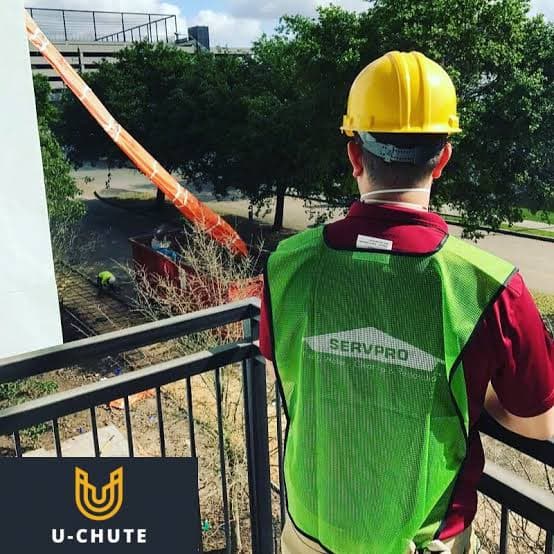
U-Chute manufactures reusable polymer-fabric trash chutes in four sizes — 10 ft lite-duty, 10 ft heavy-duty, 25 ft heavy-duty, and 50 ft heavy-duty — that stack to match any drop height. Because they're reusable, they don't add to your disposal problem after the project wraps. And because they're lightweight, they're practical for crews of any size to set up quickly.
Chute Placement That Supports Separation
- Position the chute exit directly over the target container for the material being loaded at that time.
- For multi-material projects, consider repositioning the chute exit between container changes rather than mixing everything into one bin.
- Use the chute for high-volume, uniform streams first — roofing tear-off, concrete chunks, drywall board — to keep those loads clean.
If you're working on a roofing project specifically, the guide on trash chutes for roofing contractors goes deeper on placement and load capacity for shingle tear-offs.
Safety Benefits That Tie Into OSHA Requirements
Moving debris manually from elevation carries real injury risk. The OSHA ergonomics program identifies repetitive lifting and carrying as a leading cause of musculoskeletal injuries on construction sites. A chute system reduces those lifts significantly — fewer carries per worker, fewer strain injuries, fewer OSHA incidents on your project record.
That's not just a safety win. It's a liability win and a productivity win simultaneously.
Understanding Tipping Fees and How to Negotiate Them
Tipping fees — what a facility charges per ton to accept your material — vary widely. A clean concrete load might cost nothing or even generate revenue. A mixed, contaminated load can run $80-$150 per ton or more at a standard C&D landfill, depending on your region and current market conditions.
How to Reduce Your Effective Tipping Cost
- Separate clean concrete: Move it to a concrete-specific recycler, often at no charge.
- Pull metal before weighing: Scrap metal removed before the scale reduces your billable ton count and can be sold separately.
- Negotiate volume agreements: If you work multiple projects in an area, a volume commitment to a single recycler often gets you a better per-ton rate.
- Avoid contaminated loads: A single trash bag of food waste or a bucket of paint in a drywall load can get the whole thing downgraded to general waste — at landfill rates.
- Ask about clean wood: Some biomass energy facilities accept clean dimensional lumber at no cost or low cost, as it has fuel value.
Recycling by Project Type: What to Prioritize
Not every project has the same debris profile. Here's a quick breakdown of what to focus on by project type.
Residential Renovation
- High volume: drywall, lumber, carpet, windows, doors, fixtures.
- Best diversion moves: donate salvageable fixtures to a Habitat for Humanity ReStore; take drywall to a gypsum recycler; sell copper pipe and wire to scrap.
- Watch for: lead paint in pre-1978 homes — changes your handling requirements significantly.
Roofing Tear-Off
- High volume: asphalt shingles, felt underlayment, flashing, nails.
- Best diversion moves: find a shingle-specific recycler (many exist in the mid-Atlantic and Southeast); separate metal flashing for scrap.
- Watch for: older roofs may contain asbestos-containing felt — test before tear-off.
Commercial Demolition
- High volume: concrete, steel, aluminum, glass, roofing membrane.
- Best diversion moves: concrete crushing on-site and use as base material; steel and aluminum for scrap; TPO/EPDM roofing membrane has specific recyclers.
- Watch for: PCBs in older caulks and sealants in buildings constructed before 1980.
Junk Removal and Cleanouts
- High volume: mixed household goods, appliances, furniture, general debris.
- Best diversion moves: pre-sort at pickup; take electronics to an e-waste facility; donate functional furniture.
- Watch for: mixed loads are hard to divert — the economic case depends on taking time to sort.
For more on how debris container rental fits into these workflows, the guide on construction debris container rental covers the contractor's decision between owned equipment and rented bins.
Common Mistakes Contractors Make With Debris Recycling
Even crews with good intentions end up at the landfill more than necessary. Here are the mistakes that kill recycling diversion rates on job sites — and how to avoid them.
Mistake 1: Waiting Until the End to Sort
End-of-project sorting is the least efficient approach. By that point, everything is intermixed, materials have been rained on or contaminated, and the crew is focused on wrapping up — not careful separation. Build sorting into the workflow from day one.
Mistake 2: Using Only One Dumpster
A single dumpster is a recycling dead end. It makes financial sense for small residential work, but for anything larger, the savings from material separation usually justify the additional container cost. Run the numbers before defaulting to one bin.
Mistake 3: Not Calling Ahead to the Recycler
Recycling facilities have gatekeepers. Show up with a load they don't accept, or in a configuration they can't process, and you've wasted a truck run. Always call ahead, confirm accepted materials, and ask about any load preparation requirements (minimum particle size for concrete, banding requirements for steel, etc.).
Mistake 4: Ignoring the Chute-to-Container Connection
Setting up a great sorting system on the ground level and then letting crews throw mixed debris down a single chute undoes all of it. The chute and the container strategy have to work together. Read the guidance on preventing debris spillage on multi-story buildings for setup details that keep your sorted loads clean from floor to container.
Mistake 5: Skipping the Material Assessment Before Demolition
Walking the site before a swing is taken and cataloging what's there — materials, volumes, potential hazardous content — takes a couple of hours but saves days of reactive problem-solving. A pre-demolition audit is the foundation of any real diversion plan.
How Reusable Equipment Reduces Your Own Waste Footprint
There's an irony in debris management that contractors don't often acknowledge: the equipment used to manage waste can itself become waste. Single-use plastic chutes, disposable tarps, and low-quality containers that get discarded after one project all add to the disposal burden.
Choosing reusable equipment closes that loop. U-Chute's polymer-fabric chutes are built to handle repeated use across many projects. When the job is done, you roll them up and store them — they don't go in the dumpster. That's consistent with the broader ethic of a recycling-focused operation, and it's one fewer line item on your waste disposal invoice.
It also aligns with what the SBA recommends for small business operations: reducing ongoing overhead costs by investing in durable, multi-use tools rather than disposable consumables.
To explore the full range of chute options available for your project size, visit the U-Chute product and services page.
Local Availability Across the U.S.: Chutes Ship Free Everywhere
One common barrier contractors cite when switching to a better debris management system is logistics — finding equipment that actually ships to their location at a reasonable cost. U-Chute ships free to anywhere in the United States, so whether you're managing a demolition project in a large metro or a renovation job in a smaller market, the equipment gets to you without a freight surcharge.
Contractors and crews operate in every corner of the country. U-Chute serves them all — from projects in Boulder, Colorado to Sarasota, Florida, from Manchester, New Hampshire to Bend, Oregon. The chute you need ships directly, with no middleman markup.
Building a Repeatable Recycling Protocol for Your Business
One-off recycling efforts don't move the needle on your costs or your reputation. What does move the needle is a repeatable, documented protocol that your crew can execute on every project without having to reinvent the process each time.
Your Five-Step Job Site Recycling Protocol
- Pre-project material audit: Walk the site, identify material types and volumes, flag any hazardous materials.
- Source research: Identify recycling facilities near the site for each material type. Confirm hours, accepted materials, and fees. Lock in your contacts before mobilization.
- Container and equipment setup: Order the right containers for each material stream. Set up and anchor your chute system before demo begins.
- Crew briefing: Walk every worker through the sorting system. Post signage on each container.
- Staged hauling: Don't wait for containers to overflow. Schedule hauls on a cadence that keeps materials sorted and clean — a container that gets overfull leads to tossing mixed debris on top.
Document this protocol, refine it after each project, and make it part of your standard operating procedure. Over time, your crew will execute it without prompting, and your diversion rates — and disposal savings — will compound.
If you're evaluating whether to build your own chute solution versus buying proven equipment, the analysis in the homemade construction chute: build vs. buy guide is worth reading before you commit either way.
Frequently Asked Questions
How do I find construction debris recycling near me?
Start with your county's solid waste authority website — most maintain a directory of licensed C&D processors sorted by accepted material. The EPA's recycling resource hub also links to state-level C&D diversion programs. For specific materials like concrete, call local ready-mix plants directly; for metals, search Google Maps for nearby scrap yards. Always call ahead to confirm accepted materials, current tipping fees, and any load preparation requirements before hauling.
What construction debris can actually be recycled?
Concrete, clean dimensional lumber, metals (steel, copper, aluminum), drywall, asphalt shingles, cardboard, and clean plastics are all recyclable through established C&D processors. Materials like asbestos-containing products, treated lumber, and lead paint debris require special handling and cannot go to a standard recycler. Keeping loads clean and uncontaminated is the key factor that determines whether a material qualifies for recycling or ends up at the landfill.
How does source separation reduce disposal costs?
Recyclers charge much lower tipping fees — often zero for clean concrete or scrap metal — compared to general C&D landfills, which can charge $80 to $150 or more per ton for mixed loads. By separating materials at the point of generation, you route high-volume streams to lower-cost or no-cost facilities. Pulling metal before weigh-in also reduces your billable tonnage directly. Source separation requires upfront planning but typically pays for itself in reduced hauling and disposal fees.
How does a trash chute help with recycling on a multi-story project?
A trash chute creates a controlled, consistent pathway for debris from upper floors to ground-level containers. Without a chute, crews often toss materials into whatever receptacle is closest, mixing streams that should be separated. With a chute, you direct specific materials into designated containers cleanly and efficiently. This protects the purity of your sorted loads, reduces manual carry-and-haul labor, and dramatically improves the speed of debris removal — all of which supports a higher recycling diversion rate.
Are reusable trash chutes worth the investment compared to renting or buying single-use options?
Yes, for contractors running more than a couple of projects per year. Single-use or low-quality chutes become waste themselves after one project, adding to your disposal problem. Reusable polymer-fabric chutes like those from U-Chute are designed for repeated use across many projects. Spread the purchase price across five, ten, or twenty projects and the per-use cost drops dramatically compared to renting. Free U.S. shipping further reduces the upfront cost barrier to getting started.
Do I need a permit to recycle construction debris?
For standard materials like concrete, wood, and metal, no permit is required for the contractor generating the debris — you simply transport it to a licensed facility. The facility holds the processing permits. However, if your project generates regulated materials such as asbestos, lead paint debris, or CCA-treated wood, you will need to work with licensed abatement contractors and follow specific manifesting requirements under federal and state regulations. When in doubt, contact your state environmental agency before hauling.
What is the biggest obstacle to recycling construction debris on a job site?
Contamination is the top obstacle. A clean load of drywall has recycling value; a load of drywall mixed with food wrappers, shingle scraps, and paint cans does not. The root cause is usually a lack of on-site systems — not enough separate containers, no crew briefing, and no controlled way to move debris from upper floors to sorted containers below. Fixing those systems, including using a proper chute and labeling containers by material, eliminates most contamination problems before they start.
Ready to Clean Up Your Job Site Debris Strategy?
Recycling construction debris near you is entirely achievable with the right prep, the right contacts, and the right equipment. The savings are real, the environmental impact is measurable, and the operational improvements compound over every project.
Start with the equipment that makes it possible. U-Chute's reusable polymer-fabric chutes ship free across the United States and are ready to go to work on your next project. Choose your size, order online, and have your chute on site before the first day of demo.
Browse U-Chute's debris chute systems to find the right size for your project — or visit the FAQ page if you have questions before you buy. If you'd like to talk through your specific job site setup, reach out through the contact page and we'll help you figure out the right configuration.
Quality construction debris management without compromise — that's what U-Chute delivers, job after job.