
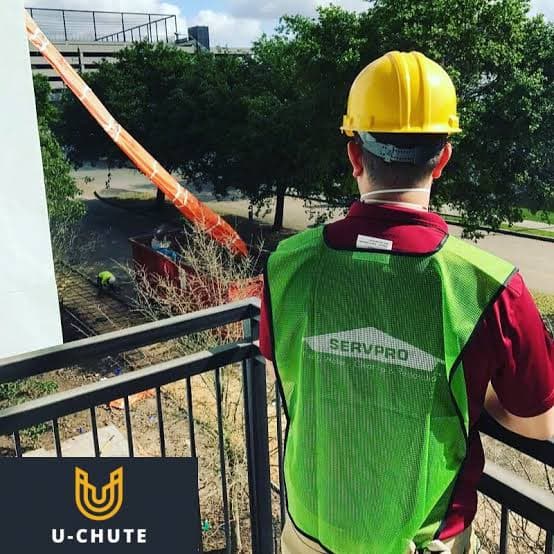
Every contractor who has ever stared down a three-story pile of demo debris has had the same thought: I could just build something. A homemade construction chute sounds appealing — raw materials are sitting right there on the job site, and YouTube makes almost everything look simple. But before you grab a sheet of plywood and a staple gun, there are some hard realities worth working through.
This guide breaks down what a homemade construction chute actually involves, where DIY builds fail, what OSHA and site safety require, and when purchasing a purpose-built reusable chute system is the smarter financial and operational move. If you are going to build one anyway, you will find a practical framework here too.
What Is a Homemade Construction Chute, Exactly?
A homemade construction chute is any field-fabricated debris channel that workers build on-site using materials not specifically engineered for the purpose — most commonly plywood, PVC pipe, corrugated roofing panels, old scaffolding boards, or even tarps duct-taped into a tube shape. The goal is the same as a commercial debris chute: guide broken drywall, roofing shingles, concrete rubble, and general demolition waste from an upper floor directly into a dumpster or collection area below.
The appeal is obvious. If you have scrap lumber on-site and a job that only lasts two days, spending money on equipment can feel wasteful. But a homemade solution introduces variables that a manufactured chute simply does not have.
Common DIY Materials Used in Field Builds
- Plywood panels — cheap, available, but heavy and prone to splintering under impact debris
- PVC or ABS pipe — works for small-diameter waste but clogs instantly with irregular debris
- Corrugated metal roofing — sharp edges create serious laceration hazards
- Tarps and rope — no rigidity, tears under load, shifts during use
- Old scaffolding planks — unpredictable load ratings, rot risk, splinter hazard
The Real Cost of Building a Construction Chute From Scratch
The first instinct is that a homemade chute is free because you are using leftover materials. That math rarely holds up once you account for all the inputs.
Consider a basic three-section plywood chute designed to drop debris two stories. You need exterior-grade plywood, hinges or brackets, lag bolts, rope or chain for suspension, and time — probably two to four hours of a skilled worker's time to build, brace, and rig the thing safely. At current labor rates for an experienced carpenter or demo worker, that build time alone can exceed what a purpose-built 25 ft heavy-duty chute costs to simply order and ship to your site.
Hidden Costs That DIY Builders Overlook
- Labor to build and tear down — every hour spent fabricating is an hour not spent on billable work
- Material cost — pressure-treated plywood is not cheap; neither are the fasteners and brackets needed to make a chute structurally sound
- Single-use waste — most homemade chutes are thrown in the dumpster at job end, adding to your disposal cost
- Liability exposure — if the chute fails and injures a worker or bystander, you own that risk entirely
- Lost time on future jobs — you build a new one every time, whereas a reusable system ships to the next site
When you add it all up, the supposed savings of a homemade construction chute frequently disappear — and that is before anything goes wrong.
OSHA Requirements and Safety Standards for Debris Chutes
This is where the DIY conversation gets serious. OSHA's ergonomics and worksite safety standards place explicit requirements on how debris is managed on multi-story construction and demolition sites. OSHA 29 CFR 1926.252 specifically governs waste disposal on construction sites and covers debris chutes.
Key points from that standard that directly affect any chute — homemade or manufactured:
- Chutes must be enclosed and capable of withstanding the impact of debris being loaded into them
- The discharge end of the chute must have a gate or bumper to control debris as it exits into a container
- The area below the chute discharge must be barricaded to protect workers from falling material
- Chutes must be positioned so that the top of each section overlaps the lower section by at least six inches
Where Homemade Builds Commonly Fail Inspection
Open-sided plywood ramps and tarp funnels — the two most common improvised designs — almost never satisfy the enclosure requirement. An open channel lets debris scatter, creating projectile hazards at every floor level it passes. OSHA inspectors cite this regularly, and fines for debris management violations can reach into the thousands of dollars per citation.
Who Bears the Liability?
If a homemade chute fails and debris falls outside the controlled drop zone, the contractor bears full liability. There is no manufacturer warranty to fall back on, no load-rating documentation to present to an inspector, and no engineering certification to demonstrate due diligence. That exposure is real, and it follows you into your insurance premiums whether or not an incident occurs.
Structural Integrity: Why Engineering Matters More Than You Think
A construction debris chute takes serious abuse. Concrete chunks, broken tile, bundled shingles, and ripped-out framing lumber all hit the chute walls at speed. The impact forces involved are not trivial, and the attachment points — where the chute connects to the structure — carry both the weight of the debris in transit and the dynamic load of that debris hitting bends and transitions.
Manufactured chutes are tested to handle these loads. A homemade chute built from whatever is on hand has no load rating and no test history. The first time a large concrete block takes a bad angle through a plywood joint, you find out if your build was adequate — and that is not the moment you want to learn the answer.
Suspension and Attachment Points
One of the most dangerous failure modes in a homemade construction chute is at the attachment point to the building. Lag bolts into window frames, ropes tied around railings, and chains looped over scaffold pipe are all improvised solutions that can fail under dynamic load. A sudden failure at height can drop the entire chute assembly — and anything in transit through it — onto workers or bystanders below.
Comparing Homemade vs. Purpose-Built Reusable Chute Systems
To make an honest comparison, here is a side-by-side look at what each option actually delivers across the factors that matter most on a job site.
- Setup time: Homemade — 2 to 4 hours per build; Manufactured — 30 to 60 minutes to stack and hang sections
- Load rating: Homemade — unknown, unverified; Manufactured — tested to rated capacity
- OSHA compliance: Homemade — often non-compliant with enclosure and overlap rules; Manufactured — designed to meet code
- Reusability: Homemade — typically single-use; Manufactured — reusable across dozens of jobs
- Weight: Homemade plywood sections are extremely heavy to maneuver at height; Polymer-fabric sections are lightweight and easy to position
- Storage and transport: Homemade chutes are bulky and awkward; Manufactured sections stack compactly in a truck
- Disposal cost: Homemade adds to your dumpster load; Manufactured goes back in the truck
- Liability: Homemade carries full contractor liability; Manufactured transfers product liability to the manufacturer
The comparison is stark once every factor is on the table. See the full line of debris chute systems to understand what a purpose-built option looks like in practice.
Who Actually Uses Homemade Construction Chutes — and Why
It is worth being honest: some contractors build their own chutes and get the job done without incident. The conditions where a homemade approach is most defensible are narrow but real.
Situations Where DIY Might Be Acceptable
- Single-story applications — a simple debris slide from a low roof to a ground-level dumpster carries much lower risk than a multi-story drop
- Very short-duration jobs — a half-day demo where the chute is in use for less than an hour and can be directly supervised the entire time
- Low-volume, light debris — loose insulation or cardboard going into a container a few feet below the work area
Situations Where You Should Not Improvise
- Any drop height of two stories or more
- Heavy debris: concrete, brick, tile, roofing material, or structural lumber
- Sites with workers or public access below the drop zone
- Jobs where an OSHA inspection is realistic — commercial sites, permitted residential renovations, public-facing projects
- Any situation where your general liability or workers compensation carrier would view an improvised structure as a coverage risk

The Weight Problem: Plywood Chutes vs. Polymer-Fabric Sections
One underappreciated problem with homemade construction chutes is the weight of the materials used to build them. A 4 ft by 8 ft sheet of three-quarter-inch exterior plywood weighs around 60 pounds. A single section of a homemade chute built from two such sheets runs to 120 pounds before you add brackets, fasteners, or bracing.
Positioning that at height — leaning out a window, over a parapet wall, or from a scaffold — is a significant ergonomic and injury risk. OSHA's ergonomics guidance emphasizes reducing awkward postures and heavy loads precisely because overhead and elevated work with heavy materials drives a disproportionate share of construction injuries.
Lightweight polymer-fabric chute sections address this problem directly. A single section weighs a fraction of what an equivalent plywood panel would, making it safe for one person to position and hang without a crane or a second crew member just to hold the piece in place.
Reusability and the Real Economics Over Multiple Jobs
The economics of a construction chute shift dramatically when you look across multiple jobs rather than just one. A homemade chute costs time and materials on every project. A manufactured chute is a one-time purchase that amortizes across every job it supports for its service life.
Consider a roofing crew that runs three to five jobs per week during peak season. If they build or improvise a debris slide on every job, they are spending two to four hours of labor on that task weekly. Over a 30-week season, that is 60 to 120 hours of productive labor consumed by fabricating disposable debris management. A purpose-built system eliminates that waste entirely.
Junk removal companies face a similar calculation. If you are running multiple residential cleanouts per day, the ability to quickly deploy, use, and re-stow a lightweight chute system is a direct competitive advantage. The complete guide to debris chutes for junk removal companies goes deeper on this specific use case.
Environmental Considerations: Waste From Disposable Builds
There is an environmental dimension to the homemade chute discussion that does not come up often enough. EPA data on construction and demolition waste consistently shows that C&D debris is one of the largest waste streams in the United States — and fabricated structures thrown away after a single use contribute to that volume.
When you build a plywood chute and toss it in the dumpster at job end, you are adding treated lumber, fasteners, and potentially chemical-coated materials to the waste stream. A reusable polymer-fabric chute system eliminates that cycle entirely. The EPA's recycling and waste reduction guidance is clear that the most effective environmental strategy is not recycling end-of-life materials — it is not generating the waste in the first place.
Reusable construction equipment, including debris chutes, fits squarely within that framework. It is a small operational choice that has a measurable impact over the life of a business.
What to Look for in a Purpose-Built Replacement
If you are researching homemade construction chutes because you need something functional and affordable, it is worth understanding what separates a good manufactured chute from a mediocre one — because the category is not all equal.
Key Specifications to Evaluate
- Material: Polymer-fabric construction balances durability with light weight — heavy enough to handle impact debris, light enough to maneuver at elevation
- Section length: Shorter sections (10 ft) are easier to manage on small jobs; longer systems (25 ft and 50 ft) reduce the number of connection points and are better suited to multi-story work
- Stackability: Sections should connect securely with positive overlap — not just sit one inside the other loosely
- Duty rating: Lite-duty versus heavy-duty matters. Roofing shingles and concrete require a heavy-duty rating; light insulation or cardboard can tolerate a lite-duty system
- Shipping: Free shipping matters for contractors buying online — a heavy chute system with freight charges can erode the cost advantage quickly
Matching Size to Job Type
U-Chute's four-size lineup — 10 ft lite-duty, 10 ft heavy-duty, 25 ft heavy-duty, and 50 ft heavy-duty — covers the full range of residential and commercial applications. A single-story residential reroof needs something very different from a five-story commercial demolition. The full product range gives you a clear path to matching the system to the work. And if you are unsure which size fits your project, the FAQ page walks through common sizing scenarios.
When Roofers, Demo Contractors, and Junk Haulers Make the Switch
The contractors who most consistently move away from improvised debris management fall into predictable categories. Roofers doing multiple tear-offs per week find that a consistent, deployable chute system cuts their setup time and keeps shingles out of landscaping and off vehicles parked below the work zone. The complete guide for roofing contractors covers this transition in detail.
Demolition crews on commercial sites face more scrutiny from general contractors and site supervisors, and a manufactured chute presents a more professional appearance and more defensible safety posture during inspections. Junk removal operators running residential cleanouts value the speed — pop a chute in a window, toss debris down, collapse and stow in under five minutes.
In each case, the motivation is similar: a homemade construction chute solved an immediate problem once, but a reusable system solves it better on every subsequent job.
Where to Buy Construction Debris Chutes Online
One reason contractors search for homemade construction chute options is frustration with availability. Big-box home improvement stores rarely stock debris chutes — if you have been down that road, the guide on debris chutes at Home Depot and what to know before you buy covers exactly what you will find there and what you will not.
Buying directly from a manufacturer online resolves the availability problem. U-Chute ships free to all U.S. addresses, so a contractor in Boulder, Colorado and one in Sarasota, Florida pay the same and receive the same system. Ordering is straightforward: choose the size that matches your project height and debris type, complete the purchase, and the chute ships to your location.
For contractors managing larger or ongoing debris removal needs, the guide on construction debris removal and container rental options can help round out the full site logistics picture.
Frequently Asked Questions
Is building a homemade construction chute legal?
It is not explicitly illegal to build your own debris chute, but any chute used on a construction or demolition site must comply with OSHA 29 CFR 1926.252, which governs debris disposal on job sites. That standard requires enclosed chutes with controlled discharge, defined overlap between sections, and barricaded drop zones. Most improvised builds do not meet these requirements, exposing contractors to OSHA citations and fines. Beyond the regulatory question, liability for any failure rests entirely with the contractor who built the improvised structure.
What materials work best for a DIY debris chute?
If you must build one for a low-risk, single-story application, smooth-surface plywood with closed joints and secure suspension points is the most practical choice. Avoid corrugated metal (sharp edges), plastic tarps (no rigidity under load), and salvaged pipe (clogs with irregular debris). Whatever material you use, every section must overlap the next by at least six inches, and the attachment points to the building must be rated for the dynamic loads the debris will impose. Even in low-risk applications, purpose-built systems are safer and faster to deploy.
How much does a homemade construction chute cost compared to a manufactured one?
When you account for the labor to build and tear down the chute, the cost of materials, and the fact that it is single-use, a homemade chute often costs more than a manufactured reusable system over the course of a season. A plywood chute for a two-story job can consume three to four hours of skilled labor plus materials. A purpose-built polymer-fabric chute system is a one-time purchase that deploys in under an hour and returns to service on the next job without any rebuild cost.
Can I use a homemade chute for roofing tear-offs?
Roofing debris — particularly asphalt shingles — is dense and heavy enough to damage improvised chutes quickly. Shingles bundled together hit the chute walls with significant force, and the nails and grit in roofing material will tear through tarps and weaken plywood joints rapidly. For roofing applications, a heavy-duty rated polymer-fabric chute is a much safer and more durable choice. It also protects landscaping, vehicles, and workers below the drop zone more reliably than an open-sided improvised slide.
What size debris chute do I actually need?
Match the chute length to the vertical drop from the highest work point to the top of your dumpster or collection area. A 10 ft system handles single-story applications. A 25 ft system covers most two- and three-story residential work. A 50 ft system is appropriate for commercial buildings of four to six stories. Always size to the actual drop height — a chute that is too short creates a gap at the bottom where debris can scatter, which eliminates most of the safety benefit of using a chute in the first place.
Are reusable construction chutes worth the investment for small contractors?
Yes, particularly for contractors running more than a handful of jobs per season. The labor savings from not building an improvised system on every job are significant. Beyond labor, a reusable chute reduces your waste footprint, presents a more professional appearance on site, and provides a defensible safety posture if an OSHA inspector arrives. For small operations where every hour of productive work time matters, eliminating the need to fabricate and dispose of a debris channel on each project has a measurable bottom-line impact.
Where can I order a construction debris chute with free shipping?
U-Chute sells four sizes of reusable polymer-fabric debris chutes directly online and ships free throughout the United States. The 10 ft lite-duty and 10 ft heavy-duty options cover single-story applications, while the 25 ft and 50 ft heavy-duty systems handle multi-story residential and commercial work. Orders go directly through the website, and the chutes ship to your location — whether you are based in a major metro or a smaller market. No freight surcharges, no minimum order volume required.
Ready to Replace Your Improvised Chute With a System That Works Every Time?
A homemade construction chute might get you through one job, but it costs you time, creates liability, and gets thrown in the dumpster at the end. A purpose-built reusable system does the same job faster, safer, and on every project after the first.
U-Chute's four-size lineup ships free across the United States. Choose the system that matches your drop height and debris type, order online, and have it on your next job site. Contact U-Chute with any questions about which size is right for your work, or head to the debris chute product page to see the full lineup and place your order today.