

At 1,396 feet tall, 432 Park Avenue is one of the most dramatic residential towers ever built. Its slender silhouette has become a fixture of the Manhattan skyline — and a fixture of conversations about what it actually takes to manage construction debris, renovation waste, and ongoing building maintenance at extreme heights. When contractors, roofers, and junk removal crews ask about a 432 Park Avenue trash chute, they're really asking a bigger question: how do you safely and efficiently move debris down from a supertall building without putting workers or pedestrians at risk?
This guide breaks down how trash chute systems function in high-rise environments, what makes supertall towers like 432 Park Avenue uniquely challenging, and how the right reusable debris chute can make the difference between a smooth operation and a costly, dangerous mess.
Why 432 Park Avenue Represents the Extreme End of Debris Management
432 Park Avenue was developed by CIM Group and Macklowe Properties and completed in 2015. Standing at 96 stories, it held the title of tallest residential building in the Western Hemisphere for several years. It's a building defined by superlatives — and those superlatives extend to the complexity of any interior demolition, renovation, or debris-removal project inside its walls.
When you're working in a building that tall, standard debris-removal assumptions go out the window. You can't just haul material down a stairwell by hand. You can't toss it off a balcony. Every piece of waste has to travel a carefully managed path from the work floor to a dumpster or collection point at street level — and that path needs to be safe, contained, and efficient.
The Physics of Dropping Debris from Extreme Heights
The taller the drop, the faster debris accelerates — and the more dangerous any uncontrolled waste becomes. A chunk of drywall dropped freely from even the 10th floor can reach speeds that cause serious injury or property damage. At the 50th or 60th floor, the physics become genuinely dangerous. A properly rated debris chute is the only responsible answer, because it controls descent speed through friction and angle, keeping material contained from the work level all the way to the dumpster below.
OSHA's ergonomics and worker safety guidelines emphasize that safe material handling — including proper chute and loading equipment — is a core element of protecting crews on construction and renovation sites. At supertall buildings, that guidance isn't optional; it's essential.
How a Construction Trash Chute Actually Works in a High-Rise Setting
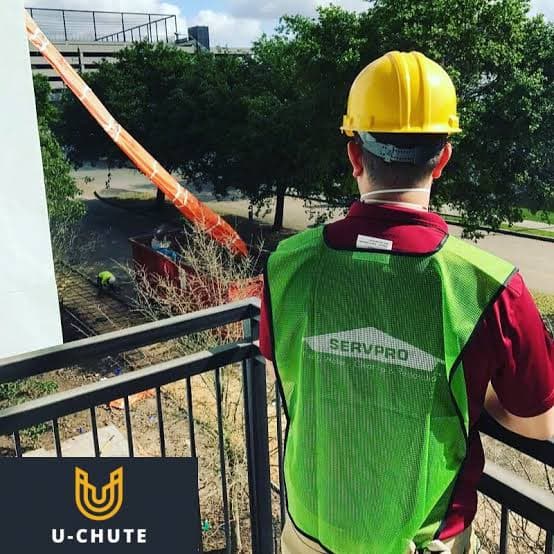
A debris chute system for construction sites is a series of interlocking sections that hang from an upper floor window, scaffold, or parapet and channel debris in a controlled downward path. Each section connects to the next, extending the chute as far as the drop requires. At the bottom, a contained chute mouth directs material into a dumpster, reducing dust, scatter, and worker exposure.
- Sections stack to match the drop height — a 25-foot heavy-duty chute handles mid-rise work; a 50-foot heavy-duty system extends to serious heights when stacked in multiples.
- Lightweight polymer-fabric construction means sections are easy for a small crew to handle, hang, and reposition without heavy equipment.
- Reusable design means the same chute ships back to storage after the job — it doesn't get thrown away with the debris it carried.
Section-by-Section Assembly for Multi-Story Drops
One of the most common misunderstandings about debris chutes is that you need one continuous piece for a tall building. In reality, chutes are assembled section by section — each piece connects to the next using integrated attachment points. For a job at a building like 432 Park Avenue, crews would stack multiple 25-foot or 50-foot sections to reach the required drop length, anchoring the system at the top and securing it at intermediate points along the building facade for stability.
This modular approach is exactly what makes reusable chute systems practical. You configure the system to match the job rather than purchasing or renting a fixed-length product that may not fit your exact drop height.
The Four Sizes That Cover Most High-Rise Scenarios
U-Chute manufactures four sizes of reusable polymer-fabric trash chutes, and understanding which size fits which scenario is essential for efficient debris management — whether you're renovating a condo on the 20th floor of 432 Park Avenue or doing roofing work on a 10-story commercial building.
- 10 ft Lite-Duty — Best for low-height residential work, interior demo on lower floors, and jobs where material volume is modest.
- 10 ft Heavy-Duty — The workhorse for single-story and low-rise exterior work, including roofing tear-offs and window replacements.
- 25 ft Heavy-Duty — Covers mid-rise scenarios and serves as a stacking section for taller buildings. Handles heavy demolition debris with confidence.
- 50 ft Heavy-Duty — The go-to for serious drop heights. Stack multiple sections to reach the floor you're working on in a high-rise environment.
All four sizes ship free anywhere in the United States. You order online, the chute arrives ready to work, and you're not paying freight surcharges that eat into your project margin.
What Makes Supertall Tower Renovations Different from Standard Jobs
Working inside a building like 432 Park Avenue isn't the same as renovating a three-flat in Chicago or a mid-rise office building in Dallas. Supertall towers present a cluster of challenges that every contractor on the job needs to plan around before the first section of drywall comes down.
Wind Loads at Elevation
432 Park Avenue is famously slender — its width-to-height ratio is extraordinary even by supertall standards. At upper floors, wind loads are significant. Any debris chute hung on the exterior of a building at that height must be properly anchored and periodically inspected throughout the job. Sections need to be secured at multiple points, not just at the top, to prevent swaying that could damage the chute, the building facade, or nearby equipment.
Building Management and Access Coordination
Luxury residential towers maintain strict control over their common areas, loading docks, and exterior facades. Any debris removal operation at a building like 432 Park Avenue requires close coordination with building management — scheduling dumpster placement, confirming facade attachment methods, and sequencing work around resident access hours. The more efficient your chute system, the less time you spend occupying premium dock space and high-traffic lobby areas.
Dust and Debris Containment
At buildings with high-end finishes and demanding ownership groups, loose debris scatter is simply not acceptable. A properly installed debris chute contains material from the work floor to the dumpster, dramatically reducing airborne particulate and scatter compared to manual carry-out or uncontained drops. This matters for responsible waste management and for maintaining the trust of building management on future projects.
Reusable vs. Single-Use Chutes: The Case for Polymer Fabric at Scale
Contractors working on high-profile jobs like 432 Park Avenue renovations often face pressure to cut costs while maintaining quality. Single-use or low-grade debris chutes seem like a bargain until they tear mid-job, leaving you scrambling for a replacement and potentially exposing workers or pedestrians to uncontrolled falling material.
Reusable polymer-fabric chutes solve both problems. The material is engineered for the stress of heavy debris — drywall, concrete chunks, roofing material, insulation — and it comes back off the job in condition to be used again. For environmental and cost reasons, reusable systems have become the preferred approach for contractors who run multiple jobs per year.
Total Cost Across Multiple Jobs
Consider a demolition contractor who runs 15 renovation jobs per year in a dense urban market like New York City. A single-use chute solution means 15 purchases, 15 disposal cycles, and 15 opportunities for a mid-job failure. A reusable U-Chute system purchased once covers all 15 jobs — with the initial investment recovered quickly and every subsequent job running at dramatically lower materials cost.
This is why the economics of debris chute pricing so often favor reusable systems for active contractors. The per-job cost drops sharply once you amortize the purchase price across a full season's worth of work.
Who Actually Uses Debris Chutes at High-Rise Buildings Like 432 Park Avenue
It's worth being specific about the trades and businesses most likely to need a debris chute solution at a supertall tower — because the application shapes the size and configuration you need.
- Interior demolition contractors — Gut renovations of individual units, particularly in aging luxury towers where owners are updating kitchens, baths, and mechanical systems.
- Junk removal companies — High-net-worth residents moving out or clearing storage spaces often generate significant volume that needs fast, contained removal.
- Mechanical and plumbing contractors — Pipe replacement, HVAC upgrades, and electrical work all generate debris that can't simply walk down a service elevator all day.
- Restoration and disaster cleanup crews — Water damage, fire damage, and similar events require rapid debris removal across multiple floors. See our guide on debris chutes for disaster cleanup and emergency removal.
- Roofing contractors — Even in a supertall residential tower, roof-level maintenance and repair generates significant material that needs to come down safely.
OSHA Compliance and Worker Safety at Extreme Heights
Federal safety standards don't get more flexible as buildings get taller — if anything, enforcement attention increases on high-profile job sites in major markets. Using a properly rated debris chute is a direct compliance tool, not just a convenience.
Keeping Workers Off Ladders with Heavy Loads
One of the most dangerous behaviors on demolition job sites is workers manually carrying heavy debris down ladders or staircases. Fatigue compounds with height, and a single misstep on a staircase carrying a heavy load can cause a serious injury or death. A debris chute eliminates the need for most manual carry-out by allowing workers to load the chute at the work level and let gravity do the descent. This directly addresses the manual handling risks that OSHA ergonomics standards are designed to prevent.
Pedestrian and Resident Protection
In a dense urban environment like Midtown Manhattan, the sidewalk below an active work site is a pedestrian corridor. Debris chutes aren't optional in that context — they're the mechanism that keeps falling material from becoming a street-level hazard. Building management at properties like 432 Park Avenue will typically require documented debris containment protocols before allowing exterior work to begin.
Our trash chute safety compliance checklist for New York covers the documentation, inspection, and signage requirements that contractors working in New York City should have in hand before the job starts.
Sizing Your Chute System for the Actual Drop Height
One of the most practical questions contractors ask is: how do I figure out how much chute I actually need? The answer starts with the drop height — the vertical distance from the work floor to the dumpster at street or ground level.
- Measure the floor-to-ground distance — Use the building's architectural drawings or confirm with the building superintendent. For a building like 432 Park Avenue, floors are approximately 14 feet tall at standard residential floors, with mechanical floors taller.
- Add clearance for the dumpster mouth — The chute needs to extend far enough to direct material into the dumpster opening, not scatter it at the rim. Add 3 to 5 feet to your base drop measurement.
- Stack sections to reach the total — Multiple 25-foot or 50-foot heavy-duty sections connect in series to cover the full drop. For a 20th-floor unit at 432 Park Avenue, you're looking at roughly 280 feet of drop — requiring a stacked configuration of multiple 50-foot sections.
If you're not sure which configuration fits your specific job, the U-Chute FAQ page covers common sizing scenarios, and the contact page connects you directly with the team for project-specific guidance.
Environmental Considerations for High-Rise Debris Removal
Responsible debris management isn't just about keeping a clean job site — it's increasingly a business expectation, particularly in markets like New York City where sustainability requirements are actively enforced. The EPA's materials and recycling data consistently shows that construction and demolition debris is one of the largest waste streams in the United States, and municipal regulations in major cities are pushing contractors toward documented diversion and recycling programs.
A well-run debris chute operation supports better waste sorting at the bottom. When material comes down in a controlled, contained flow, ground-level crews can more easily separate recyclable material — metal, concrete, clean wood — from true landfill waste. That sorting capability is harder to achieve when debris is carried down by hand and dumped haphazardly into a single container.
For contractors looking to understand where debris can go once it comes off the building, our guide on where to dump construction debris near you is a practical starting point.
Shipping, Setup, and Getting to Work Quickly
Time is money on every job site, but it's particularly acute at high-profile urban projects where daily rates for crews, equipment, and staging areas add up fast. U-Chute's direct-to-contractor model is designed to get you a working chute system without the friction of rental coordination, regional warehouse pickup, or freight surcharges.
- Order online — All four sizes are available on the site. No sales rep call required, no minimum order quantity.
- Free shipping to any US address — That includes New York City, with all the complexity of urban freight delivery.
- Lightweight sections — Polymer-fabric construction means your crew can carry sections up a service elevator without specialized equipment or multiple personnel.
- Reuse on the next job — After the job at 432 Park Avenue, the chute comes down, gets rolled or folded for storage, and is ready for the next project.
Contractors working across multiple markets can read about regional applications — including trash chutes in Boca Raton, trash chutes in Boulder, and trash chutes in Asheville — to see how the same system adapts to different project types and climates.
Common Mistakes Contractors Make on High-Rise Debris Jobs
Even experienced crews make avoidable errors when scaling up to supertall building work. Here are the most common pitfalls and how to get ahead of them.
Underestimating the Total Drop Length
Contractors frequently order a chute configured for the number of floors above ground without accounting for below-grade dumpster placement or loading dock setbacks. Always measure the actual vertical distance from the loading point to the dumpster opening — not just floor count times a rough floor height estimate.
Skipping Intermediate Anchor Points
At extreme heights, a chute anchored only at the top will sway significantly in wind, creating load instability and potential damage to the building facade or the chute itself. Secure the chute at intermediate points every 20 to 30 feet using building-approved attachment methods.
Ignoring Weight Limits per Load
Even heavy-duty chutes have design load limits per drop cycle. Training workers to load material in manageable increments — rather than dumping an entire wheelbarrow's worth simultaneously — protects both the chute and the dumpster below from impact damage.
No Spotter at the Bottom
Every active debris chute operation should have a dedicated spotter at the dumpster level whose job is to keep pedestrians and equipment clear of the drop zone. At a building like 432 Park Avenue with heavy foot traffic in the surrounding plaza, this isn't optional — it's basic site safety protocol.
Frequently Asked Questions
What size trash chute do I need for a high-rise renovation like 432 Park Avenue?
For supertall buildings, you'll need multiple heavy-duty sections stacked in series to cover the full drop height. U-Chute's 25-foot and 50-foot heavy-duty sections are designed to connect and extend to match any drop length. Start by measuring the actual vertical distance from your work floor to the dumpster opening at ground level, then stack sections to cover it. For a 20th-floor unit in a building with 14-foot floor heights, you're looking at roughly 280 feet of total drop requiring multiple 50-foot heavy-duty sections connected end to end.
Are reusable polymer-fabric trash chutes strong enough for concrete and heavy demolition debris?
Yes. U-Chute's heavy-duty polymer-fabric chutes are engineered to handle the kind of mixed demolition debris typical of interior gut renovations — drywall, tile, concrete chunks, insulation, and roofing material. The key is loading material in controlled amounts rather than dropping large bulk loads all at once. Properly used, a reusable heavy-duty chute will last through many jobs without failure, making it far more cost-effective than single-use alternatives over the course of a full project season.
Do I need special permits to use a debris chute in New York City?
Permit requirements for debris chutes in New York City depend on the scope of the job and whether the chute extends over a public sidewalk or right-of-way. Projects that require sidewalk shed permits will often also require documentation of debris containment methods. Building management at luxury towers typically has its own approval process for facade attachments. Check with the NYC Department of Buildings and your building management contact before installing any exterior chute system. Our safety compliance checklist for New York covers key documentation requirements contractors should prepare in advance.
How do I anchor a trash chute on the exterior of a supertall building safely?
The top of the chute should be secured to a structural anchor point — a scaffold rail, window frame reinforcement, or parapet bracket rated for the load. At every 20 to 30 feet down the building face, intermediate anchor points should stabilize the chute against wind movement. At buildings with strict facade access rules, like 432 Park Avenue, coordinate attachment methods with building engineering staff before installation. Never rely on a single top anchor for drops exceeding 30 feet — wind loading and debris weight combine to create lateral stress that a single anchor point cannot reliably manage.
Can a single crew handle the setup and teardown of a high-rise trash chute?
Because U-Chute sections are made from lightweight polymer fabric, a two-person crew can typically handle setup and teardown without specialized lifting equipment. Each section is light enough to carry up a service elevator and position through a window or over a parapet. For very long drops requiring many sections, a third person at the bottom to manage the chute mouth and dumpster positioning is recommended. The lightweight design is a deliberate advantage — it reduces the labor cost of setup and makes redeployment to the next job quick and straightforward.
What happens if debris gets stuck or jammed in the chute mid-drop?
Jams typically happen when oversized pieces are loaded without breaking them down first. Standard practice is to break demolition debris into sections no larger than roughly 12 inches in any dimension before feeding the chute — this keeps material moving freely and prevents buildup that can stress the chute walls. If a jam does occur, never reach into an active chute from above. Clear the blockage from the bottom using a long-handled tool, with no one positioned directly in the drop path. Training your crew on load size before the job starts is the most effective jam-prevention measure.
Is there a minimum drop height where a debris chute makes sense vs. just carrying debris manually?
As a general rule, any job where debris is traveling more than one full floor in height benefits from a chute system — both for worker safety and efficiency. Manual carry-out on stairs adds significant labor time and fatigue risk even at two or three stories. By the time you reach five stories and above, manual carry-out is not only inefficient but creates meaningful injury risk from repeated heavy lifting on stairs. OSHA ergonomics guidance supports minimizing manual load-carrying on stairs and ramps, and a debris chute is the most practical solution for any multi-floor drop.
Ready to Order the Right Trash Chute for Your High-Rise Project?
Whether you're managing a gut renovation on the 30th floor of a Midtown tower or handling a junk removal job in a dense urban high-rise, the right debris chute system makes the job safer, faster, and more cost-effective. U-Chute's reusable polymer-fabric chutes are available in four sizes, ship free to any US address, and are built to perform across dozens of jobs before you've recovered the original investment.
Visit the U-Chute debris chute systems page to browse all four sizes, or head to the FAQ page if you have sizing or application questions. When you're ready to order, the process is straightforward — choose your size, buy online, and get to work. Quality construction debris management without compromise.