

When a structure suffers sudden damage — a tornado strike, a flood, a fire, or an explosive demolition — time is never on your side. Every hour that debris sits on upper floors is an hour of blocked egress, hidden hazards, and ballooning labor costs. A construction debris chute for disaster cleanup and emergency removal is one of the most direct solutions available to crews who need to move material from height to ground level safely, quickly, and without risking additional damage to the structure or the people working in it.
This guide covers everything you need to know: why standard debris-removal methods fall short in emergency scenarios, how to select the right chute size, how to rig it safely under pressure, what regulatory obligations apply, and how reusable polymer-fabric chutes outperform disposable alternatives on multi-day emergency jobs. Whether you are a demolition contractor, a junk removal company, or a general contractor brought in after a catastrophic event, the information below will help you get the job done right.
Why Emergency Debris Removal Is Different From Routine Cleanup
Routine tenant-improvement tearouts and planned demolitions allow crews to plan equipment placement, sequence work, and schedule haul-off at a measured pace. Emergency cleanup is a different animal entirely. The building may still be structurally compromised, floor loading is uncertain, stairwells can be partially blocked, and debris composition is unpredictable — burnt timber mixed with waterlogged drywall, broken glass mixed with insulation, or storm-driven soil mixed with shingles.
These conditions create several specific problems:
- Ergonomic overload: Workers carrying heavy, irregular debris down partially damaged stairs face a sharply elevated injury risk. OSHA ergonomics guidance consistently identifies manual material handling on unstable surfaces as a leading source of musculoskeletal injuries on construction sites.
- Speed pressure: Restoration timelines, insurance deadlines, and re-occupancy requirements create pressure to move fast — sometimes faster than is safe without the right equipment.
- Unknown debris streams: You may not know the weight or bulk of what you are moving until you open a wall or ceiling cavity, so equipment has to handle a wide range of load types.
- Limited crane or dumpster access: In tight urban environments or on sites with structural instability, cranes and large dumpsters cannot always be positioned optimally.
A properly rigged debris chute directly addresses all four of these problems by creating a continuous gravity-fed pipeline from the work level to the dumpster below — no carrying, no trips, no guesswork.
How a Construction Debris Chute Works in a Disaster Context
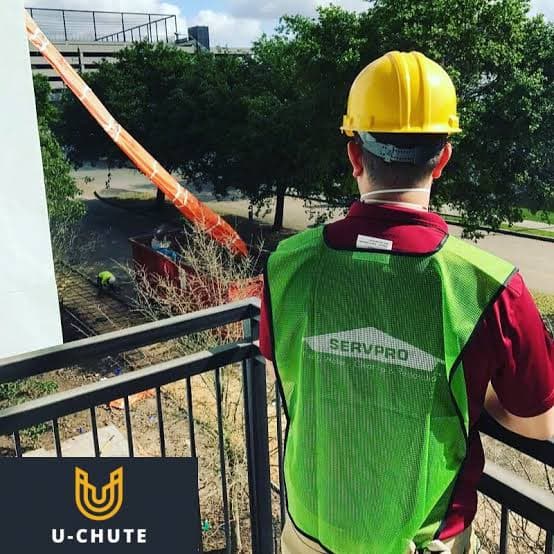
The core mechanics are simple: lightweight polymer-fabric chute sections clip or hook together and hang vertically from an upper-floor window, scaffold opening, or roof edge. Workers feed debris into the chute at the top; gravity delivers it to the dumpster or collection point at the bottom. The chute contains dust and debris scatter, protects pedestrians and workers below, and dramatically reduces the number of trips required to move material.
In a disaster-cleanup context, the chute serves an additional function: it channels unpredictable debris streams. Unlike a wheelbarrow run or a forklift, a chute will accept whatever you feed it — loose rubble, bagged insulation, broken drywall panels, torn roofing material — without requiring the material to be pre-sorted or uniformly sized. That flexibility is critical when you are working through the aftermath of a catastrophic event.
Gravity as Your Workhorse
The physics are entirely on your side. Once material enters the chute, it moves itself. Workers at the loading level are freed from carrying loads down stairs; they simply need to break debris into feedable chunks, guide it into the chute inlet, and move on to the next section of the work area. This reallocation of labor — from carrying to breaking and feeding — consistently accelerates overall project pace.
Dust and Debris Containment
Disaster debris is often laden with hazardous particulates: mold spores from flood damage, silica dust from concrete and masonry failure, asbestos from older building materials disturbed by the event. Enclosed chute sections contain these particles within the chute column rather than releasing them into the surrounding environment. This matters for neighbor relations, regulatory compliance, and crew respiratory health alike.
Choosing the Right Chute Size for Your Emergency Job
U-Chute manufactures four sizes to match different drop heights and load intensities. Picking the wrong size creates either unnecessary cost or inadequate capacity. Here is how to think through the selection for emergency scenarios:
- 10-foot lite-duty: Designed for single-story applications or roof-edge work where the drop is minimal and the debris stream is light — think shingles, light framing, or bagged soft debris. It is a practical choice for residential storm-damage cleanup when the structure is single-story and debris is relatively uniform.
- 10-foot heavy-duty: Same drop range, significantly heavier construction. Best for single-story commercial tearouts, ground-floor slab removal, or any low-drop application where debris weight or abrasiveness is a concern.
- 25-foot heavy-duty: The go-to for two- to three-story structures. This covers the majority of residential and low-rise commercial emergency jobs — tornado-damaged apartment buildings, flood-gutted two-story homes, fire-damaged small commercial properties.
- 50-foot heavy-duty: Built for mid-rise and high-rise applications. If you are clearing a five-story flood-damaged office building or a tornado-struck warehouse complex, this is the configuration you need. See the 50ft heavy-duty construction chute specifications for detailed load and dimension data.
When in doubt about drop height, measure the distance from the highest intended feed point to the top of your dumpster or collection container — not to the ground. That is the actual working drop, and it is the number that determines which chute length you need. The guide to choosing construction debris chute size by project type walks through this calculation in detail for a range of scenarios.
Stacking Sections for Exact Drop Height
U-Chute sections are designed to stack, so you are not locked into a fixed drop length. If you need 35 feet of drop, you combine sections to reach that height. This modularity is especially valuable in emergency work, where you may not know the exact working height until you are on site — or where the working level may change as the job progresses.
Rigging a Debris Chute Safely on a Compromised Structure
Standard rigging protocols are designed around intact, load-rated anchor points. In a disaster scenario, you may be working with a structure whose anchor points have unknown or degraded load capacity. That demands a more careful approach.
Pre-Rig Structural Assessment
Before hanging any chute hardware, a qualified person — ideally a licensed structural engineer or an experienced superintendent with documented knowledge of post-event structural assessment — should evaluate the proposed anchor point. Key questions include:
- Has the anchor element (window frame, floor joist, roof edge member) been visually inspected for fire, water, or impact damage?
- Is the anchor point rated to handle the combined static weight of the loaded chute plus any dynamic loading from large debris pieces?
- Is there a secondary anchor point available if the primary shows signs of distress during the job?
These questions should be answered before the first chute section goes up — not after. Review the construction chute safety regulations overview for a fuller picture of the documentation and planning requirements that apply on regulated job sites.
Establishing the Drop Route
Before installing any section, walk the drop route from the work level to the collection point below. Identify any obstructions — protruding rebar, damaged windowsills, damaged facade elements — that could deflect or damage the chute. Clear these before hanging. Mark the exclusion zone on the ground below with cones, barricades, or warning tape before any debris begins moving.
Securing the Base
The lowest section of the chute should terminate inside or directly over the dumpster opening, not hovering above it at an angle. A chute that discharges at an angle will scatter material and can whip under load. If the dumpster cannot be positioned directly beneath the chute outlet, use a simple funnel or skirt made from poly sheeting to capture the discharge and direct it into the container.
Debris Types Commonly Encountered in Disaster Cleanup
Understanding what you will be moving helps you assess chute wear, plan for blockages, and sequence the work intelligently. Emergency debris streams tend to fall into a few categories:
- Flood-damaged materials: Waterlogged drywall, saturated insulation, swollen wood framing, and mold-contaminated materials. These are heavy per cubic foot and often come apart during handling. Feed in manageable sections rather than whole panels.
- Fire-damaged materials: Charred lumber, melted plastics, brittle masonry, and collapsed roofing. Fire debris often includes unpredictable sharp edges from collapsed structural elements. Heavy-duty chute construction handles this well.
- Wind and impact damage: Shingles, broken glass, splintered lumber, insulation batts, and displaced rooftop equipment. Debris sizes vary widely; break large pieces before feeding to avoid chute jams.
- Seismic or structural collapse debris: Concrete rubble, rebar, CMU blocks, and mixed finish materials. This is the heaviest category. For anything involving concrete or masonry, use only heavy-duty chute configurations and avoid feeding individual pieces larger than what comfortably fits through the chute inlet.
For more context on how chutes serve different industries including demolition and junk removal, the debris chute systems overview covers a wide range of applications.
Reusable vs. Disposable Chutes in Emergency and Disaster Scenarios
When procurement decisions are made under time pressure, it is tempting to reach for whatever is available rather than what is optimal. Disposable cardboard or single-use plastic chute sections are sometimes considered for emergency jobs because they can be sourced quickly from local building supply stores. The economics and performance do not support this choice for anything beyond a single half-day job.
Consider a multi-day flood gutting of a ten-unit apartment building. Disposable sections saturate from contact with wet debris and lose structural integrity fast. They tear under abrasive loads. Each set typically survives one or two uses before requiring replacement. By day three of a five-day job, the cumulative cost of replacement sections has often exceeded the cost of a quality reusable chute — with worse performance to show for it.
Reusable polymer-fabric chutes, by contrast, clean off with a hose, fold for compact storage, and ship back to your yard for the next job. The 2026 reusable vs. disposable debris chute comparison breaks down the per-job cost math in detail. For crews that handle more than a handful of emergency or disaster jobs per year, reusable construction is the clear long-term choice.
Environmental Considerations
Disposable chutes become waste themselves at the end of every job. On a long emergency project, that means a meaningful volume of plastic or cardboard going to landfill on top of the debris you are already managing. The EPA recycling overview and broader EPA materials waste and recycling data make clear that construction is already one of the largest sources of landfill material in the United States. Reusable equipment is a straightforward way to reduce that footprint without sacrificing performance.
Crew Safety and Ergonomics During Emergency Removal
Debris chutes dramatically reduce ergonomic risk on emergency jobs by eliminating the need for workers to carry loads down stairs or ladders. But they introduce their own safety considerations that crews need to manage proactively.
Loading-Level Safety
- Maintain clear footing at the chute inlet. Workers focused on feeding the chute may not watch their footing as carefully as they should.
- Establish a maximum feed rate. Stuffing debris faster than the chute can evacuate it creates a jam, which workers then try to clear by pushing from above — a hazardous habit.
- Use appropriate PPE: hard hat, safety glasses or face shield, gloves rated for the debris type, and respiratory protection if the debris stream contains silica, mold, or other hazardous particulates.
- Keep non-essential personnel away from the inlet area. The loading zone should be a one- or two-person operation, not a gathering point.
Ground-Level Safety
- Establish and enforce an exclusion zone below the chute outlet that extends at least six feet beyond the dumpster perimeter. Debris can bounce or deflect unpredictably at impact.
- Use a spotter at ground level, especially at the start of the job, to confirm that material is discharging correctly and not building up inside the chute.
- Never allow workers or bystanders to reach into the dumpster while the chute is active. Wait until the feed is stopped before anyone enters the collection area.
Logistics and Procurement for Emergency Response Teams
One of the practical challenges of emergency response is that procurement decisions happen under duress. The job call comes in, the site is ready, and you need equipment in hand as fast as possible. Here is how to streamline the process.
Pre-Stocking the Right Size Range
Crews that respond to emergency and disaster work regularly should maintain at least one 25-foot heavy-duty and one 50-foot heavy-duty chute in inventory. These two sizes between them cover the overwhelming majority of residential and commercial emergency scenarios. The 10-foot options can be ordered per-job without meaningful lead-time risk given free US shipping, but having the longer configurations on hand eliminates procurement delay on the most common urgent calls.
Online Ordering and Free Shipping
U-Chute sells all four chute configurations directly online with free US shipping. There is no dealer network to navigate, no minimum order quantity, and no negotiation required. For procurement teams operating under emergency timelines, the simplicity of choosing the size, buying it online, and tracking a single shipment is a meaningful operational advantage. Visit the all services page to see the current product lineup, or go directly to the frequently asked questions page for shipping timeline details.
Applications Beyond the Obvious: Who Uses Emergency Debris Chutes
The obvious users are demolition contractors and general contractors brought in for storm or flood recovery. But the range of businesses that benefit from a construction debris chute in emergency and urgent-removal contexts is broader than most people initially consider.
- Junk removal companies: When a hoarding cleanup or estate clearout involves upper floors with no functional elevator, a chute turns a two-day job into a one-day job. This is effectively an emergency-pace application even if it is not a disaster scenario.
- Roofing contractors: Post-storm roof tearoffs are time-sensitive and often involve debris volumes that overwhelm manual bucket-and-carry methods. A chute mounted at the eave edge accelerates the tearoff phase significantly, as explored in more detail in the guide to trash chutes for commercial tenant improvement contractors.
- Fire restoration contractors: Gut-and-rebuild after a fire requires moving large volumes of charred, compromised material quickly while maintaining site safety — exactly the scenario chutes are built for.
- Municipal crews: Following a tornado or hurricane, municipal public works departments handling emergency debris clearance from public structures face the same logistical pressures as private contractors.
- Insurance-driven rapid-response firms: Firms contracted by insurers to perform rapid structural stabilization and debris removal operate on aggressive timelines where every hour of delay translates to additional claim cost. Equipment that eliminates manual carry steps is directly reflected in project profitability.
For crews based in specific regions, U-Chute ships free to the entire United States — including Charleston, West Virginia, Asheville, NC, and Boulder, Colorado, all areas that have faced significant natural disaster debris volumes in recent years.
Regulatory and Documentation Considerations
Even in a declared emergency, construction and demolition work is subject to regulatory oversight in most jurisdictions. Chute use does not exempt a job from OSHA fall protection requirements, hazardous material handling regulations, or local demolition permitting — and in some cases, the emergency declaration that triggered the job creates additional documentation requirements.
Key areas to check before mobilizing on any emergency debris removal job:
- Asbestos and lead assessment: Pre-1980 buildings disturbed by disaster events may have released asbestos or lead paint. Many states require an assessment before any demolition or debris removal begins, emergency or not. Document your assessment and keep it in the project file.
- Waste manifest requirements: Some debris categories — treated wood, certain plastics, mixed construction waste — require specific disposal routing and documentation under state environmental regulations.
- Fall protection: Workers operating at the chute inlet on an upper floor are working at elevation. Standard OSHA fall protection rules apply regardless of the emergency nature of the job.
- Neighbor and pedestrian protection: Flying debris is a liability on any job site. Chutes significantly reduce scatter, but the exclusion zone below must be established and enforced before any material is loaded.
The construction chute safety regulations guide provides a detailed breakdown of the regulatory framework that applies in Texas and can serve as a useful reference for understanding the general compliance landscape in other states as well.
Planning a Multi-Day Emergency Debris Removal Operation
Single-day emergency cleanups are relatively straightforward. The complexity grows significantly on multi-day operations — storm-gutted apartment complexes, post-flood commercial buildings, or large residential subdivisions hit by severe weather. Here is a simplified operational framework for multi-day chute-assisted emergency removal:
- Day 1 — Assessment and Setup: Walk the structure, identify working levels, assess anchor points, establish exclusion zones, position dumpsters, and rig the chute. Begin debris removal from the highest working level and work down.
- Day 2 and onward — Systematic Clearance: Work level by level, maintaining the chute position or repositioning as needed when the working elevation changes. Inspect chute sections at the start of each shift and after any heavy or abrasive debris run.
- Daily cleanup protocol: At the end of each shift, clear any residual debris from inside the chute sections. Do not leave material sitting overnight inside a chute that is exposed to wind or temperature swings.
- Closeout and equipment care: When the job is complete, hose down chute sections, inspect for wear, and store folded in a dry location. Polymer-fabric construction is durable, but a post-job inspection catches any section that needs replacement before the next emergency call comes in.
Crews working in areas with high disaster frequency — Gulf Coast contractors, Appalachian restoration teams, Midwest tornado-corridor companies — will find that having chutes staged and ready to deploy at a moment's notice is a genuine competitive advantage. The Round Rock Texas contractor guide discusses similar readiness planning for Texas-based crews dealing with the state's severe weather patterns.
Common Mistakes Contractors Make on Emergency Debris Chute Jobs
Even experienced crews make avoidable errors when working under emergency-pace pressure. Here are the ones that come up most often:
- Underestimating drop height: Measuring to the ground instead of to the top of the dumpster results in a chute that is too long, creating a pile-up at the outlet. Always measure to the collection point, not the ground.
- Skipping the exclusion zone: In the rush to get started, ground-level controls get skipped. This is a liability issue as well as a safety issue. Take the five minutes to set it up before loading anything.
- Feeding oversized material: Large debris pieces that fit in the chute inlet on the diagonal may jam partway down. Break material into feedable sizes before loading, especially with bulky items like whole drywall panels or intact roofing sections.
- Using a lite-duty chute for abrasive debris: Broken brick, concrete rubble, and sharp metal scrap will wear through lite-duty fabric faster than expected. Match the chute duty rating to the actual debris type, not just the drop height.
- Not having backup sections: On a long emergency job, having one spare set of sections on site allows you to swap out any section that shows wear without halting the operation. Order extra sections when the initial procurement decision is made.
Frequently Asked Questions
What size construction debris chute do I need for a two-story flood-gutting job?
For a two-story structure, the 25-foot heavy-duty chute is typically the right choice. Measure the actual drop from your intended feed point — usually a second-floor window — to the top of your dumpster. If that measurement is 20 feet or less, the 25-foot configuration provides adequate working length with margin. For taller two-story commercial structures where floor-to-floor heights are higher than residential standard, verify the measurement before ordering. The debris chute size selection guide walks through this calculation for multiple structure types.
Can I use a debris chute on a structurally compromised building after a disaster?
Yes, but the anchor point evaluation is critical. Before hanging any chute hardware, a qualified person must assess the proposed anchor element for structural integrity — fire damage, water saturation, impact damage, and rot all reduce load capacity in ways that are not always visually obvious. If the primary anchor point is questionable, identify a secondary option. Never hang a loaded chute from an anchor element that has not been evaluated by someone qualified to assess its condition after the event that caused the damage.
How do I prevent debris jams inside the chute during emergency cleanup?
The most effective jam-prevention measure is consistent feed size management. Break large debris into pieces that pass through the chute inlet without forcing. Avoid feeding multiple large pieces simultaneously, especially near the top of the chute where a jam is hardest to clear. If a jam occurs, stop feeding immediately and clear from below if safe, or use a long pole to dislodge from the inlet above. Never send a worker to reach inside a loaded chute to clear a jam while material is still being fed from above.
Are reusable polymer-fabric chutes appropriate for heavy debris like concrete rubble and brick?
Heavy-duty configurations are built to handle abrasive and heavy materials, including broken concrete, brick, and masonry. Lite-duty configurations are not appropriate for this debris type. For concrete or masonry-heavy debris streams, use the 10-foot, 25-foot, or 50-foot heavy-duty options. Break large chunks into manageable pieces before feeding — individual pieces should fit comfortably through the inlet without forcing. Inspect chute sections more frequently when processing abrasive debris, as wear accumulates faster under those conditions.
Does using a debris chute affect my OSHA fall protection obligations?
No — a debris chute does not substitute for or modify fall protection requirements. Workers operating at the chute inlet on an upper floor are working at elevation and are subject to all standard OSHA fall protection rules. The chute manages debris movement safely, but it is a separate system from worker fall protection. Workers at the loading point must be protected by guardrails, personal fall arrest systems, or other OSHA-compliant measures appropriate to the work surface and elevation.
Can a debris chute handle wet, waterlogged material from flood cleanup?
Yes. Polymer-fabric construction handles wet materials well — the fabric does not absorb water or lose integrity when wet, unlike cardboard or paper-based alternatives. Waterlogged drywall, saturated insulation, and wet framing lumber all move through heavy-duty chute sections without issue. Be aware that wet material is significantly heavier than dry material of the same volume, which affects how much debris you can feed per unit time before creating excessive dynamic loading at the anchor point. Feed at a controlled rate and do not dump large batches at once.
How quickly can I receive a chute if I have an emergency job starting in a few days?
U-Chute ships all four chute configurations with free US shipping directly from the manufacturer. For the most current shipping timeline, visit the frequently asked questions page or use the contact page to reach the team directly with your timeline and they can confirm expected delivery for your location. For crews that handle emergency and disaster work regularly, pre-stocking the most common sizes — typically the 25-foot and 50-foot heavy-duty configurations — eliminates the procurement timeline entirely.
Get Your Emergency Debris Chute Ordered Today
When a disaster cleanup call comes in, the last thing you need is an equipment gap. U-Chute manufactures reusable polymer-fabric debris chutes in four sizes — including the 25-foot and 50-foot heavy-duty configurations that handle the majority of multi-story emergency and disaster removal jobs — and ships every order free anywhere in the United States.
The process is straightforward: choose your size on the site, buy online, and get to work. No dealer markup, no minimum order, no negotiation. If you have questions about which configuration fits your specific emergency project, start with the debris chute systems page or reach out through the contact page. For everything you need to know about U-Chute products, the about page provides full background on the company and manufacturing approach.
Equip your crew right before the next emergency call arrives — not after it does.