
Every contractor hauling debris off a job site faces the same fundamental choice: funnel material down a chute or toss it into an open dumpster. On the surface, both methods move waste from point A to point B. Beneath that surface, however, the two approaches create very different environmental footprints — and in 2026, those differences matter more than ever to clients, municipalities, and the crews doing the work.
This guide breaks down the full environmental and sustainability picture of construction chutes versus open dumpsters, from airborne particulates and carbon emissions to material recovery rates and long-term cost of ownership. By the end, you will know exactly which system earns the greener label — and why that label increasingly translates to real dollars on your bottom line.
Why Sustainability Metrics Matter on Modern Job Sites
The construction industry is under a level of environmental scrutiny that would have seemed extreme a decade ago. Municipal permits increasingly require dust-mitigation plans. General contractors on commercial builds often need to submit waste-management documentation before a single nail is pulled. Clients — particularly in multifamily and mixed-use development — ask how debris will be handled before they sign off on a scope of work.
According to the EPA's materials waste and recycling data, construction and demolition debris accounts for more than twice the volume of municipal solid waste generated in the United States each year. That staggering figure puts every debris-handling decision — including the one you make before hanging a chute — into a broader environmental context.
Choosing between a chute and an open dumpster is no longer just a logistics call. It is a sustainability decision with measurable downstream consequences.
Airborne Dust and Particulate Pollution: The Most Visible Difference
When workers throw drywall scraps, old roofing shingles, broken concrete or plaster chunks from an upper floor into an open dumpster, a visible cloud of particulate matter erupts on impact. That dust does not simply drift away harmlessly. It settles on neighboring properties, enters stormwater systems, and — critically — is inhaled by workers and bystanders in the immediate area.
What Open Dumpsters Release Into the Air
- Silica dust from concrete, masonry, and tile cutting — a known occupational health hazard regulated by OSHA
- Asbestos fibers disturbed during older-building demolition if debris is not properly contained
- Fibrous glass particles from insulation material thrown from height
- Lead-paint chips and dust from pre-1978 structures
- General gypsum and calcium sulfate dust from drywall impacts
A contained chute system changes this equation significantly. Material travels inside the chute from the drop point to the collection bin. The turbulent "explosion" of dust that happens when debris free-falls and impacts an open dumpster is replaced by a guided, enclosed flow of material. Dust is not eliminated entirely, but it is dramatically reduced at both the drop point and the landing zone.
Dust Suppression and Regulatory Compliance
Many jurisdictions now require active dust suppression on demolition and renovation sites above a certain square footage. A well-installed chute system counts as passive suppression infrastructure and can reduce or eliminate the need for additional water-spray equipment, saving both water and labor hours. Check your local permit requirements — in several Texas municipalities, for instance, enclosed debris channels are explicitly listed as an acceptable dust-control measure. Our guide on trash chute regulations and permits in Texas 2026 covers the specific documentation contractors need.
Stormwater Contamination: The Hidden Environmental Risk of Open Dumpsters
Open dumpsters sit exposed to rain. In Texas and across the South, summer thunderstorms are intense and arrive with little warning. When rainwater hits a dumpster loaded with mixed construction debris — paint residue, adhesives, treated lumber, gypsum board, roofing granules — it picks up contaminants and routes them toward the nearest storm drain.
This is not a theoretical concern. The EPA's National Pollutant Discharge Elimination System (NPDES) requires construction sites above a certain acreage to maintain Best Management Practices (BMPs) for stormwater. An uncovered dumpster sitting at grade directly violates the spirit of those BMPs and, depending on site size and local rules, can trigger regulatory action.
How Chute Systems Reduce Stormwater Risk
- Material is enclosed during transit, so loose particles do not accumulate around the base of the container
- Because debris arrives in a more controlled stream rather than scattered throws, the landing zone stays cleaner and requires less washdown
- Some crews pair chute systems with covered roll-off bins, fully enclosing the waste stream from upper floor to transport — eliminating rain exposure almost entirely
- Smaller material footprint around the bin means less contaminated runoff during a storm event
The EPA's recycling and waste guidance emphasizes that construction debris management practices directly affect local waterways. Reducing stormwater contamination is one of the clearest, most measurable environmental wins a job site can achieve.
Carbon Footprint of Dumpster Hauls vs. Reusable Chute Systems
This is where the sustainability comparison gets particularly interesting — and where reusable construction chutes hold a compounding advantage over disposable alternatives and open-dumpster-only workflows.
Truck Trips and Fuel Burn
An open dumpster has a fixed volume. When it fills, a roll-off truck makes a trip to the landfill and returns with an empty bin. On large projects, multiple hauls per week are routine. Each truck trip burns diesel fuel and contributes to local air quality degradation — particularly relevant in urban areas with ozone and NOx concerns.
A chute system does not reduce the number of hauls on its own. However, it dramatically increases the efficiency of each haul. Because debris is channeled directly into the bin rather than scattered and piled haphazardly, crews can pack bins more densely — fewer air pockets, more compact material. A denser load means fewer hauls for the same volume of debris, fewer truck miles, and lower fuel consumption per ton of waste moved.
The Reusability Multiplier
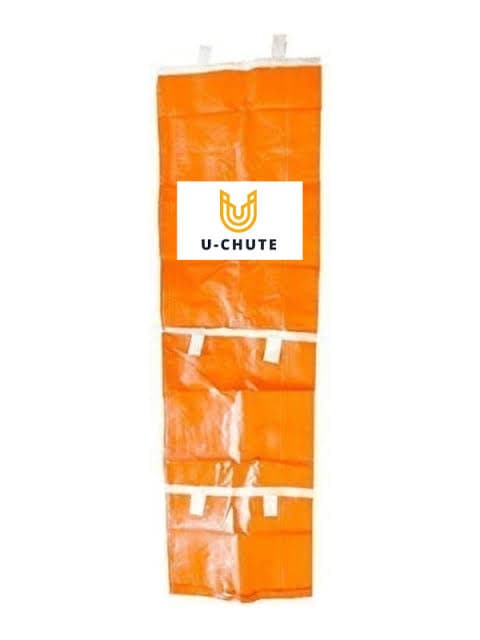
A single-use or low-durability chute system gets thrown away after a project or two, generating its own waste stream. U-Chute's polymer-fabric chutes are engineered for repeated use across multiple projects. That reusability fundamentally changes the lifecycle carbon math:
- Manufacturing energy is amortized across dozens of uses rather than a single deployment
- Fewer chutes manufactured overall means fewer raw materials extracted and processed
- Lightweight polymer construction means lower freight emissions when shipping to job sites — and U-Chute ships free across the US
- Sections that stack to match drop height mean you are not ordering excess material you do not need
For a deeper look at the carbon footprint math, read our detailed breakdown on construction debris chute environmental impact and carbon footprint in 2026.
Material Recovery and Recycling Rates: Where Chutes Win Decisively
One of the least discussed but most environmentally significant differences between these two debris systems is their effect on material-recovery rates. When wood, metal, drywall, concrete, and roofing materials are thrown into a single open dumpster together, they commingle into a mixed load that is expensive and labor-intensive to sort — often making recycling economically unviable. Most of that mixed load goes straight to a landfill.
Source Separation at the Drop Point
A chute-based workflow encourages — and operationally enables — source separation. Because the chute terminus is a defined, controlled location, crews can arrange multiple bins at the base:
- One bin for clean wood and timber
- One bin for metal (often profitable to sell to a scrap yard)
- One bin for drywall (often accepted at dedicated recycling facilities)
- One general mixed bin for true landfill material
Workers chuting material can direct loads to the appropriate container at the drop-off point, dramatically improving sort purity. This is structurally difficult with an open dumpster workflow because multiple dumpsters take up significant site space and workers throwing debris from elevated positions have poor accuracy over the container edge.
Landfill Diversion and LEED Credits
Construction projects pursuing LEED certification or local green-building program credits need documented waste-diversion rates — typically 50 percent to 75 percent of total debris by weight. Achieving those rates is nearly impossible without source separation infrastructure. A chute system is a foundational tool for any job site trying to hit those diversion targets.
Even without formal certification goals, diverting metal and clean wood from the landfill stream has direct environmental value: it reduces landfill methane generation, conserves virgin raw materials, and reduces energy demand in the manufacturing of new building products.

Noise Pollution: A Sustainability Factor That Rarely Gets Discussed
Environmental impact is not limited to air, water, and carbon. Noise is a regulated environmental pollutant in most jurisdictions, and construction sites are a primary source of noise complaints in both urban and suburban areas. Open-dumpster debris disposal is loud — the crash of materials hitting a metal bin from two or three stories above generates impact noise that can exceed 90 decibels at close range.
A chute absorbs and distributes the energy of falling debris across the length of the chute rather than allowing it to concentrate in a single impact event. This does not make a job site silent, but it measurably reduces peak impact noise — an advantage when working in noise-sensitive neighborhoods, near schools or hospitals, or on projects with restricted-hours permits.
Worker Safety as a Sustainability Dimension
Sustainability frameworks are increasingly broadening to include social sustainability — worker wellbeing, safe working conditions, and reduced occupational health risk. By this measure, a properly installed chute system outperforms open-dumpster debris handling in several ways.
Eliminating Dangerous Tosses and Carries
Without a chute, workers on upper floors either carry heavy loads down stairs — a significant ergonomic and fall risk — or heave debris over a railing or from a window. Both practices carry serious injury potential. OSHA consistently identifies struck-by incidents and overexertion injuries as among the leading causes of construction-worker harm.
- A chute eliminates the need to carry debris down multiple flights of stairs under load
- Workers feed material into the chute opening rather than leaning over a railing or ledge
- Lighter, section-by-section chute assembly means no heavy equipment installation at height
- Reduced debris scatter at ground level means fewer trip hazards for workers below
For a full breakdown of how chute mistakes compound these risks, see our guide on construction chute mistakes contractors make on high-rise job sites.
Site Cleanliness, Neighbor Relations, and Community Environmental Impact
An open dumpster on a busy renovation site becomes an environmental eyesore within hours. Wind scatters lightweight debris — insulation batting, plastic sheeting, dust-laden cardboard — beyond the site boundaries. These materials end up in neighboring yards, storm drains, and public spaces. In many cities, this constitutes a code violation that can halt work.
A chute-managed site is measurably cleaner. The contained debris path means less scatter. Neighbors notice. Clients notice. Inspectors notice. The community environmental impact of a chute-equipped site is lower by essentially every measurable standard — less dust, less litter, less stormwater contamination, less noise.
Long-Term Neighborhood Effects
Demolition and renovation projects in residential neighborhoods are a persistent source of community friction. Contractors with a reputation for clean, contained debris management win repeat referrals and face fewer permit delays. Sustainability, in this sense, is also a brand and business asset — not just an abstract environmental value.
Comparing Total Lifecycle Cost Against Environmental Benefit
A sustainability case built only on environmental metrics will not persuade every contractor. The economics need to line up too — and they do. For a detailed cost breakdown by project type, see how much a construction debris chute costs in Texas. But the key lifecycle math for sustainability purposes looks like this:
Cost and Environmental Variables Side by Side
- Open dumpster (single-project): Rental fee per haul, multiple hauls on large jobs, potential fines for stormwater violations or dust-control non-compliance, landfill tipping fees on mixed loads, possible permit delays due to site-cleanliness complaints.
- Reusable chute system: One-time purchase, free shipping, no rental cycles, reusable across projects, reduced haul frequency due to denser packing, improved material-recovery rates that can offset disposal costs, and no single-use waste generated by the chute itself.
Over a contractor's typical annual project volume, the math consistently favors the reusable chute — both financially and environmentally. The purchase cost of a U-Chute system spreads across every subsequent project, while the environmental benefits compound with each reuse.
Open Dumpsters Are Not Going Away — But the Way You Use Them Should Change
To be clear: this is not an argument that open dumpsters are inherently bad or should be abolished from job sites. Roll-off containers remain a necessary part of construction waste logistics. The point is that the way debris enters that dumpster makes an enormous environmental difference.
An open dumpster with debris tossed directly in from height, in an unsorted mixed stream, represents the highest-impact, lowest-recovery-rate version of debris disposal. A chute feeding a covered, strategically positioned container — paired with source separation — represents the lowest-impact, highest-recovery-rate version of essentially the same infrastructure.
The chute does not replace the dumpster. It transforms the environmental character of how the dumpster is used.
Industry Trends: Where Environmental Standards Are Heading
The regulatory and market trajectory in 2026 is unmistakably toward stricter debris-management standards. Several large metropolitan areas have enacted or are piloting construction waste recycling mandates requiring minimum diversion rates. Federal infrastructure spending increasingly includes green-construction provisions that affect subcontractor requirements. Insurance carriers are beginning to price environmental liability exposure into contractor premiums.
The SBA's small-business guidance consistently emphasizes that contractors who build sustainability into their operations — rather than reacting to mandates — gain durable competitive advantages. Investing in reusable chute infrastructure now positions your operation ahead of requirements that are almost certain to tighten over the next several years.
Whether you work in Boulder, Colorado, Portland, Maine, or anywhere across the Sun Belt, the local regulatory environment is trending in the same direction: more documentation, stricter dust and stormwater controls, and higher expectations for material recovery. A reusable chute system is infrastructure that positions you for those requirements proactively rather than reactively.
Choosing the Right Chute System for Sustainable Debris Management
Not all chute systems deliver the same environmental performance. Key factors to evaluate include material durability (single-use plastic chutes generate their own waste), modularity (stackable sections that match your drop height avoid material waste from unused sections), and ease of cleaning (a chute that can be rinsed and reused without degradation extends lifecycle and amortizes manufacturing impact further).
U-Chute manufactures four sizes to match real project conditions: the 10 ft lite-duty for light renovation work, the 10 ft heavy-duty for standard demo loads, the 25 ft heavy-duty for mid-rise applications, and the 50 ft heavy-duty for high-rise and large commercial projects. Each is built from reusable polymer fabric, ships free anywhere in the United States, and is priced directly on the site so contractors can match their investment to the project scope.
Explore the full range on our debris chute systems page, or review the frequently asked questions to understand which size fits your specific drop height and load type. If you are a demolition contractor evaluating cost and sustainability together, the demolition contractor trash chute cost and buying guide walks through both dimensions in detail.
Frequently Asked Questions
Does a construction chute actually reduce dust compared to throwing debris into an open dumpster?
Yes — significantly. When debris free-falls from height and impacts an open metal dumpster, the sudden deceleration creates a pressure burst that expels dust outward in all directions. A chute encloses the debris path, so that energy dissipates gradually along the chute walls rather than in one explosive release. Particulate matter — including silica dust, gypsum, and fibrous materials — stays contained within the chute channel rather than dispersing into the surrounding air and onto neighboring properties.
How do reusable chutes compare to disposable single-use chutes environmentally?
Reusable polymer-fabric chutes like those manufactured by U-Chute have dramatically lower lifecycle environmental impact than single-use alternatives. A disposable chute is manufactured, shipped, used once, and landfilled — meaning 100 percent of its production energy and material cost is allocated to a single job. A reusable chute amortizes that manufacturing and shipping footprint across dozens of projects, reducing per-use emissions and eliminating recurring chute waste from the job-site waste stream entirely.
Can a trash chute system help a project achieve LEED waste-diversion credits?
A chute system is not a direct LEED credit item, but it is a critical enabler of the waste-diversion rates LEED requires. LEED Construction Waste Management credits require projects to divert a significant percentage of debris by weight from landfill. Achieving those rates depends on source separation — routing different material types to separate bins. A chute with a defined terminus makes source separation feasible in a way that open-top dumpster throws from height generally do not allow, making the chute a practical prerequisite for hitting LEED diversion targets.
Does using a chute reduce the number of roll-off dumpster hauls needed?
Often, yes. Material funneled through a chute tends to pack into a roll-off container more densely than material thrown in haphazardly from the side or from height. Less air space in the container means more debris per load, which directly reduces the number of hauls required. Fewer hauls mean fewer truck trips, lower diesel consumption, reduced traffic disruption near the job site, and lower disposal costs — all of which have both environmental and financial value.
Are there stormwater risks associated with open dumpsters that chutes help mitigate?
Yes. Open dumpsters exposed to rainfall allow water to contact mixed construction debris — paint, adhesives, roofing granules, gypsum, treated lumber — and carry contaminated runoff into storm drains and local waterways. A chute system reduces the debris scatter zone around the collection container, and when paired with a covered roll-off bin, can minimize rain exposure to the waste stream almost entirely. Cleaner site perimeters also mean less contaminated runoff washing away from the base of the container.
What size chute do I need for a typical two-story renovation project?
A two-story residential renovation typically has a drop height of 16 to 22 feet from the upper-floor debris-loading point to the ground-level collection area. A 25 ft heavy-duty chute provides comfortable coverage for that range while allowing for routing flexibility. For a single-story addition or a roof tear-off on a standard residential structure, a 10 ft heavy-duty chute is often sufficient. U-Chute sections stack to match your specific drop height, so you are not paying for length you do not need.
Is a reusable construction chute practical for a small contractor or occasional user?
Absolutely. The economics of reusable chutes favor even infrequent users over the alternative of renting disposable equipment or relying purely on open-dumpster tossing, because a single purchase provides the system for every future project. For small contractors doing periodic roofing, light demo, or junk removal work, a 10 ft lite-duty or 10 ft heavy-duty chute is an affordable entry point that ships free anywhere in the United States and starts paying back on the very first project through safer, cleaner, faster debris removal.
Ready to Make the Sustainable Choice for Your Next Job Site?
The environmental case for construction chutes over open-dumpster tossing is clear: less airborne particulate, reduced stormwater contamination, lower carbon footprint through dense packing and reusability, higher material-recovery rates, and a cleaner, safer job site for workers and neighbors alike. These are not theoretical benefits — they are measurable, documentable, and increasingly expected by clients and regulators in 2026.
U-Chute makes it straightforward to get the right system in place. Browse the available sizes on our debris chute systems page, find the chute that matches your drop height and load type, and order online with free shipping to anywhere in the United States. If you have project-specific questions, the contact page is the fastest way to reach us directly.
Quality construction debris management without compromise — that is what reusable chute systems deliver, and it is exactly what your next project deserves.