

The construction industry generates more solid waste than almost any other sector in the United States. According to EPA data on materials, waste, and recycling, construction and demolition debris accounts for roughly twice the volume of municipal solid waste produced nationally each year. In 2026, that number keeps climbing — and contractors, demolition crews, and project managers are under more pressure than ever to answer for it.
What most job-site supervisors overlook is that the method you use to move debris off a building has a measurable effect on your project's total carbon footprint. Manual bucket brigades, repeated dumpster lifts, and inefficient material handling all add fuel consumption, labor hours, and unnecessary emissions. A properly deployed debris chute system for your construction site changes the calculus in ways that are easy to quantify — and easy to act on.
This guide breaks down the full environmental picture: where the carbon comes from, what reusable chute systems change, and how to make decisions that hold up under scrutiny from clients, municipalities, and your own bottom line.
Why Construction Debris Management Has an Environmental Problem
Before you can reduce the footprint, you need to understand where it originates. Construction and demolition waste travels through several phases before it reaches final disposal — and each phase carries its own environmental cost.
The Three-Phase Waste Journey
- Generation: Cutting, demolishing, and renovating produces physical debris — drywall, concrete chunks, roofing shingles, lumber, insulation.
- Transport: Workers carry or toss debris to a collection point, often multiple times before it hits a dumpster. Each unnecessary movement costs time and increases ergonomic injury risk, which OSHA ergonomics guidance identifies as a direct productivity and safety concern.
- Disposal: Trucks haul the dumpster to a landfill or transfer station, burning diesel at roughly 6-7 miles per gallon under full load. Landfilled construction debris decomposes partially anaerobically, releasing methane over years.
The transport and handling steps are where a debris chute has the most immediate impact. Gravity does the work, replacing multiple manual carries and reducing the number of equipment-intensive lifts needed to load a dumpster from above.
How a Construction Debris Chute Directly Reduces Carbon Emissions
When you route debris through a chute rather than handling it manually or using equipment-assisted removal, several carbon-intensive activities drop off the list. The environmental gains are not theoretical — they follow directly from physics and logistics.
Fewer Equipment Cycles
High-reach equipment like forklifts and crane-mounted skips burns significant diesel per cycle. A crew that replaces even 30 percent of those cycles with gravity-fed chute flow can meaningfully reduce fuel consumption on a multi-week project. For large demolition projects, that adds up to hundreds of avoided equipment-hours over the job's duration.
Reduced Manual Labor Miles
When workers carry debris across a floor and down stairs repeatedly, they are essentially performing low-value transport work that a chute eliminates. Fewer carries means less physical exertion, fewer safety incidents, and — from an emissions standpoint — reduced demand for secondary equipment brought in to handle fatigue-related slowdowns.
Faster Dumpster Cycles, Better Sorting
A chute that deposits debris into a dedicated dumpster zone makes sorting easier at ground level. When materials can be separated — concrete in one bin, clean wood in another, metals diverted for recycling — more of the volume stays out of landfills. The EPA's recycling program overview consistently highlights source separation as the highest-leverage intervention in construction waste diversion.
Reusable vs. Single-Use: The Lifecycle Carbon Comparison
Not all debris chute systems carry the same environmental profile. The material the chute is made from and how many times it can be used before disposal determines whether it represents a net positive or negative compared to alternatives.
Single-Use or Low-Cycle Chutes
Some contractors use lightweight disposable plastic or thin-film chute systems that are discarded after one or two projects. These contribute directly to plastic waste, require re-purchasing for every job, and generate packaging and shipping emissions repeatedly. Their per-project carbon cost is front-loaded and never amortized.
Reusable Polymer-Fabric Chutes
U-Chute manufactures its chutes from durable polymer-fabric construction designed for repeated use across many projects. Each chute you buy ships once, uses free ground shipping (one transport leg), and then serves your crew job after job. The manufacturing carbon is spread across every project the chute handles — meaning the longer you use it, the lower its per-project footprint becomes.
This is the same lifecycle logic that underlies most sustainable product choices: a reusable item that absorbs its manufacturing impact over dozens of cycles almost always beats a single-use alternative on a per-use emissions basis. For construction teams running four to eight projects per year, the math tips strongly toward reusable systems within the first season of use.
Sizing Your Chute to Match Drop Height — Why It Matters Environmentally
One often-overlooked factor in debris chute sustainability is matching your chute length to your actual job-site drop height. Over-spec'ing or under-spec'ing both create waste — either in unused chute sections or in the need to supplement with manual handling.
U-Chute's Four-Size System
- 10 ft lite-duty: Best for single-story residential cleanouts, low-height window drops, or supplemental runs off a smaller structure.
- 10 ft heavy-duty: Handles heavier demolition debris from the same drop heights — roofing shingles, plaster, concrete fragments.
- 25 ft heavy-duty: The workhorse for two- to three-story commercial or residential renovation projects.
- 50 ft heavy-duty: Engineered for mid-rise and high-rise drops where gravity acceleration and section integrity both matter.
Choosing the right size means you are moving debris efficiently in a single pass without supplemental equipment. Fewer equipment assists, less wasted labor, less fuel. The U-Chute FAQ walks through the sizing decision in more detail if you are unsure which option matches your project height.
Carbon Footprint of Construction Hauling — The Numbers Behind the Decisions
You don't need to be an environmental engineer to understand the fuel math. Construction dumpster trucks are heavy vehicles operating in stop-and-go urban or suburban conditions — among the least fuel-efficient duty cycles a diesel engine can run.
Dumpster Swap Frequency
Every dumpster swap involves a truck arriving, lifting a full container, transporting it to a transfer station, dropping an empty, and driving back. Depending on distance, that round trip might burn 3-8 gallons of diesel. On a large renovation, crews that don't manage debris flow efficiently may trigger three to five unnecessary swaps per project compared to a well-organized chute-fed operation that fills containers uniformly and completely.
Sorting at Ground Level Reduces Hauling Trips
When your chute deposits material into a clearly organized dumpster area, ground crews can direct material to separate bins: recyclable concrete aggregate, clean dimensional lumber (often reusable or donated), metal scraps, and general landfill waste. Fewer mixed loads mean higher diversion rates, which means fewer truck trips to the landfill. Every diverted trip is a direct carbon reduction with a fuel-cost saving attached.
For a deeper look at how debris chute choices affect your overall project budget alongside these sustainability gains, see our complete cost estimate and buying guide for demolition contractors.
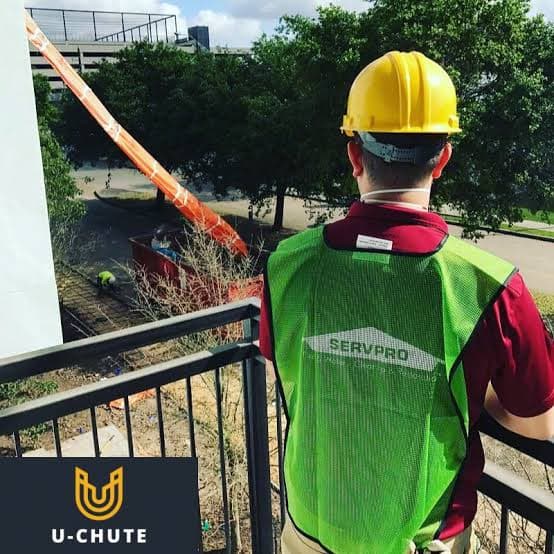
OSHA, Site Safety, and the Indirect Environmental Costs of Poor Debris Handling
There is a less obvious connection between worker safety and environmental impact that gets ignored in most sustainability discussions: when debris handling is unsafe, projects slow down, equipment runs longer, and the total energy budget of a job climbs.
Injury-Related Project Extensions
A worker injured carrying heavy debris down stairs represents days or weeks of project delay. Delayed projects mean equipment sitting idle with engines running, temporary site power running longer, and hauling vehicles making more trips because the work isn't completed on schedule. OSHA's ergonomics framework specifically calls out repetitive heavy carrying as a high-injury-risk activity — one that chutes eliminate almost entirely for the debris-movement portion of the job.
Controlled Drop vs. Tossing
Workers who toss debris out of windows or off roofs — a common shortcut — create two problems simultaneously: a safety hazard and an uncontrolled debris scatter that requires secondary cleanup. That cleanup costs additional labor, often requires a second dumpster placement, and sometimes creates an environmental spill concern if materials contain hazardous components. A chute channels everything to one controlled point, eliminating scatter and the cleanup cost that follows.
If your crews work on high-rise jobs, the common construction chute mistakes on high-rise job sites guide is worth reading before your next installation.
Regulatory Trends Pushing Contractors Toward Greener Debris Management in 2026
The regulatory environment around construction waste in 2026 has tightened meaningfully compared to even three years ago. Municipalities across the country are adding construction waste diversion requirements to building permits, particularly for projects above a certain square footage threshold.
Waste Diversion Requirements
Many jurisdictions now require contractors to document that a minimum percentage of demolition and renovation debris — often 50 to 75 percent — was diverted from landfill through recycling, salvage, or reuse. Failing to meet those thresholds can result in permit holds or fines. A well-organized chute-fed sorting operation at ground level makes diversion documentation far easier because materials are collected in separated streams from the start.
State-Level Winter Safety and Debris Regulations
Beyond diversion, some states have added weather-specific requirements for how debris is managed and contained on active job sites — particularly during winter months when frozen debris behaves differently. Our 2026 guide to winter trash chute safety regulations by state covers the most current state-by-state requirements for contractors operating in colder climates.
Green Building Certification Points
LEED and similar green building rating systems award points for construction waste management plans. If your project is pursuing certification, the documentation of chute-facilitated source separation and diversion percentages translates directly into certification credit. Clients paying premium rates for sustainable construction increasingly expect to see those credits reflected in the final certification score.
The Role of Debris Chutes in Reducing Embodied Carbon on Renovation Projects
Embodied carbon — the carbon emitted during the manufacture and transport of building materials — is a growing focus in construction sustainability. When you renovate rather than demolish and rebuild from scratch, you preserve embodied carbon already locked into the existing structure. But that benefit only holds if you manage the renovation waste efficiently.
Preserving Salvageable Materials
A chute that channels debris to a sorted collection point makes it practical to pull out reusable materials before they end up mixed in a dumpster. Clean old-growth lumber, solid hardwood flooring, antique hardware, and undamaged brick all have second-life value. When these materials are saved from landfill, you preserve both their material value and the embodied carbon tied up in their original manufacture.
Renovation vs. Tear-Down: The Carbon Math
Choosing renovation over demolition and new construction already represents a significant carbon saving. Efficient debris management with a properly sized chute reinforces that saving at the operational level — making the renovation process faster, cleaner, and more sortable. For projects under a certain budget threshold, our buyer's guide for residential renovation under $5,000 lays out how to approach debris management cost-effectively without sacrificing environmental outcomes.
Roofing Projects: A High-Impact Use Case for Debris Chutes
Roofing replacements represent one of the most environmentally consequential debris scenarios in residential and light commercial construction. Old asphalt shingles are heavy, non-biodegradable, and notoriously difficult to recycle in most markets.
Volume and Weight
A standard residential roof replacement generates between one and three tons of old shingle debris per job. Without a chute, workers either carry shingles down ladders — an injury risk — or toss them from the roof edge, creating scatter and secondary cleanup. A chute routes all of that material directly into the dumpster in a controlled stream, reducing scatter, reducing labor hours, and keeping the job site cleaner throughout the project.
Shingle Recycling Opportunities
Several regional recycling programs accept old asphalt shingles for reprocessing into road base material. When your chute deposits material cleanly into a designated shingle bin rather than mixing it with other roofing debris, you increase the likelihood that a recycling haul is viable. More diversion from landfill means fewer landfill methane contributions from decomposing composite materials.
Junk Removal and Interior Demolition: Chute Sustainability at Scale
Junk removal companies and interior demolition contractors operate at high volume — multiple projects per week, often with tight turnaround times. For these users, the environmental case for a reusable chute system is perhaps the strongest of any segment.
Per-Project Footprint Amortization
A company running 200 projects per year amortizes the manufacturing carbon of a U-Chute system across every single one of those jobs. By project 20 or 30, the chute's lifecycle footprint is already lower than the cumulative footprint of the disposable alternatives it has replaced. At project 200, the gap is substantial.
Pricing and Waste Hauling Efficiency
Interior demolition contractors competing on price need every efficiency they can find. Faster debris movement means shorter project time, which means lower labor cost and the ability to schedule the next job sooner. Our trash chute pricing guide for interior demolition contractors breaks down the cost model in detail, including how to build reusable chute costs into your project estimates.
Geographic Considerations: Sustainability Standards Vary by Region
Environmental expectations for construction debris management are not uniform across the country. Contractors operating in different regions face different regulatory floors, different recycling infrastructure, and different client expectations.
High-Regulation Markets
Urban centers and states with strong environmental legislation — including parts of the Northeast, Pacific Northwest, and Colorado Front Range — tend to have the most demanding waste diversion requirements and the best recycling infrastructure to support them. Contractors in markets like Boulder, Colorado or Portland, Maine are already operating under frameworks that reward organized debris management.
Emerging Markets
Markets in the South and Mountain West are catching up quickly as green building demand from commercial clients spreads and municipal waste ordinances tighten. Contractors in Asheville, North Carolina and Bend, Oregon are seeing this shift in real time. Getting a reusable chute system in place now positions crews to meet those requirements without scrambling when the mandate arrives.
Free Shipping Nationwide
One practical environmental consideration worth noting: U-Chute ships free anywhere in the United States, which means contractors in markets with less developed local supply chains — like Scottsbluff, Nebraska or Fargo, North Dakota — don't have to absorb extra shipping emissions or cost to access the same reusable system as contractors in major metro areas.
How to Build a Sustainable Debris Management Plan Around Your Chute System
Owning a reusable chute is step one. Getting maximum environmental benefit from it requires a simple operational plan that any crew can follow consistently.
Pre-Project Waste Audit
- Estimate total debris volume by material type before work begins.
- Identify which materials are recyclable in your local market — concrete, clean wood, metals, cardboard.
- Pre-position the appropriate number and type of dumpsters at the chute discharge point.
- Brief the crew on which materials go where before the first hammer swing.
On-Site Sorting Protocol
- Assign one ground-level crew member to manage material flow during peak debris generation periods.
- Label dumpsters clearly: general waste, recyclable concrete, clean wood, metals.
- Pull salvageable items before they hit the chute — not after they land in the dumpster.
- Monitor fill levels and call for swaps based on actual capacity, not habit. Partially full dumpsters are wasted hauling capacity and unnecessary fuel burn.
Post-Project Documentation
- Record the total volume and weight of each material stream diverted.
- Keep recycling facility receipts as proof for permit compliance and green building certification submissions.
- Compare actual diversion rate against your pre-project estimate and adjust your audit methodology for the next job.
For a broader look at all the services and use cases U-Chute systems support, visit our full services page.
Frequently Asked Questions
How does using a construction debris chute reduce my project's carbon footprint?
A debris chute replaces multiple carbon-intensive steps — manual carries, equipment lifts, and scattered debris cleanup — with a single gravity-fed process. Fewer equipment cycles means less diesel burned. Faster, more organized debris flow means dumpsters fill more efficiently, reducing the number of haul trips to landfills. Reusable chutes also spread their manufacturing carbon across many projects, further reducing per-project emissions compared to single-use alternatives.
Are reusable polymer-fabric chutes actually more sustainable than disposable options?
Yes, across the full lifecycle. Single-use or low-cycle chutes require repeated manufacturing runs, repeated packaging, and repeated shipping — all of which carry emissions costs. A reusable polymer-fabric chute like U-Chute's ships once with free ground shipping and then serves dozens of projects. The longer you use it, the lower its per-project environmental footprint becomes. For high-volume contractors running multiple projects per year, the lifecycle comparison tips decisively toward reusable systems within the first season of operation.
What size debris chute do I need for a two-story renovation project?
Most two-story residential or light commercial renovation projects are well-served by the 25 ft heavy-duty chute. It covers the drop height comfortably with room for installation slack, handles the debris weights typical of drywall, tile, and light demo work, and can be configured to discharge cleanly into a standard dumpster positioned at grade. If your drop height is closer to one story, the 10 ft heavy-duty is likely sufficient. The U-Chute FAQ covers sizing guidance in more detail.
Can debris chutes help me meet construction waste diversion requirements?
Absolutely. Many municipalities require 50 to 75 percent of demolition and renovation debris to be diverted from landfill as a permit condition. A chute that deposits material into a clearly organized, sorted dumpster area at ground level makes source separation practical — clean wood, concrete, metals, and general waste can each go to a designated bin from the moment they leave the chute. That separation is the foundation of achieving and documenting high diversion rates for permit compliance and green building certification submissions.
Do debris chutes help with LEED or green building certifications?
Yes. LEED and similar rating systems award credits for construction waste management plans that demonstrate measurable diversion from landfill. A chute-facilitated sorting operation at ground level makes it easier to track material streams, retain recycling receipts, and document the diversion percentages required for credit. The operational discipline that a well-run chute system enforces — sorted dumpsters, organized collection, reduced scatter — aligns directly with what green building certification auditors look for in a waste management plan.
How does debris chute use reduce OSHA-related risks and indirect project emissions?
Manual debris carrying down stairs is a leading cause of musculoskeletal injuries on renovation and demolition sites. OSHA's ergonomics guidance identifies repetitive heavy carrying as a high-risk activity. When workers are injured, projects slow or stop — and idle or extended projects mean equipment runs longer, temporary power stays on longer, and vehicles make more trips than a well-managed schedule would require. Chutes eliminate most of that carrying, reducing injury risk and keeping projects on schedule, which indirectly keeps the total project energy budget in check.
Does U-Chute ship to all US states, including remote markets?
Yes. U-Chute ships free to anywhere in the United States, with no minimum order and no regional surcharges. That means contractors in less densely supplied markets — from rural Nebraska to coastal Maine — can access the same reusable chute systems as contractors in major cities, without absorbing extra shipping costs or the environmental impact of expedited freight. You select your size online, check out, and the system ships directly to your location.
Ready to Reduce Your Job-Site Carbon Footprint?
Every project is an opportunity to handle debris more efficiently, divert more material from landfills, and run a tighter, lower-emission operation. U-Chute's reusable polymer-fabric systems are built for exactly that — durable enough to serve dozens of projects, priced to make sense on day one, and sized to match real job-site drop heights from one story to mid-rise.
Choose your size, buy online, and get free shipping anywhere in the United States. Contact U-Chute if you have questions about which system fits your next project, or browse the full debris chute lineup to find the right fit today.