
Multi-story commercial demolition and renovation work is unforgiving. The bigger the building, the more expensive a setup mistake becomes — in wasted labor, in safety exposure, and in project delays that ripple across every trade on site. Yet the same handful of trash chute setup errors appear on job sites across the country, year after year.
This guide breaks down every major trash chute setup mistake contractors make on multi-story commercial buildings, explains exactly why each one causes problems, and gives you the practical correction so you can get the chute configured right the first time. Whether you are running a rooftop tear-off on a five-story office block or stripping interiors on a ten-story apartment conversion, what follows applies directly to your project.
Why Multi-Story Commercial Sites Demand More Precision Than Residential Work
A two-story house renovation is forgiving. If your chute angles slightly wrong or the sections shift during the day, the drop height is modest enough that debris usually lands somewhere acceptable. On a commercial building with five, eight, or twelve stories, every small miscalculation multiplies.
Consider the physics: debris accelerating through a chute gains speed with every foot of drop. By the time material exits at ground level from a fifty-foot chute, it is moving fast enough to damage dumpster walls, scatter on impact, and create serious hazard zones. This is why commercial-scale chute work requires genuine planning, not just improvisation.
The Cost Difference Between a Good Setup and a Bad One
- A bad setup on a residential job might cost an hour of rework.
- A bad setup on a commercial job can mean a full-day stoppage for multiple crews.
- OSHA citations from unsafe debris management on commercial sites carry penalties that dwarf the cost of a proper chute system.
- Injury claims connected to falling or scattered debris on commercial properties are among the most expensive construction liability events in the industry.
Getting the setup right from the start is not optional on commercial work — it is a core part of professional project management. The debris chute systems used across Texas commercial sites that hold up best share one thing: a deliberate, mistake-free installation process.
Mistake 1: Choosing the Wrong Chute Length for the Drop Height
This is the most common and most consequential mistake made on commercial sites. Contractors underestimate the drop height, order a chute that is too short, and then improvise with extensions that were never designed to work together. The result is gaps between sections, debris spillage, and a chute that sways dangerously in even mild wind.
How to Calculate Drop Height Correctly
- Measure from the point where debris enters the chute — not the roofline, but the actual top intake opening — to ground level.
- Add at least five feet of buffer to account for the angle of the chute against the building face and the distance from the wall to the dumpster.
- Choose the chute length that meets or exceeds that number without requiring improvised extensions.
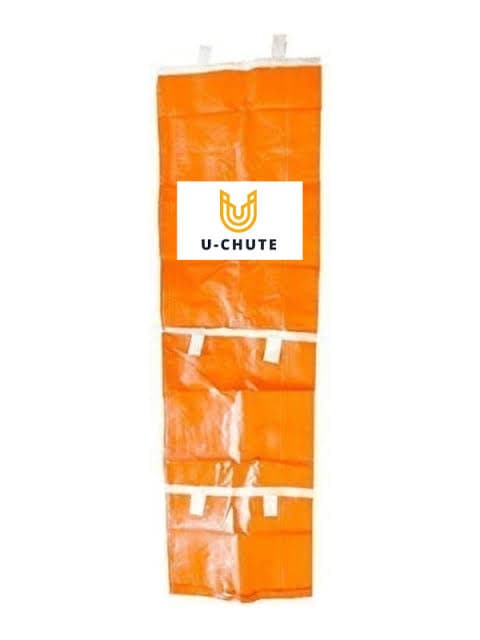
U-Chute's lineup covers the most common commercial drop heights: the 50 ft heavy-duty chute is the workhorse for commercial multi-story applications, while the 25 ft heavy-duty handles mid-rise work and the 10 ft heavy-duty handles lower-level applications or can serve as supplemental connectors in a stacked configuration.
Stacking Sections: When and How
U-Chute's polymer-fabric sections are designed to stack, meaning you can combine lengths to match your exact drop height. The key is to use sections from the same product line — stacking lite-duty sections into a heavy-duty configuration is not appropriate for commercial demolition debris. Each section should be rated for the material weight and drop energy involved.
Mistake 2: Improper Anchoring at the Top Attachment Point
On residential work, crews sometimes clip a chute to a window frame or lash it to a ladder bracket and call it done. On a multi-story commercial building, that approach is a liability. The top attachment point must support not just the weight of the chute itself, but the dynamic load of debris moving through it at speed.
Wind loading is the other factor most crews underestimate. A fifty-foot chute hanging off a commercial building in open air behaves like a sail in a crosswind. The anchoring system must account for lateral forces, not just vertical pull.
Anchoring Best Practices
- Use structural attachment points — parapet walls, roof curbs, or purpose-built scaffolding hardware — not finish elements like gutters or fascia boards.
- Distribute the load across multiple anchor points when the chute is over 25 feet tall.
- Inspect anchor connections at the start of each shift, not just at initial setup.
- Add mid-point ties to the building face on very tall drops to reduce swing.
Refer to OSHA guidance on safe material handling and loading for the regulatory framework around debris management equipment installation — your anchoring choices fall squarely within that scope on commercial sites.
Mistake 3: Skipping the Ground-Level Hazard Zone Setup
The chute is only half the system. At ground level, how debris exits the chute and where it lands determines whether the site is safe and efficient. On commercial jobs, this is where many setups fail completely.
Debris hitting the bottom of the chute at high speed can rebound out of a dumpster, scatter across pedestrian paths, or create dust clouds that violate site air quality standards. In urban commercial environments — where pedestrians, neighboring businesses, and parked vehicles are often within the debris impact zone — this is a serious liability.
Setting Up the Ground-Level Landing Zone
- Position the dumpster so the chute's exit point is centered over the container, with minimal overhang on any side.
- Establish a clearly marked exclusion zone of at least ten feet in all directions from the dumpster during active debris dropping.
- Use barricades and signage that meet local jurisdictional requirements — not just cones.
- Designate one crew member as the ground-level monitor when debris is being dropped from upper floors.
- Never allow material to back up in the chute — if the dumpster is full, stop the drop operation until the container is swapped.
Mistake 4: Using Lite-Duty Equipment on Heavy Commercial Debris
The terminology matters. A lite-duty chute is engineered for lighter, lower-volume residential debris — drywall scraps, light framing offcuts, asphalt shingles from a single-family roof. When contractors bring lite-duty equipment to a commercial demolition site and run concrete chunks, heavy masonry, or large framing timbers through it, chute failure is a matter of when, not if.
Heavy-duty polymer-fabric chutes are built to handle the punishment of commercial-grade debris streams. The material weight rating, the reinforcement at seam points, and the connection hardware are all specified for the heavier loads that commercial work generates.
Matching Equipment to Debris Type
- Light debris (drywall, insulation, light framing): 10 ft lite-duty acceptable for low-rise or supplemental use.
- Mixed commercial debris (framing, roofing, mechanical components): 10 ft or 25 ft heavy-duty depending on drop height.
- Heavy commercial demolition (masonry, concrete pieces, structural elements): 50 ft heavy-duty only; never use lite-duty.
- High-volume operations (multiple crews feeding the same chute): Heavy-duty throughout, with monitored feed rates to prevent overloading.
The roofing and demolition debris chute setup guide covers how to match equipment to debris type in detail — a must-read before specifying for any commercial roofing or structural demo project.
Mistake 5: Failing to Account for Building Setback and Dumpster Positioning
On commercial properties — especially urban infill sites, downtown renovation projects, and multi-tenant buildings — the available ground space around the building is often constrained. Contractors sometimes set up the chute first and then discover the dumpster cannot be positioned where the chute exits, leading to last-minute improvisations that compromise the whole system.

Pre-Setup Site Survey Checklist
- Walk the exterior of the building and identify all potential chute attachment faces before selecting the drop location.
- Confirm dumpster staging area availability — including truck access for swap-outs — before committing to a drop face.
- Check for overhead utilities, awnings, and neighboring structures that might interfere with the chute path.
- Verify local permit requirements for dumpsters and temporary equipment in the right-of-way.
- Identify pedestrian routes that will need to be redirected during operations.
On tight urban sites, the best chute drop face is often not the most convenient one. Taking twenty minutes to walk the site before setup saves hours of rework and can prevent a permit or safety violation that shuts the job down.
Mistake 6: Ignoring Wind and Weather Conditions on Tall Drops
Weather affects every exterior operation on a commercial building, but the chute is particularly vulnerable. A fifty-foot fabric chute in a twenty-mile-per-hour crosswind becomes unpredictable. Debris can exit the chute laterally rather than straight down, anchor points experience load spikes, and the entire system can begin to oscillate in ways that stress connection hardware past its rated limits.
Most commercial sites have operational wind limits for aerial and elevated work. Your chute system should have a clearly defined wind limit as well, communicated to all crew members before the project starts.
Wind and Weather Protocol for Commercial Chute Operations
- Establish a site-specific wind limit (typically 25-30 mph sustained) at which debris dropping stops and the chute is tied off or removed.
- Brief all crew on the protocol at the morning safety meeting.
- Inspect mid-point ties and top anchor connections after any significant wind event, even if operations continued.
- In rain, assess whether wet debris weight changes the load profile through the chute and adjust feed rates accordingly.
- Never leave an unsecured chute hanging from a commercial building unattended overnight in forecast wind or storm conditions.
Mistake 7: Treating the Chute as a Set-and-Forget Installation
Initial setup is only the beginning. On multi-story commercial projects that run for days or weeks, the chute system requires active monitoring and maintenance throughout the project lifecycle. Hardware loosens under vibration. Fabric sections wear at high-impact points. Anchor connections can shift as debris loads change the load distribution on the system.
Contractors who install the chute on day one and then ignore it until the job is done are setting themselves up for a mid-project failure — often at the worst possible moment, when the job is at peak debris volume.
Daily Inspection Routine for Multi-Story Chute Systems
- Check top anchor connections before the first debris drop of each day.
- Inspect all section-to-section connections for signs of loosening or misalignment.
- Look for fabric wear at impact zones, particularly at bends and at the exit point near the dumpster.
- Confirm the ground-level landing zone is clear and the dumpster is properly positioned.
- Document any changes or repairs in your site safety log.
This daily routine takes less than fifteen minutes and is the single most reliable way to prevent mid-project chute failures on commercial sites. The frequently asked questions about U-Chute systems covers common maintenance questions that come up during extended commercial projects.
Mistake 8: Not Coordinating the Chute Operation Across Trades
On a commercial renovation or demolition, multiple trades are often working simultaneously at different heights on the same building. Without coordination, a roofing crew dropping debris through the chute might create a hazard for a masonry crew working below, or block access for an MEP crew making deliveries at street level.
The chute is not just a debris management tool — on a multi-story commercial site, it is a shared piece of infrastructure that requires active coordination across all trades using the building.
Multi-Trade Chute Coordination Protocol
- Designate a single point of contact (typically the general contractor's site supervisor) responsible for chute operation decisions.
- Include chute operation windows in the daily work plan — specific times when debris can be dropped — so other trades can plan around them.
- Use radio communication between the top-floor crew and the ground-level monitor during every drop session.
- Post clear signage at the chute intake point indicating who to contact before using the chute.
Mistake 9: Overloading the Chute With Oversized Material
Even a heavy-duty chute has dimensional limits. Contractors sometimes attempt to push oversized debris — full-length lumber, intact ceiling panels, large mechanical components — through the chute because it is faster than manually carrying it down. The result is a chute blockage that is difficult to clear at height, or material that gets stuck mid-drop and then releases suddenly, creating an uncontrolled high-energy event at the bottom.
Commercial demolition debris is notoriously mixed in size. Establishing clear site rules about what goes in the chute versus what gets hand-carried or crane-lifted out is a basic safety practice that many crews skip.
Acceptable vs. Unacceptable Debris for Chute Feeding
- Acceptable: Broken concrete pieces, asphalt shingles, drywall scraps, insulation, small framing offcuts, roofing felt, light mechanical debris.
- Unacceptable: Full-length dimensional lumber, intact drywall sheets, large mechanical units, glass panes, any material that exceeds the chute's interior diameter.
- Use judgment: If you have to force material into the intake opening, it does not belong in the chute.
For junk removal companies handling mixed commercial cleanouts, the complete guide to using construction debris chutes for junk removal covers debris sorting best practices in depth.
Mistake 10: Neglecting Waste Stream Separation Requirements
Commercial projects increasingly operate under mandatory waste diversion requirements — local ordinances, LEED compliance targets, or client sustainability commitments that require specific materials to be separated for recycling rather than landfilled. Running all debris through a single chute into a single dumpster makes waste stream separation impossible after the fact.
According to EPA data on construction and demolition waste, building demolition generates a significant share of total material waste in the United States — and that fraction is increasingly subject to regulatory diversion requirements in many jurisdictions. Contractors who set up their chute system without considering waste separation often find themselves in compliance trouble mid-project.
Integrating Waste Separation Into Your Chute Setup
- Brief crews at the top of the building on which materials must be set aside rather than chuted.
- Provide separate staging areas at the top-floor intake point for materials that will be hand-carried down or staged for separate pickup.
- Consider whether a second dumpster for a specific material stream (metal, concrete, wood) is warranted based on the project's waste diversion requirements.
- Document your waste stream for submittal purposes if the project requires it.
The EPA recycling program resources provide guidance on construction material categories eligible for diversion — a useful reference when planning commercial demolition waste management.
Mistake 11: Skipping the Post-Job Inspection and Storage Process
One of the biggest advantages of reusable polymer-fabric chutes is the long-term cost savings across multiple projects. But that advantage only materializes if the chute is properly inspected, cleaned, and stored after each use. Crews that fold a dirty, damaged chute into storage and forget about it until the next job often find it unusable when they need it — or worse, deploy it in a damaged state without realizing it.
For commercial operators running chutes on multiple projects per year, a formal post-job process is part of the equipment management discipline that protects the asset and keeps the operation efficient. The 2026 guide to construction chute tax deductions is also worth reviewing — proper maintenance documentation supports the asset's deductibility over its service life.
Post-Job Chute Inspection Checklist
- Inspect all fabric sections for tears, abrasion wear, and stress points at seams.
- Check all connection hardware for bending, cracking, or corrosion.
- Clean debris and dust from the interior of each section before folding.
- Allow sections to dry completely before storage to prevent mildew in the fabric.
- Tag any damaged sections for repair or replacement before the next deployment.
- Store in a dry, protected location away from UV exposure and sharp edges.
Mistake 12: Not Buying the Right Size for Your Most Common Commercial Applications
Some contractors try to make a single chute size work across wildly different commercial applications — using a 10 ft chute on a four-story building by daisy-chaining sections in ways the system was not designed for, or buying a 50 ft chute for a two-story commercial strip mall renovation where a 25 ft unit would have been more practical to handle and store.
Buying the right size for your typical project scope is a straightforward decision that saves time, reduces setup errors, and extends equipment life. U-Chute's four-size lineup covers the full spectrum of commercial applications — from the compact 10 ft units for low-rise supplemental work up to the 50 ft heavy-duty for true multi-story commercial drops. All sizes ship free anywhere in the United States, making it practical to own more than one size for different project types.
Contractors working across markets — from urban high-rise renovation to suburban commercial strip work — often find value in holding both a 25 ft and a 50 ft heavy-duty unit to match the right chute to each job without improvisation. See the full product lineup to compare options for your operation.
Mistake 13: Failing to Brief the Full Crew Before Operations Begin
Setup quality is only as good as the crew using the system. Even a perfectly installed, correctly specified chute will generate problems if the crew feeding debris into it does not understand the rules — what can go in, how fast material should be fed, when to stop, and who to communicate with at ground level.
On multi-story commercial buildings, the crew members feeding the chute at the top and the crew members monitoring at the bottom may not be able to see each other or hear each other over ambient noise. Establishing communication protocols before operations begin is not optional — it is a basic safety requirement.
Pre-Operation Crew Briefing Points
- Acceptable debris types and sizes for the chute.
- Maximum feed rate — how much material should be dropped at one time before pausing.
- Communication protocol between top and ground crews (radio channels, signal words).
- What to do if a blockage occurs — never try to clear a chute blockage from below.
- Wind conditions that trigger a work stop.
- Who has authority to call a halt to chute operations.
For crews new to using debris chutes on commercial projects, the setup guide for renovation projects provides a useful baseline on chute fundamentals before scaling up to commercial-grade operations.
Frequently Asked Questions
What is the best trash chute size for a five-story commercial building?
For a five-story commercial building, the 50 ft heavy-duty chute is typically the right choice. A five-story structure generally has a working height of 50 to 60 feet from roof to ground level when you account for floor-to-floor height and the parapet. The 50 ft heavy-duty is rated for the debris weights and drop energies involved in commercial demolition at that height. If your drop height is closer to 40 feet, the 25 ft heavy-duty sections can be stacked to reach that length while staying within design parameters.
How often should I inspect the chute connections during a multi-week commercial project?
Inspect all top anchor connections and section-to-section joints at the start of each working day before the first debris drop. On high-volume days where the chute is operating continuously for multiple hours, add a mid-day visual check from the ground and from any accessible point along the building face. After any significant wind event — even one that did not halt operations — do a full connection inspection before resuming. Logging these inspections in your site safety records is good practice and supports liability documentation if an incident occurs later.
Can I use a lite-duty chute on a commercial demolition project?
Only for very light, low-volume debris streams and at limited drop heights. If the commercial project involves concrete, masonry, heavy framing, or high-volume debris output from multiple crew members, a lite-duty chute is not the appropriate specification. The heavy-duty product line is designed for the load profiles, impact forces, and continuous use that commercial demolition generates. Using lite-duty equipment on heavy commercial work risks premature failure, which creates safety exposure and project delay.
What do I do if the chute becomes blocked mid-operation on a tall commercial building?
Stop all debris input at the top immediately and communicate the blockage to the ground crew via radio. Never attempt to clear a chute blockage from below — material above the blockage may release suddenly and with significant force when the jam gives way. Clear the blockage from the top by carefully removing material from the intake opening. If the blockage is below the intake level and cannot be safely reached, the chute sections may need to be partially disassembled from the building face to clear it. Document the blockage event and identify the debris type that caused it to prevent recurrence.
Are there wind speed limits for operating a trash chute on a commercial building?
Most commercial site safety plans specify work suspension thresholds for all elevated operations. For chute work specifically, a common threshold is 25 to 30 mph sustained wind speed — above that, a fifty-foot fabric chute hanging on a building exterior begins to experience significant lateral loading and unpredictable debris trajectory at exit. Establish a site-specific wind limit before the project starts, communicate it to all crew, and ensure the chute is tied off securely — not left to swing freely — when operations are suspended for wind.
Does using a reusable trash chute on commercial projects create any tax advantages?
Reusable polymer-fabric chutes are durable business equipment with a multi-year service life, which generally makes them eligible for depreciation deductions under standard business asset rules. Depending on the project structure and applicable tax elections in your jurisdiction, accelerated depreciation options may also apply. The 2026 guide to construction chute tax deductions covers this topic in detail. As always, consult a qualified tax professional for advice specific to your business structure.
What waste management regulations should I be aware of when setting up a chute on a commercial site?
Commercial demolition and renovation projects in most jurisdictions are subject to construction and demolition waste regulations that may include mandatory diversion requirements for specific material types. Some municipalities require a waste management plan as part of the demolition permit. LEED-certified projects have specific waste diversion documentation requirements. Check with your local building department and review the project specifications for waste diversion mandates before finalizing your debris management setup. The EPA recycling resources provide a baseline overview of material categories and federal guidance.
Ready to Set Up Your Commercial Project the Right Way?
Every mistake covered in this guide is preventable with the right equipment, the right planning, and the right crew briefing. U-Chute's reusable heavy-duty polymer-fabric chutes are built specifically for the demands of commercial and multi-story construction work — the kind of debris loads, drop heights, and continuous operation that residential-spec equipment simply cannot handle.
All four sizes — the 10 ft lite-duty, 10 ft heavy-duty, 25 ft heavy-duty, and 50 ft heavy-duty — are available for direct purchase online with free shipping anywhere in the United States. Choose the size that matches your drop height, order online, and have it on site before your project kicks off.
Contact U-Chute with questions about which configuration is right for your commercial project, or explore the full debris chute system lineup and place your order today. Quality construction debris management without compromise — that is the U-Chute standard on every commercial site.