

Des Moines is growing fast. From the East Village condo conversions to the warehouse gut-jobs along the riverfront, from roofing crews working the older neighborhoods of Beaverdale and Highland Park to demolition teams clearing space for new mixed-use projects downtown — every one of these projects generates debris, and every one of them needs a smart, efficient way to get that debris off upper floors and into a dumpster below.
That is exactly what a quality trash chute does. And if you are a contractor, roofer, junk removal operator, or property manager working in or around Des Moines, this guide covers everything you need to know: how construction debris chutes work, which size fits which project, what to look for when you buy, how to install safely, and how reusable polymer-fabric chutes save money compared to alternatives over the long haul.
Let's get into it.
Why Des Moines Contractors Need Reliable Debris Chutes
Des Moines is no longer just an insurance and government town. The metro has been in a sustained construction boom, with permit activity climbing across residential remodels, commercial builds, and infrastructure projects. That volume translates directly into debris-handling pressure on crews.
Manually carrying debris down ladders or stairwells is slow, dangerous, and expensive. OSHA's ergonomics guidelines make clear that repetitive overhead carrying and awkward load-bearing postures are among the leading contributors to musculoskeletal injuries on job sites. A properly routed trash chute eliminates most of that risk by letting gravity do the work.
For Des Moines projects specifically — many of which involve multi-story residential teardowns, historic brick buildings, and steep-pitch roofing jobs — the ability to drop debris cleanly from upper floors directly into a street-level container is a workflow upgrade that pays for itself fast.
What Is a Construction Trash Chute and How Does It Work?
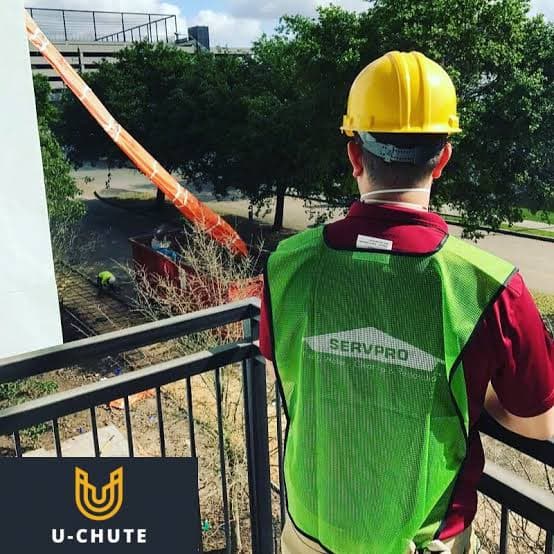
A construction debris chute is a series of connected tubular sections, typically made from durable fabric or rigid plastic, that channel debris from an upper-level drop point down to a ground-level container. Sections stack together at the job site and the assembled chute is secured to the structure at each floor level.
How Polymer-Fabric Chutes Differ from Rigid Alternatives
Traditional rigid plastic chutes are heavy, awkward to transport, and often single-use. Polymer-fabric chutes — like the ones U-Chute manufactures — are lightweight, foldable, and reusable across dozens of projects. Each section can be carried by a single person, which matters when you are working a narrow stairwell or tight jobsite in a dense Des Moines neighborhood.
The polymer-fabric construction is tough enough for heavy demolition loads but flexible enough to fold down for storage. When a project is done, you break it down, stack the sections, and move to the next job — no disposal cost, no landfill contribution.
The Basic Workflow on a Job Site
- Identify the drop height from the highest debris-generation point to the dumpster level.
- Select the chute length that matches or exceeds that drop (with sections that stack together).
- Secure the top section to a window opening, scaffold rail, or roof edge at the drop point.
- Connect additional sections downward, anchoring at each floor or scaffold level.
- Position the dumpster at the chute outlet.
- Feed debris into the top opening and let gravity handle the rest.
The Four U-Chute Sizes: Which One Fits Your Des Moines Project?
U-Chute manufactures and sells four sizes of reusable polymer-fabric trash chutes, each designed for a different scope of work. Understanding which size matches your project saves time and avoids the frustration of under- or over-buying.
10 ft Lite-Duty
This is the entry option for smaller residential jobs — think single-story additions, low-slope roof tear-offs, or deck demolitions. If your drop height is one story and your debris volume is modest, the 10 ft lite-duty is the right call. It is the lightest and most affordable option in the lineup.
10 ft Heavy-Duty
Same drop height as the lite-duty version but built for heavier materials — roofing shingles, plaster, masonry fragments, or any project where debris density is higher. Many Des Moines roofers working two-story homes use this size as their standard unit.
25 ft Heavy-Duty
The workhorse for mid-rise projects. A 25 ft chute handles roughly two to three stories of drop, making it ideal for the kind of three-story apartment renovations and commercial gut-jobs that are common in neighborhoods like Sherman Hill and downtown Des Moines. Sections connect to reach the full drop height.
50 ft Heavy-Duty
Designed for large-scale demolition and multi-story commercial or mixed-use projects. If you are working a building that is four stories or taller, the 50 ft heavy-duty gives you the reach you need. This is the size trusted by larger demolition contractors on projects where volume and drop height both demand maximum capacity.
You can review all sizes, specifications, and pricing directly on the U-Chute services page — no guessing, no quoting process, just straightforward online ordering with free shipping to anywhere in the United States, including anywhere in Iowa.
Common Applications: Who Uses Trash Chutes in Des Moines?
The range of industries and project types that benefit from a quality debris chute is wider than most people assume. Here is a breakdown of who is putting these systems to work in and around Des Moines.
Roofing Contractors
Roofing is probably the single most common use case. Shingle debris is heavy, jagged, and dangerous to carry down a ladder. A trash chute routed from the roof peak to a dumpster at street level keeps crews on the roof and debris moving fast. For Des Moines roofers working the older housing stock in places like Drake and Ingersoll Park — where lot sizes are tight and dumpster placement options are limited — a well-positioned chute is also a neighbor-relations tool, keeping debris contained and off the property below.
Demolition Contractors
Interior demolition — drywall, plaster, subfloor, framing — generates enormous debris volume quickly. A 25 ft or 50 ft heavy-duty chute channeling that material out of an upper-floor window and into a dumpster turns a four-person manual carry into a one-person chute-loading operation. That labor savings adds up fast on a week-long gut job.
Junk Removal Companies
Junk removal crews working upper-floor cleanouts — hoarding situations, estate cleanouts, foreclosure properties — often face stairwells packed with furniture and decades of accumulated material. A trash chute gives them a secondary path for loose debris while the stairs stay clear for bulkier items. It is a meaningful operational upgrade for any junk removal company building out their equipment inventory.
General Contractors and Remodelers
Multi-phase renovations generate debris at every stage. A reusable chute that goes up on day one and stays in place through the project lifecycle — moving from floor to floor as work progresses — is far more practical than renting or borrowing equipment for each phase.
Property Managers and Facilities Teams
Large apartment complexes and commercial properties undergoing partial renovations often need debris management solutions that do not require full construction site setups. A compact, easily deployed chute system fits that need without the overhead of a full equipment rental.
Buying vs. Renting: Why Ownership Wins for Most Crews
Equipment rental has its place, but for debris chutes, the math on ownership is compelling — especially for contractors who run multiple projects per year.
The Rental Cost Problem
Rental yards that carry debris chutes typically charge per day or per week, and those costs accumulate fast on projects that run longer than expected (which, in construction, is most projects). Add delivery and pickup fees and the per-project cost of renting starts to rival the purchase price of a reusable chute within two or three jobs.
Availability and Logistics
Rental availability is not guaranteed. If you need a chute on Monday and the rental yard is out of stock, your project sits. Owning your equipment means it is available when you need it, on your schedule — no calls to check inventory, no deposits, no return deadlines.
Reusability and ROI
A U-Chute polymer-fabric chute is designed for repeated use across many projects. The material holds up to heavy debris loads, resists tearing, and cleans easily. If you run even four or five projects per year that require debris management at height, a reusable chute pays for itself quickly and then generates pure savings on every subsequent job.
For a deeper look at how pricing breaks down by size and project scope, check out the reusable trash chute price breakdown by size and the trash chute cost estimator by project scope — both walk through the numbers in detail.
Installation Best Practices for Des Moines Job Sites
A debris chute is only as safe as its installation. Rushing the setup or skipping anchor steps creates hazards for crew, bystanders, and the property itself. Here is a practical installation playbook for Des Moines contractors.
Pre-Installation Checklist
- Measure the total drop height from the loading point to the dumpster rim. Add a few feet of margin.
- Confirm the dumpster is positioned directly under the intended outlet — diagonal chute paths stress the sections and reduce flow.
- Inspect each chute section before connecting: check for tears, worn attachment points, or degraded hardware.
- Identify anchor points at each floor level — window frames, scaffold rails, or purpose-built brackets.
- Check local Des Moines building permit requirements if the chute extends over a public sidewalk or alley — some projects require permits or pedestrian barriers.
Anchoring and Securing the Chute
Each section connection point should be secured to the structure, not just gravity-hung from the section above. Wind loads in Iowa can be significant — Des Moines sits in a region where spring and summer storms arrive with little warning, and an improperly anchored chute becomes a hazard quickly. Use straps or rope ties at each floor level and inspect anchors at the start of every workday.
Loading Protocols to Prevent Blockages
- Feed debris in manageable loads — large, single-piece items can bridge across the chute interior and create blockages.
- Break down bulky debris (drywall sheets, plywood panels) before loading.
- Avoid loading wet concrete, asphalt, or other materials that can harden inside the chute.
- Station one crew member at the outlet during active loading to monitor flow and flag blockages early.
For a full installation walkthrough, the trash chute installation checklist for contractors covers every step from site survey to teardown.
Safety Standards and Compliance on Iowa Job Sites
Iowa follows federal OSHA standards for construction site safety, and debris management is explicitly covered under fall protection and housekeeping requirements. Running a proper chute system is not just a workflow decision — it is a compliance tool.
OSHA Housekeeping Requirements
OSHA's 29 CFR 1926.25 requires construction sites to be kept clear of debris accumulation that creates trip, fall, or struck-by hazards. A debris chute that moves material off upper floors quickly and efficiently directly supports compliance with this standard. Documented housekeeping procedures — including chute use — can also be useful in the event of an inspection or incident review.
Struck-By and Fall Prevention
Debris dropped from height without a chute creates struck-by hazards for anyone working or passing below. A fully enclosed chute system channels material to a controlled outlet, eliminating the scatter zone that open-air tossing creates. This is particularly important in dense Des Moines neighborhoods where driveways, sidewalks, and adjacent properties are close to the work area.
Ergonomic Benefits of Chute-Based Debris Removal
As OSHA's ergonomics resources highlight, manual material handling — especially on stairs and ladders — is a leading cause of construction worker injury. Routing debris through a chute instead of carrying it down reduces repetitive strain exposure significantly. For crew retention and workers' comp cost control, that matters.
Environmental Considerations: Debris Management and Waste Reduction
Construction and demolition waste is a significant share of total landfill volume in the United States. According to EPA data on materials, waste, and recycling, construction debris represents a substantial portion of solid waste generated nationally each year.
Sorting Debris at the Source
A well-managed chute system makes it easier to sort debris at the point of generation rather than sorting through a mixed dumpster later. Some contractors run separate chutes — or separate loading sessions — for materials like metal, clean wood, and drywall that can be diverted from landfill to recycling or salvage facilities. Des Moines has recycling infrastructure for several construction material streams, and sorted loads are worth more (or cost less to dispose of) than mixed loads.
Reusable vs. Disposable Equipment
The EPA's recycling program emphasizes the value of choosing reusable products over single-use alternatives wherever possible. A reusable polymer-fabric chute that lasts through dozens of projects has a dramatically lower environmental footprint than single-use rental equipment that gets disposed of at the end of its short service life. For contractors who want to make credible sustainability claims — increasingly important in commercial bid processes — equipment reusability is a talking point worth documenting.
How to Order a Trash Chute for a Des Moines Project
Ordering from U-Chute is straightforward. There is no sales process, no quote request, no waiting for a callback. You visit the site, choose the size that matches your project's drop height and debris load, and place the order online. Free shipping is included for every order to anywhere in the United States — that means delivery to Des Moines, Ankeny, West Des Moines, Urbandale, or any other Iowa address at no additional cost.
Choosing the Right Size
The key variables are drop height and debris type:
- One story, light debris (leaves, light insulation): 10 ft lite-duty
- One story, heavy debris (shingles, plaster, masonry): 10 ft heavy-duty
- Two to three stories, any debris type: 25 ft heavy-duty
- Four or more stories, high-volume demolition: 50 ft heavy-duty
If you are unsure, the U-Chute FAQ page answers common sizing questions, and the contact page is available if you want to talk through a specific project before ordering.
What Happens After You Order
Once your order is placed, U-Chute ships directly to your address — job site, shop, or home. The sections arrive ready to deploy. There is no assembly required beyond connecting the sections on site, which takes minutes rather than hours. You are ready to work the same day the shipment arrives.
Trash Chutes Across Iowa: Regional Considerations
Des Moines contractors often work across a broader regional footprint — taking jobs in Ames, Council Bluffs, Iowa City, and smaller markets across central Iowa. A reusable chute that you own travels with you. It is as useful on a farmhouse renovation in Adel as it is on a downtown Des Moines commercial demo.
U-Chute ships to construction crews across a wide geographic range. If you are looking at how other regional markets handle debris chute logistics, it is worth seeing how crews in comparable cities approach the same challenges — from reusable trash chutes in Fargo, North Dakota to reusable trash chutes in Columbia, SC. The principles are the same; the project types may vary.
For contractors working in the Mountain West or Pacific Northwest, similar resources exist for crews in Boulder, Colorado and Bend, Oregon — all dealing with the same core challenge of efficient debris removal from height.
Common Mistakes Contractors Make With Debris Chutes
Knowing what to avoid is as valuable as knowing what to do. Here are the most common errors contractors make when using debris chutes — and how to sidestep them.
Underestimating Drop Height
This is the most frequent sizing mistake. Contractors measure the floor-to-floor height but forget to account for the distance from the top floor surface to the roof edge (for roofing jobs), or the height differential between the outlet and the dumpster rim. Always measure generously and err on the side of more chute rather than less.
Skipping Floor-Level Anchoring
Hanging a chute from the top attachment point only — without anchoring intermediate sections to the structure — creates a pendulum effect in wind. Even moderate Iowa winds can swing an unsecured chute enough to pull attachment points loose or scatter debris outside the dumpster. Anchor at every floor level, every time.
Loading Oversized or Incompatible Materials
A debris chute is not a garbage disposal for everything on site. Whole sheets of plywood, large concrete chunks, or wire mesh bundled in coils can lodge in the chute and require dangerous retrieval work. Break materials down before loading and train every crew member on what goes in and what does not.
Neglecting End-of-Day Inspection
A chute left in place overnight should be inspected every morning before use. Check anchor points, look for overnight damage (storm debris, tool contact), and confirm the dumpster has not been moved. A quick five-minute check prevents the kind of mid-day failures that slow projects and create liability.
The winter construction debris chute safety checklist has additional inspection guidance that applies to cold-weather projects, which is relevant for Des Moines crews working through Iowa winters.
Debris Chute ROI: Running the Numbers for Iowa Contractors
Let's put some concrete numbers around the value proposition for a Des Moines contractor running a typical project mix.
Scenario: Roofing Contractor Running 30 Jobs Per Year
- Average project involves one full-day of shingle tear-off from a two-story home.
- Without a chute: 2 crew members dedicated to debris carry for 4 hours each = 8 labor hours per job.
- With a chute: 1 crew member loading the chute for 2 hours = 2 labor hours per job.
- Labor savings per job: 6 hours. At $25/hour burdened labor cost: $150 saved per job.
- Annual savings across 30 jobs: $4,500.
- Cost of a 10 ft heavy-duty chute: a fraction of that annual savings figure.
That math holds up across project types. The construction debris chute cost per project breakdown walks through additional scenarios with more granular numbers.
Scenario: Demo Contractor on Multi-Story Projects
For a demolition crew running interior gut jobs on three-story buildings, the labor displacement is even more dramatic. A 25 ft heavy-duty chute routed from the top floor can allow one person to load while the rest of the crew continues demolition — instead of stopping work cycles to carry debris down two flights of stairs. Over a week-long project, that continuous workflow advantage is worth thousands in labor efficiency.
Frequently Asked Questions
Can I use a U-Chute trash chute for roofing projects in Des Moines?
Yes — roofing is one of the most common applications. The 10 ft heavy-duty chute handles single-story roofing debris like shingles and underlayment with ease. For two-story homes, the 25 ft heavy-duty gives you the drop height needed to reach a street-level dumpster from the roof edge. The polymer-fabric construction is built to handle the weight and abrasiveness of roofing materials without tearing or degrading quickly. Many Des Moines roofers use U-Chute equipment as a standard part of their job site setup.
Does U-Chute ship to Des Moines and other Iowa locations?
Yes. U-Chute offers free shipping to anywhere in the United States, which includes Des Moines and all Iowa addresses. You order online, choose the size you need, and the chute ships directly to your location — job site, home, or shop. There is no regional surcharge, no freight calculation, and no minimum order. Iowa contractors get the same pricing and shipping terms as anyone else in the country.
How do I know which chute size is right for my project?
The key variables are drop height and debris density. For one-story drops with lighter material, the 10 ft lite-duty works well. For one-story drops with heavy debris like shingles or plaster, go 10 ft heavy-duty. For two to three story drops, the 25 ft heavy-duty is the standard choice. For four or more stories or high-volume demolition, the 50 ft heavy-duty is the appropriate option. If you are uncertain, the U-Chute FAQ page addresses common sizing questions, and the contact page is available for project-specific guidance.
Are reusable chutes more cost-effective than renting?
For most contractors, yes — especially those running multiple projects per year. Rental costs accumulate per day or per week, and availability is not guaranteed. A reusable polymer-fabric chute purchased outright is available whenever you need it, travels with your crew, and generates savings on every job after the initial purchase. Contractors who run even four or five debris-generating projects per year typically see a positive return on ownership within the first season. The reusable trash chute price breakdown by size has detailed cost comparisons.
What types of debris can I run through a construction trash chute?
U-Chute debris chutes are designed for typical construction and demolition debris: roofing shingles, drywall, plaster, light framing lumber, insulation, tile, and similar materials. You should avoid loading whole sheets of plywood or OSB without breaking them down, wet or setting concrete, loose wire or rebar bundles, and any single piece large enough to span the interior diameter of the chute. Breaking down oversized material before loading prevents blockages and protects the chute from damage.
How do I secure a trash chute on an Iowa job site in windy conditions?
Iowa weather — including Des Moines — can bring significant wind, especially during spring and summer storm season. Anchor each chute section to the structure at every floor level using straps or rope ties rated for the load. Do not rely solely on the top attachment point. Check all anchors at the start of each workday and after any overnight weather event. If severe weather is forecast, take the chute down or add additional anchoring as a precaution. The winter construction debris chute safety checklist has additional guidance for adverse-weather installation.
Can junk removal companies use a trash chute, or is it only for construction crews?
Junk removal companies are a great fit for debris chutes. Upper-floor cleanouts — estate cleanouts, hoarding situations, foreclosure properties — generate high volumes of loose debris that is tedious and physically demanding to carry down stairs. A trash chute provides a secondary debris path that keeps stairwells clear for bulkier items and speeds up the overall job significantly. The 10 ft heavy-duty or 25 ft heavy-duty sizes are the most commonly used by junk removal operators, depending on the building height involved.
Ready to Order a Trash Chute for Your Des Moines Project?
Whether you are a roofer working Beaverdale, a demo contractor gutting a warehouse near the river, or a junk removal crew tackling a multi-story cleanout, U-Chute has the right size for your job. Four sizes, direct online ordering, free shipping to Des Moines and everywhere else in the United States.
Visit the U-Chute debris chute systems page to see all available sizes and current pricing. If you want to compare costs across your typical project scope before buying, the project scope cost estimator is a useful starting point. And if you have questions before placing your first order, the contact page is the fastest way to get answers.
Quality construction debris management without compromise — that is what U-Chute delivers. Order today and have your chute on site before your next project breaks ground.