
Every contractor, roofer, and demolition crew faces the same question at some point: should you rent a debris chute for this job, or buy one outright? It sounds like a simple math problem, but once you factor in availability, logistics, project frequency, and the true cost of downtime, the answer gets a lot more nuanced.
This guide breaks down every dimension of the debris chute rental vs buy construction decision — job type, cost structure, storage, safety, and long-term ROI — so you can make a confident call before your next project breaks ground.
Why the Rental vs Buy Question Matters More Than Ever in 2026
Construction activity across the US is at a high-water mark. Renovation, teardown, and roofing projects are booked months out in many markets, and equipment availability is tighter than it was even a couple of years ago. Crews that relied on local rental yards are finding chutes unavailable on short notice, or priced higher than anticipated when demand spikes.
At the same time, the category of reusable polymer-fabric construction chutes has matured significantly. Products like those from U-Chute's debris chute systems ship free across the United States and arrive ready to stack and deploy — shifting the buy-vs-rent math in ways that weren't as clear five years ago.
Understanding your options today means understanding both traditional rental-yard chutes and the newer direct-purchase model that has become the standard for professional crews who run multiple jobs per year.
What Exactly Is a Construction Debris Chute?
Before comparing cost models, let's align on what we're talking about. A construction debris chute is a gravity-fed channel — typically cylindrical or funnel-shaped — that directs demolition waste, roofing shingles, concrete chunks, drywall scraps, and similar materials from an upper floor or roof level down to a dumpster, truck bed, or ground-level collection point.
Common Materials and Designs
- Steel spiral chutes: Heavy, durable, but expensive to buy and difficult to transport. Mostly found in large commercial rental fleets.
- Rigid plastic sections: Lightweight but brittle at higher drop weights. Common in residential rental stock.
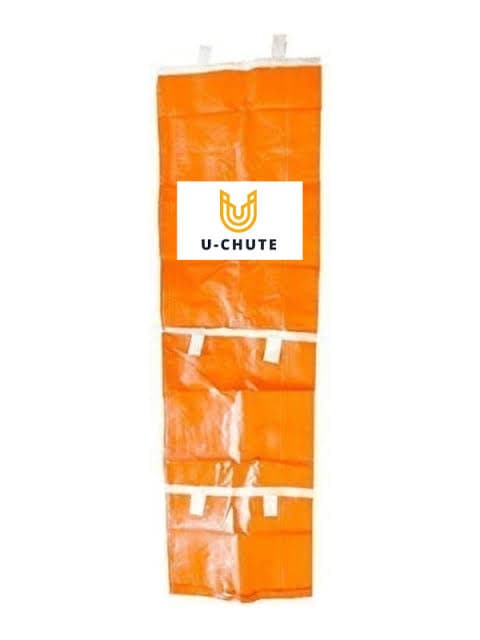
- Polymer-fabric reusable chutes: The modern standard for crews who want portability, durability, and reusability without the weight penalty of steel. U-Chute's lineup uses this construction exclusively.
Standard Size Configurations
- 10 ft lite-duty: Single-story residential work, light shingle removal, small interior demo.
- 10 ft heavy-duty: Low-rise projects with heavier debris loads — masonry scraps, tile, dense drywall.
- 25 ft heavy-duty: Two- to three-story structures; the workhorse size for most residential and light commercial crews.
- 50 ft heavy-duty: Four-story and above; mid-rise demolition, commercial roofing, multifamily teardowns. Learn more in the complete 50ft heavy-duty chute specifications guide.
How Construction Debris Chute Rental Actually Works
Renting a debris chute typically means calling a local equipment rental yard, confirming availability, arranging delivery or pickup, signing a rental agreement, and returning the equipment by a specific date. On paper, that's straightforward. In practice, several friction points emerge.
The Hidden Costs Inside a Rental Agreement
- Daily vs weekly rates: Rental yards often quote a daily rate that sounds low but escalates fast. A chute that costs $35 per day adds up to $245 over a one-week job — before delivery fees.
- Delivery and pickup charges: Many yards charge $75–$150 each way for equipment delivery. On smaller jobs, this alone can dwarf the utility of the rental.
- Damage liability: Rental agreements typically hold you responsible for any damage beyond normal wear. A torn section or a bent connector can result in a charge far exceeding the rental cost.
- Cleaning requirements: Some yards require returned chutes to be cleaned, or charge a cleaning fee automatically.
- Minimum rental periods: Even if you only need the chute for two days, you may be billed for a full week minimum.
Availability and Scheduling Risk
Rental stock is finite. During peak construction season — spring through early fall — debris chutes are frequently checked out. If you're working in a high-activity market like Boulder, CO, Asheville, NC, or Sarasota, FL, you may find that the specific length you need simply isn't available on your start date. Delayed starts cost money.
The Real Cost of Buying a Reusable Debris Chute
The buy-side math begins with a straightforward purchase price. U-Chute publishes its pricing directly on the site — no quotes, no phone calls, no negotiation. You pick the size your project needs, place the order, and the chute ships free anywhere in the United States.
Calculating Your Break-Even Point
This is the most important number in the rental vs buy decision. Here's how to think about it:
- Get the all-in rental cost for one comparable job (include delivery, pickup, minimum period, and any damage deposit).
- Get the purchase price of the equivalent U-Chute size.
- Divide the purchase price by the all-in rental cost per use.
- That quotient is your break-even number of jobs.
For most crews, the break-even sits between two and five uses. If you're running more than five debris-chute jobs per year — and most active contractors are — ownership pays for itself quickly and then generates pure savings on every subsequent job.
Depreciation and Lifespan of Polymer-Fabric Chutes
A well-maintained reusable polymer-fabric chute doesn't depreciate on a short timeline. These materials are engineered to flex without cracking, resist UV degradation, and shed debris cleanly after each use. A crew that cleans and stores their chute properly can expect multiple seasons of reliable service from a single purchase, spreading the original cost across dozens of jobs.
Compare that to rental stock, which often shows visible wear, patched sections, or connector damage that affects performance — and you've paid rental rates for equipment that isn't in peak condition.

Job Frequency: The Single Biggest Factor in the Decision
If you only run one debris-chute job every two or three years, rental probably makes financial sense. The upfront purchase price doesn't amortize efficiently at that frequency, and storage between infrequent uses adds minor friction.
But that scenario doesn't describe most active contractors. Roofers, junk removal companies, demolition crews, and general contractors typically run anywhere from ten to fifty debris-producing jobs per year. At that frequency, the buy math is nearly always superior.
Industries Where Buying Almost Always Wins
- Roofing contractors: Shingle tear-offs are a recurring, predictable workflow. A chute is part of the standard toolkit, not a one-off need. See our roofing demolition debris chute setup guide for the full field playbook.
- Junk removal operators: Fast-moving jobs with tight margins need equipment that's always available, never delayed by rental logistics.
- Demolition subcontractors: Continuous project pipelines mean a purchased chute earns back its cost within the first month of use.
- Multifamily renovation GCs: Unit-by-unit interior demo and renovation work generates debris on a near-daily basis.
When Renting Might Still Make Sense
- One-time projects with no follow-on work planned (estate cleanout, single building teardown for a non-contractor).
- A project requiring a length you don't own — renting to supplement existing inventory for an unusually tall structure.
- A contractor testing debris chutes for the first time before committing to a purchase (though buying the smallest size for evaluation is often cheaper than rental over a week).
Safety Considerations That Shift Based on Ownership vs Rental
Debris management is a safety-critical operation. OSHA ergonomics guidance underscores the risks associated with manual handling of heavy construction materials — back injuries, dropped loads, and fall hazards are all measurable concerns on active job sites. A properly deployed debris chute eliminates a significant portion of that manual handling risk.
Condition Control: Owned vs Rented Equipment
When you own your chute, you know its history. You know whether it's been overloaded, whether a connector was stressed beyond spec, and whether any sections need replacement. With a rental, you're taking the word of a busy equipment yard that has inspected hundreds of items between jobs.
Rental chute failures — disconnected sections, torn fabric under load, unstable mounting — are more likely when equipment has passed through many crews' hands without rigorous inspection between uses. Owning your equipment puts condition control in your hands.
Proper Setup Is Non-Negotiable Regardless of Source
Whether you rent or buy, safe operation requires:
- Secure attachment at the roof or floor opening with appropriate bracing.
- A debris catch area below that is barricaded from foot traffic.
- Sections properly interlocked so no gaps exist mid-chute.
- Load rates appropriate to the chute's rated capacity (lite-duty vs heavy-duty matters).
- Worker awareness of what materials are prohibited — no wet concrete, no live electrical, no materials exceeding the chute's rated dimensions.
Our 10ft construction trash chute safety checklist covers these steps in detail for single-story applications, and the principles scale directly to longer configurations.
Regulatory Compliance: Does It Differ Between Rental and Purchase?
Debris chute regulations are project-specific and jurisdiction-specific, not ownership-specific. Whether you rent or buy, you're responsible for complying with local building codes, OSHA fall protection requirements, and any municipal permits that apply to scaffolding or exterior chute attachment.
One practical distinction: when you own your equipment, you have easy access to the manufacturer's documentation — load ratings, installation instructions, and material specifications — that inspectors or site safety officers may request. Rental yards don't always provide that documentation promptly, and scrambling for it mid-job is a headache you don't need.
For a state-by-state regulatory overview, our construction debris chute regulations by state guide is a practical starting point. Always verify with your local AHJ (authority having jurisdiction) before project start.
Environmental Impact: Reusable Ownership vs Rental Chutes
This angle gets overlooked in most rental vs buy comparisons, but it's worth addressing directly. EPA data on construction and demolition debris makes clear that C&D waste is one of the largest material streams in the United States — and how that debris is handled matters environmentally.
From a chute-lifespan standpoint, a reusable polymer-fabric chute that serves dozens of jobs before end of life generates far less material waste than single-use or rapidly-degrading alternatives. Reusability is a core part of U-Chute's product philosophy — it's built into the name and the construction of every product in the lineup.
When evaluating rental stock, it's worth asking how often the rental yard replaces worn-out sections, and what happens to those discarded materials. With owned reusable chutes, that lifecycle is in your hands and visible to you. Learn more about EPA recycling principles as they apply to construction site operations.
Storage, Transport, and Logistics: Practical Realities of Ownership
One objection contractors raise when considering a purchase is storage. Where does a 50-foot chute system live between jobs? This is a legitimate question, but it's less of a barrier than most people expect.
How Much Space Do You Actually Need?
Polymer-fabric chutes fold and stack compactly. A 25 ft system breaks down into sections that fit comfortably in a pickup bed, a trailer, or a corner of a shop or garage. The 50 ft configuration takes more room, but it's still manageable for any contractor with a dedicated equipment area. Compare that to steel spiral chutes, which are genuinely difficult to store and transport — the polymer-fabric format wins on logistics by a wide margin.
Transport Advantages Over Rental
- No scheduling a delivery truck around the rental yard's calendar.
- No waiting on equipment that didn't arrive on time.
- Load and unload on your own schedule — the chute is in your truck when you need it.
- Between jobs, sections can be cleaned at your facility rather than at a rental yard's pace.
Cost Estimating: Putting Real Numbers on Both Options
Abstract comparisons only go so far. Let's look at a concrete scenario to illustrate how the math plays out over a calendar year.
Scenario: A Roofing Contractor Running 20 Tear-Off Jobs Per Year
Assume all jobs are two-story residential requiring a 25 ft heavy-duty chute configuration.
Rental path (estimated, market rates vary):
- Weekly rental rate: $180
- Delivery + pickup per job: $120
- All-in cost per job: $300
- Annual cost (20 jobs): $6,000
Purchase path:
- One-time purchase of 25 ft heavy-duty U-Chute (price visible on site): check current pricing at U-Chute's product listings
- Shipping: $0 (free US shipping)
- Annual maintenance: minimal — cleaning supplies and occasional connector inspection
- Year 1 break-even: typically reached within the first 2–4 jobs depending on local rental rates
- Year 2+: essentially zero chute cost per job, pure margin retention
Our trash chute cost estimator by project scope walks through this calculation for multiple project types so you can model your own numbers accurately.
Seasonal Demand and Market Fluctuations Affect Rental Pricing
Equipment rental pricing is not static. During high-demand periods — spring roofing season, post-storm repair surges, summer construction peaks — rental yards adjust rates upward and availability tightens. A chute that costs $150 per week in January may cost $230 per week in May, and may not be available at any price during a regional surge.
Contractors who own their equipment are completely insulated from this volatility. Their cost per job is fixed the day they make the purchase. There's no spring markup, no storm-surge pricing, no scrambling for the last available unit in a 50-mile radius.
If you operate in high-activity markets — Boca Raton, FL, Columbia, SC, or Portland, ME, for example — seasonal demand swings are a real factor in your cost structure. Ownership eliminates that variable entirely.
Making the Final Call: A Decision Framework for Contractors
If you've read this far, you have all the variables. Here's a simple decision framework to make the call for your specific situation:
Buy if Any of These Are True
- You run 5 or more debris-chute jobs per year.
- Your jobs are time-sensitive and rental availability is unpredictable in your market.
- You want full condition control and manufacturer documentation on hand.
- You're tired of delivery scheduling friction slowing down project starts.
- You want to eliminate a recurring line item from your equipment cost structure.
- You operate in a market with seasonal demand spikes that affect rental pricing.
Rent if All of These Are True
- You run fewer than 3 debris-chute jobs per year.
- Your local rental yard has reliable stock of your required size at a competitive all-in rate.
- You have no storage capacity for equipment between infrequent uses.
- The project is a one-off with no follow-on work anticipated.
For most active contractors, the buy column fills up faster. The shift to direct-purchase reusable chutes has made ownership more accessible than ever — free shipping, transparent pricing, and a durable product that earns back its cost quickly.
If you're starting out in a new market — say, Fargo, ND, Billings, MT, or Bend, OR — where local rental options may be limited to begin with, the buy case is even stronger. Read our spring construction debris cleanup tips for additional context on equipping your crew efficiently for seasonal peak work.
The SBA's small business guidance consistently emphasizes reducing recurring variable costs as a lever for margin improvement — and equipment ownership that replaces ongoing rental fees is a textbook application of that principle.
Frequently Asked Questions
How many jobs does it take to break even on buying a debris chute vs renting?
For most markets, break-even sits between two and five jobs, depending on local rental rates, delivery fees, and the size of chute required. Rental costs typically include a weekly minimum, delivery, and pickup charges that add up quickly. Once you've broken even — often within the first season — every subsequent job is essentially chute-cost-free. Contractors running 10 or more jobs per year see the most dramatic return on a purchase.
What sizes of debris chutes can I buy vs rent?
Rental yards typically carry a limited stock of sizes, often skewing toward common residential lengths. When you buy direct from a manufacturer like U-Chute, you choose from four purpose-built sizes: 10 ft lite-duty, 10 ft heavy-duty, 25 ft heavy-duty, and 50 ft heavy-duty. Each size is designed for a specific range of project types, and lightweight polymer-fabric sections stack to match your drop height precisely, without the size limitations of local rental inventory.
Are rented debris chutes safe to use on job sites?
Rented chutes can be safe, but condition control is the key variable. Rental equipment passes through many crews between inspections, and wear, connector damage, or fabric stress may not be immediately visible. When you own your chute, you know its full history and can inspect it before every deployment. Regardless of source, always verify load ratings, secure attachment points properly, and barricade the debris catch area below. Review manufacturer specs and relevant OSHA guidance before use.
Do I need a permit to use a debris chute on a construction site?
Permit requirements vary by jurisdiction and project scope. Many municipalities require permits for exterior chute attachment or scaffolding, and OSHA regulations govern fall protection around chute openings. This applies whether you rent or buy the chute — the permit requirement is tied to the project and location, not to how the equipment was acquired. Always check with your local authority having jurisdiction before starting work. Our state-by-state regulations guide covers the key variables by region.
How do I store a purchased debris chute between jobs?
Polymer-fabric debris chutes fold down compactly between uses. Most sizes fit in a pickup truck bed, a trailer, or a dedicated corner of a shop or equipment bay. Clean the sections after each job, allow them to dry fully before folding, and store away from direct UV exposure when not in use. With proper care, a reusable chute system maintains its performance characteristics across many seasons of regular use, making storage a minor consideration compared to the cost savings ownership generates.
Can I use one debris chute for different types of construction projects?
Yes — that's one of the core advantages of the heavy-duty polymer-fabric format. A 25 ft or 50 ft heavy-duty chute is suitable for roofing tear-offs, interior demolition, junk removal operations, and general construction debris. The lite-duty 10 ft model is best reserved for lighter residential applications. Choosing the right size and duty rating for your most common project type means one purchase covers a wide range of work, and additional sections can be added if project requirements change.
Does free shipping apply to all debris chute sizes including the 50 ft heavy-duty?
Yes — U-Chute offers free shipping on all four sizes to anywhere in the United States, including the 50 ft heavy-duty configuration. This eliminates one of the major hidden costs in the buy vs rent calculation: with rental, delivery fees often add $75 to $150 or more per job. Free shipping on a purchase means the delivered price is the total price, making the break-even calculation straightforward from day one.
Ready to Stop Paying Rental Rates on Every Job?
The debris chute rental vs buy decision comes down to one number: how many jobs you run per year. If you're an active contractor, roofer, demolition crew, or junk removal operator, the math almost always favors ownership — and U-Chute makes that ownership as friction-free as possible with transparent pricing, four purpose-built sizes, and free shipping anywhere in the US.
Browse the full lineup and place your order directly at U-Chute's debris chute systems page, or visit the FAQ page if you have questions about sizing, setup, or compatibility with your projects. If you want to talk through which size fits your work, reach out via the contact page — we'll point you in the right direction.
Your next job shouldn't start with a phone call to a rental yard. Own your equipment, control your schedule, and keep more margin on every project.